
Now Available! My newest book!

Saturday, March 05, 2011

Rubber Spider Revue

You know it wasn't all that long ago that you could walk into the Haunted Mansion, hop in a doombuggy, ride up through the library and past the self-playing piano and see this:

Boo.

HBG2 at the excellent Long-Forgotten blog has recently written on the Haunted Mansion's debt to popular culture Halloween traditions, or the lack thereof, and locates these spiders in a tradition of iconic Halloween images - like sheet ghosts, orange and black treat bags, etc.

I'm not exaggerating when I say that, at the time when the Haunted Mansion fangroup was still being organized on the internet, a time I was absolutely a part of, everybody hated this scene. It was dark, spare, unimaginative, and cheap, and - worse of all - put square into the middle of a ride known for lavish sets and effects. I took that picture in 2002 and it was for my old GrimGhosts.Com Haunted Mansion website, by the way, so I speak from experience here!

Well... I'm not so sure about all that. I've posited in the past that the Grand Staircase scene was a bold if failed attempt to create something basically impossible to represent, that it was Claude Coats at his most representative and basic, that the concept was interesting if the execution was not, etc. By and large these opinions have not infiltrated the fan community to any extent and most people will agree that the endless staircase / spooky eyes scene that exists in that spot in the Haunted Mansion now is a far better use of that space than what was basically a flat black wall, some string and a few rubber spiders on wires.

Or, to put put it simple: rubber spiders, nobody loved you.

But here's the thing, those guys may have just been stupid rubber spiders painted day-glo colors and jerked around in webs, but those rubber spiders deserve your respect, darn it. And I'm going to prove it. You may not agree with me in the end, but at least you'll be fully equipped to understand where that scene came from and make up your own mind about something that was, after all, despite its obvious faults, part of our Magic Kingdom heritage.

Now, I've searched high and low to find the origins of those rubber spiders. Ken Sundberg offers in his super comprehensive look at Snow White's Scary Adventures that the 1955 version of that attraction may have included one or more rubber arachnids in the original Ken Andersen dungeon sequence, but photographic evidence is not forthcoming and I have a better idea anyway. Although Mansionologists like myself tend to associate these rubber spiders with Claude Coats and his ideas about negative space in themed design, Marc Davis is actually the one to blame.

This is a segment from a beautiful Davis piece from 1963, drawn for his top-to-bottom re-imagining of the Jungle Cruise's "sunken city":


And the actual scene from a mid-60s Pana-Vue Slide:
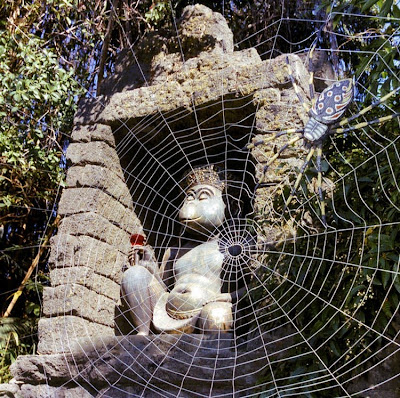

You'll notice that although Davis' concept features Ganesha, the Hindu Remover of Obstacles, the final scene actually depicts Hanuman, the ape-headed disciple of Rama. Ganesha got moved to appear just before Davis' new Indian Elephant Bathing Pool scene and the alligators which previously appeared where those elephants now play were moved to this new scene. This whole little stretch of the river has been subject to dozens of iterations which may be tracked on Daveland's Jungle Cruise page more or less chronologically, but the point is that once Hanuman shows up in his rebuilt shrine, the giant spider makes his debut in Disney history. Marc Davis spearheaded all these changes.

Let's take a close look at that Jungle Cruise spider because it's the best look you'll ever get at her.
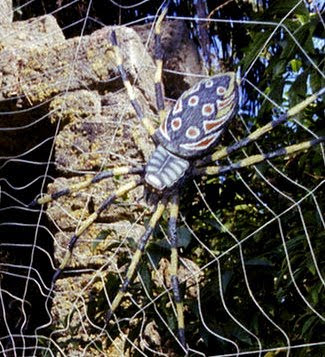

I say that this spider must date from 1963 for a variety of reasons. The first is that it's a custom mold and an excellent one at that; we're used to seeing the default "orange spider" around these days but painted differently it can look like a pretty creepy beastie. Even had there been rubber spiders in the 1955 Snow White ride, they likely would have been off the shelf spiders. By the mid 60s WED had a very robust model shop and had the time and money to make a serious and unique rubber spider, which is what they did. It's impossible to prove but to my eye it looks like the work of Adolfo Procopio, who was WED's resident wildlife expert for almost 40 years.


Now HBG2, resident Mansionologist at Long-Forgotten Haunted Mansion, tells me that this spider and its twin which lurked in the loading area of the Disneyland Haunted Mansion for almost 35 years, were basically props, ie, not animated in any way. But from the Disneyland Haunted Mansion to the Magic Kingdom Haunted Mansion it's only a leap of about two years, so follow me now and together we'll go on a...


THE HAUNTED MANSION!

We'll begin our Safari at the point we began this article, in the Haunted Mansion. It's fairly common knowledge these days that the Florida Haunted Mansion expanded on the Disneyland load area concept to make the "Grand Staircase" it's own scene (or maybe not: as we used to joke, the "Grand Staircase" was neither grand nor the staircase [it is and has always been a ramp]). For a few weeks in the test and adjust phase, the scene consisted of three webs: two with the familiar rubber spiders, and one with a skeleton caught in it. The skeleton was shortly removed but the vacant web stayed for almost 35 years.

Both of these spiders got upgraded to what Disney calls "animated figures" for the 1971 show, via a wire attached to a solenoid valve which would click open and closed, causing the spider to wiggle slightly. The resulting clicking sound was familiar enough to anybody ever got stuck in this part of the ride.

Here's the spiders. This first image I stole from Imagineering Disney because it's a different angle than the first and shows the spider clearly. The second I got off Disney Fans and was taken by Al Huffman in the mid 90's, showing the second of the two spiders and webs.


(I feel like I'm making a GrimGhosts.Com page again...)

Two things about these spiders. First, they looked okay under black-light, but their webs were pretty terrible. Just look at that first spider, whose web was very impressively sized, but just filled with broken strings, spit, and debris. Goodness knows how old that iteration of his web was - twenty years? Thirty years? Scroll up and look at that 60s Pana-Vue slide and you can't tell me that these webs weren't in awful shape. I think this accounts for the poor reputation of the scene: it just looked cheap.

The second issue is that the webs weren't painted so much as sprayed with the Mansion webbing effect, giving the scene a dusty, ethereal quality. Because the web was right near a wall and very large, it was lit up a bit too much, casting light on the wall and ruining the "boundless void" effect. Had the scene been suitably black, had the webs been well maintained and commonly replaced, and painted properly, this particular part of the Haunted Mansion may have needed nothing more than some new set dressing to update it.

Well. Okay, maybe not.

THE JUNGLE CRUISE!

Let's hop across the park and visit an attraction Marc Davis was heavily involved in c. 1969-1970: the expanded Walt Disney World Jungle Cruise. For this incarnation, Davis took his 1963 "sunken city" concept to new heights with an entire indoor sunken temple. The pivot point of the scene is a shrine to Hanuman, covered with gems and treasure and guarded by swaying cobras. This is pure gold Marc Davis intrigue, but he repeated the spiders too, to the left and right of the scene:
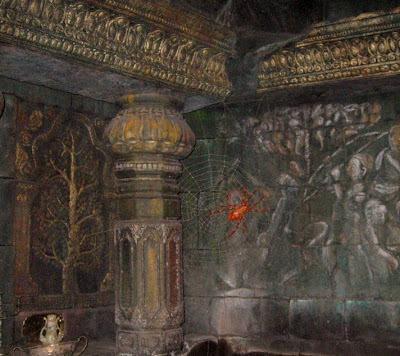
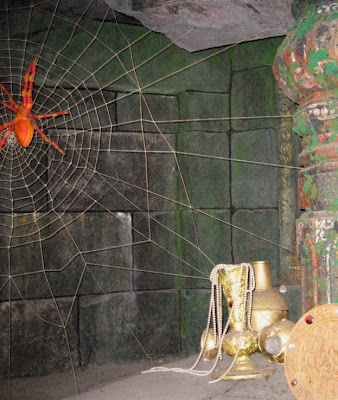
Also noteworthy: unlike the Disneyland original, these spiders also moved, in the same manner as the Haunted Mansion arachnids discussed above.

Both of these spiders actually look fantastic under show lighting conditions, with careful painting, properly built webs, and excellent staging. That first spider, which is to the right of the shrine, is rarely seen due to appearing extra-dim on daytime cruises but if you ride the Jungle Cruise at night and the skipper turns off all the lights on her boat as you head through the temple, you'll see and appreciate the proper appearance of this simple gag.

I've never much liked the second spider because she looks a little too flopsy and rubbery, but expand the image and you'll be able to clearly see the wire tied 'round her midsection leading behind the pillar to the solenoid that makes her wiggle. Classic Imagineering, people!

I think it's important to note that Davis still felt this simple tableau - I mean, is there anything simplier than sticking a rubber spider in a fake web? - merited inclusion in a ride which dramatically and sometimes totally reworked the basic stuff of the Disneyland original, and despite his gag having been already recycled twice in other attractions.

Twice? Actually... make that three times.

SNOW WHITE'S ADVENTURES!

Moving further eastward, we come across the 1971 Snow White's Adventures, probably the nearest WED ever got to designing a true, traditional spookhouse dark ride. A variety of people worked on these rides, including the "1955" crew for Fantasyland, amongst them Ken Andersen and Claude Coats, plus some later-generation Imagineers who had a hand in refurbishing the 1955 originals in the 1960s: Yale Gracey and Rolly Crump.

Hey, Yale, what'cha doing there?


See? The Rubber Spider conspiracy grows by the moment.

I'll stop here and quote Ken Sundberg's Snow White Adventures page now. He's talking about the 1955 original version of the attraction at Disneyland, referencing scene where the shadow of the Witch crosses your path through an arch. In that arch was a spider web, and a picture of the scene may be found in issue #13 of The E Ticket.

"Following immediately after the Dungeons scene, the vehicle faced a huge spider web in a dark archway. The silhouetted Shadow of the Wicked Witch emerged behind the web and moved across the wall. [...] In the late 1970's the foreground of the Shadow of the Wicked Witch scene was changed glowing in fire-orange, with a spider possibly flicking across the web as the vehicle passed the archway. The movement of the Witch's shadow was also changed; it didn't move across the wall anymore, but rocked up and down to the right, as if the Witch was dipping the apple in a cauldron."

Whoever it was who decided to add this little vingette to the Walt Disney World version of the ride, however, was undoubtedly doing so in the spirit of both the original and the generally increased interest in rubber spiders at WED in the late 60s:


Mike Lee took this picture of part of the original dungeon scene in the early 90s, shortly before the ride was removed. The skeleton would flap its jaw at you and warn you to "Go Back!" You'll notice that this spider's web is painted right on the wall behind it... because this spider was the only one to actually move. That's right, it would slowly lower towards the skeleton on a track. I remembered this vividly from my early visits to Walt Disney World and after the removal of this scene - this corner is where the witch can now be seen poisoning the apple - I couldn't remember which ride it was from and swore that the Haunted Mansion spiders used to move towards you on a track.

We lost this spider, probably the most impressive of them all, in 1994.

In 2007, both of the Haunted Mansion's spiders went away, leaving the two in the Jungle Cruise the only spiders left holding down the fort. The Magic Kingdom's 1971 rubber spider population has been decimated by 60%.

Over at Disneyland, the spider in their Haunted Mansion load area bowed out in 2003 and has not been seen since. In 2005, as part of a larger refurbishment effort, the 60s WED spider was removed from the Jungle Cruise. Some new spiders, in more realistic but less fun webs, appeared deeper in the Sunken City sequence. But these spiders look off-the-shelf and don't match the subject of our article here, the 60s version.

Overseas, Tokyo Disneyland's Haunted Mansion carries on the tradition of the giant rubber spiders, and I'm sure their spiders and webs looks very good, not just because they're Tokyo Disneyland but because they each have to be removed and replaced once a year for their Haunted Mansion Holiday Nightmare overlay. And in an ironic twist of fate, the same year that the original WED spider was removed from the Disneyland Jungle Cruise, in Hong Kong Disneyland the "Jungle River Cruise" ride opened, the saddest and most anemic of all the Jungle Cruises. But it features an astonishing number of these fake spiders... I counted at least six in one ride video and there's probably more. So overseas at least, rubber spiders continue to haunt the darkest corners of Disney rides.

It's sort of hard to feel bad for the fate of these singularly unconvincing rubber arachnids. I've made the best possible case for them here but let's not forget: It's a rubber spider. In a fake web. Some of you have probably made more impressive rubber spider displays in your Halloween decorations than all of WED could muster in the early 70s.

But the real fascination isn't what it is, it's how easy it was to find it. All of Imagineering and WED-era design especially has maddening consistencies, consistences which made the experience of going to The Magic Kingdom or Disneyland truly singular. Beyond the obvious scope and scale of the ambition, it had to do with the excellence of the staging, the care of the painting and sculpting, and yes, sometimes, the constant recycling of materials. Submarine Voyage's tropical fish obtained a new coat of paint and became salmon jumping in and out of the water on the Mine Train Trough Nature's Wonderland. The "Old Man in the Bayou" scene of Disneyland's Pirates of the Caribbean begets The Magic Kingdom's Beacon Joe, who makes return appearances at Tokyo and Disneyland Paris. Beacon Joe's face is a Blaine Gibson sculpture who appears elsewhere in Pirates of the Caribbean, along with several appearances in the Haunted Mansion and so on.. and on and on. These are the sort of fun games the true hardcore students of WED design can play.

So now I've clued you into a secret. Have fun playing the game and remember: it all started with a rubber spider.

Sunday, February 13, 2011

Written by Us!

Last year, I was approached by Chad Emerson, whose book "Project Future" had recently been published, to write for an compendium of Walt Disney World essays to celebrate the resort's 40th anniversary. Naturally I accepted and am pleased to announce that the book is actually available, for reals, in print, to hold and to cherish!

For those of you looking to complete your (tentative) FoxxFur library, this is my first published material.


The lineup of authors contributing the twenty-eight essays is pretty impressive. On one hand you have fanpress authors like me, George Taylor, Michael Crawford, Sam Gennaway and Jeff Pepper, but there's also contributions by much larger Disney personalities like Lou Mongello and Kevin Yee. It's also safe to assume that this is your only option for reading essays by myself and Mike Lee printed together with an introduction by Jim Hill. The world moves in mysterious ways.

As for my own essays, I've included a revised (and hopefully improved) version of my urban legend mystery story Goodnight George, first published over at 2719 Hyperion. I've also written a totally new account of the Walt Disney World Village with improved coverage of the Empress Lilly and an all-around effort to be more concise and accessible. That the Village article is still somewhat incomplete means either I need to find a new obsession or maybe I just ran out of space.

Anyway the whole thing is now available online at Amazon.Com and you can also get it for your virtual reader Kindle thingie instantly. Or, you can visit the website of Ayefour Publishing for more details!

(FULL DISCLOSURE: I have not received monetary compensation for my contributions to this book and am publishing this article strictly as a voluntary announcement for readers of my blog.)

Saturday, February 05, 2011

Buena Vista Obscura: The World Cruise


"What is the World Cruise?"

I asked that about two years ago. It would prove to be a fateful question, because answers were not exactly available. I can tell you now what it was with absolute certainty, but at the time the World Cruise was a total mystery and as always... the actual core of the mystery isn't as interesting - or as instructive - as all the other factors working into and through it.

So, for now, with your permission, we are going to defer that question a bit in the service of working towards it from a historical context, because simply telling what the World Cruise was is only half the battle - knowing why it was is the real story, and what took me so long to piece together. And as it always seems with these things, we can't help but to go all the way back to the start - the late 60s, when Disney's publicity and planning machines were moving in lock-step to bring Walt Disney World into being.

I would be very surprised if the experienced Walt Disney World researcher has never come across this image, as it's one of a clutch of late sixties publicity images - the monorail zipping through the Contemporary, Liberty Square, the castle itself - that more or less put over the resort concept to the Florida government and the general public. This particular incarnation is a post card, much like ones sold at the Preview Center and even into the resort's first few years. So in this way we can see that the roots of the World Cruise go back even deeper than may be suspected, all the way back to before there was a preview center or a Walt Disney World, to speak of.

From "A Complete Edition About Walt Disney World", 1969, page 10:
"The principal means of travel from the parking center and main entrance to and from the theme park and hotels will be aboard the Walt Disney World-Alweg Monorail trains. Current plans call for the building of six five-car trains, some to stop at every hotel on the way around the circuit, while others carry passengers non-stop directly to the 'Magic Kingdom.'

Double-deck busses and other land conveyances will back the monorail at peak hours, in the job of moving large number of visitors to the theme park.

On the water, there will be a pair of double-deck side-wheelers to cross the lagoon from the entrance area. They'll be driven by steam and patterned after river boats of a hundred years ago. A steam-driven, open-deck excursion boat is also in the planning for Phase One, and steam will be the motive power for half a dozen launches or water taxis for use in the various activities on the lake and lagoon."
And then later:
"The resort hotels will be showcases in themselves, presenting entertainment consistent with the individual theme of each.

In addition to its theme-slanted activities, plans are for each hotel to present nightly entertainment spectaculars to appeal to every taste, and both family and adult audiences. Top name popular, folk and rock groups will perform. A Dixieland cruise originating from one of the hotels will feature a southern fried chicken dinner and a show."
What ended up happening, more or less, is that all of these different concepts presented in the 1969 text ended up being integrated into the routines of two boats, which were built in drydock on property - the Ports-O-Call and the Southern Seas. These hundred foot long "Osceola-class" (Disney just invented that term, don't worry) steamboats were driven by a central "Gallows A-Frame Walking Beam" engine and roughly modeled on similar famous riverboats like the Mary Powell and Francis Skiddy. They were driven exclusively by side-wheel paddlewheels and authentic in every regard, including temperamental steam engines.

Quoting a "Captain Jeff" speaking on the boats at Walt Disney World: A History in Postcards:
"The Osceola class steamships "Ports O'Call" and "Southern Seas" were steam driven by a replica of an 1858 Gallows A-Frame steam engine. They were oil fired boilers running at 350 lbs of pressure. The steam engine only ran on 15-20 pounds of steam pressure, most of the pressure was used by a steam turbine to generate electricity. It took 3 people to run the steamships; a pilot that steered, an engineer that operated the steam engine and controlled the forward and reverse speeds and a deck hand whose duties were to cast off and secure the vessel at each dock. Each steamship was 100 feet, 5/8 inch long and 30 feet wide, drawing 3.5 feet of water, weighing in at 100 tons and could take on board 250 guests."
Assembling one of the live steam engines in drydock, 1969

One of the most intriguing aspects of the earliest years of Walt Disney World is the sheer abundance of varieties of modes of transit, including some varieties in an intentionally outmoded style. Live steam engines riding rails or rivers or lakes fought for attention with absurd 1970's Bob-a-Round boats (with stereo music!!!) and a converted Chinese junk docked at the Polynesian. Seven Seas Lagoon may have been ringed with futuristic monorails and modern conviences, but in those earliest days old fashioned steam power ran paddlewheelers back and forth from the Magic Kingdom. There was originally but one single dock at the front of the park, extending outwards with symmetrical precision into Bay Lake in a T configuration. Here's a blurry close-up image taken from Time magazine, showing the park just weeks away from an October opening:


And another, depicting an opening year post card, again from the superlative Walt Disney World: A History in Postcards:


An October 1971 issue of Walt Disney World News includes these opening year operating notes, including a hint that the Ports-O-Call was not ready for the October opening:
"OSCEOLA - Southern Seas: 9:30 am to 7:00 pm. (The Southern Seas will stop at the Magic Kingdom one half-hour prior to opening. Last stop will be made one hour after the Park closes.)"
During the resort's first few months of Operation, the Ports-O-Call and the Southern Seas served a dual purpose, because in those early years the Magic Kingdom was rarely open past 6:00 in the evening. Once those final Magic Kingdom guests had made their way back to the Main Entrance Complex or their Walt Disney World Resort, the two paddlewheelers would begin the Moonlight Cruise. What was the Moonlight Cruise? From an April 1972 Walt Disney World News:
"CRUISE ON A LUXURY YACHT OR STEAMER... Moonlight Cruises on steampowered paddlewheelers leave from both resort-hotel marinas Monday, Tuesday, Wednesday and Saturday evening. Departures: Polynesian 9 pm (Saturday 9:45 pm) and Contemporary 9:30 pm (Saturday 10:15 pm). One and a half hours of leisurely cruising, live entertainment, cocktails... Adults - $3, Children under 12 - $1."
And from a 1973 Walt Disney World Vacationland:
"Guests who wish to cruise the waters of Walt Disney World after dark will have a lark on authentic, paddlewheel steamboats which depart twice nightly from both resort hotel marinas and from the Fort Wilderness dock. The "Showboat" cruises last approximately 90 minutes and, while costumed hostesses serve refreshments, a Dixieland Band entertains passengers with Ragtime favorites."
Generally two to three costumed hostesses, attending from the Contemporary Hotel, would be on hand to mix and serve drinks. Besides live entertainment, both the Ports-O-Call and the Southern Seas were provided with background music. Former Watercraft Operator Greg Chin recalled to me via e-mail:
"One of the great memories I have of the Watercraft charters that we did on the "Kingdom Queen" ferryboat (now the "General Joe Potter"), and the "Ports-O-Call" steamship is having the ragtime soundtrack tape.

Some of the ragtime songs on the soundtrack tape were Scott Joplin's "Peacherine Rag", "Pineapple Rag", and of course, "The Easy Winners", which was made famous earlier, by the movie "The Sting" (1973). There's also the famous ragtime song called "Dusty", which is also part of the Magic Kingdom - Main Street USA background music. There were other songs, too.

(Photobucket user Icegator-fan)

I remember how sometimes we would play the ragtime soundtrack tape for our own listening pleasure, while we were washing, cleaning and prepping the "Ports-O-Call" and the "Kingdom Queen". Ragtime music seemed to fit the "Ports-O-Call" and the "Southern Seas" steamships real good.

The tape cartridges were specially made to fit the tapedeck cabinets, in order to play them, over the ships' P.A. system. The looping 8-track tapes played at 1-1/2 times the speed of a normal 8-track tape that you would have at home. But these were show-quality 8-track tapedecks, and that was their playing standard. "
It was these demands and dual schedules of the Seven Seas Lagoon steamships that would soon bring The World Cruise into existence in 1972.

The problem is that 1971 and early 1972 saw some unexpected infrastructure stresses on the fledgling resort, and Disney's noble plans to have "...land conveyances [back] the monorail at peak hours, in the job of moving large number of visitors to the theme park" eventually proved somewhat unrealistic. In David Koenig's Realityland, Bob Gurr recounts having to engineer trams that could easily ascend the hills under the famous Water Bridge without overheating, and six more monorails were quickly ordered. The entire transit system was overtaxed. It's hard to imagine the sense of growing panic over concerns about the number of guests visiting the new resort, but these transportation concerns apparently even led to Mike Fink Keelboats being pressed into service on the Seven Seas Lagoon during Preview days:

(Taken from one boat looking at another. From Flickr user UFG8R)

In 1972, two new Ferryboats arrived at the Seven Seas Lagoon to alleviate the traffic concerns, the creatively named Magic Kingdom 1 and Magic Kingdom 2. Modeled on New York's Staten Island ferries, these two flat-bottomed, 120 foot long boats ran on diesel engines, not finicky and difficult to maintain steam engines, and had propellers on each end, allowing the boats to travel north and south laterally - without having to turn around - instead of side-docking at the Magic Kingdom's T dock like the Osceola steam boats.

A steamboat and ferryboat pass.

A second dock was built to accommodate the new ferries, and with a 600 passenger capacity per boat departing every five minutes, the leisurely steam boats were free of their peoplemoving obligations.

A 1975 view showing the steamboat dock and ferryboat dock.

And so this is where our story really begins. In the summer of 1972, Walt Disney World premiered two new attractions:

From a GAF guide to the Magic Kingdom, helpfully directing new riders:


A July 1972 Walt Disney World News fills in the details:
"World Cruise - Our Latest Attraction... See all that Walt Disney World is...and will be...an entirely NEW way, with a paddlewheel steamboat World Cruise around the Vacation Kingdom!

Osceola-class sidewheelers make 50-minute cruises daily around both the Seven Seas Lagoon and Bay Lake, giving guests an unprecendented opportunity to view all of Walt Disney World from the water.

Along the way, guides explain future expansion programs planned for the Vacation Kingdom, including construction of new Walt Disney World hotels and other attractions along the lakefront. Guests can also learn how Walt Disney World was created and how thousands of tons of earth were moved to form the completely man-made 200-acre Seven Seas Lagoon!

Cruises depart at noon, 1, 2, 3, 4 and 5pm, from the Magic Kingdom dock, directly in front of the Main Street railroad station. 90 cents or "E" coupon at boarding gate."
Both the Ports-O-Call and the Southern Seas had been planned as charter cruiseships and so were equipped with snack bars and facilities. Available were cold sandwiches, Frito-Lay chips, and a basic soda fountain. Additionally, taped spiels describing the sights around Walt Disney World probably replaced the steamboat's arriving and departing narration at this time, even if some World Cruise pilots have told me they were not exactly always reliable about turning it on! Also, the issue of how often the spiels were updated is questionable - for how long after the projects had been abandoned, for example, did World Cruise guests hear about the Asian and Venetian Resorts? Or did the taped narration stick to only certain "official" events around the lagoon? Greg Chin relates:
"All of the large Disney Watercraft vessels had tapedeck cabinets in the "Trunk Rooms" where the electronic equipment was, aboard the ships. The tape cartridges resembled an 8-track tape cartridge... these Disney "Show Soundtracks", or "Spiel-Tracks" tape cartridges were usually gray on one side of the casing, and the other side was transparent polycarbonate plastic, so we could see the tape looping around inside.

All the Ferryboats, Cruise ships, Monorails, and even the Frontierland Riverboats have these Tapedeck cabinets aboard. At the beginning of the trip, or cruise, the Pilot will press a button on the P.A. box, in the Pilothouse. The spiel will start. The tape itself is equipped with a series of high-pitch signals on the tape, as it reaches certain positions in the "spiel". The tape and spiel will stop at those points. As the Pilot feels it's the right time, they will press the button again, and the spiel advances, and so on.

The ferryboat Pilots would press the spiel button on the black P.A. box on the port side of the Pilothouse, and the spiel would start. "Welcome aboard the Walt Disney World ferryboat, we're heading for the Magic Kingdom, across the Seven Seas Lagoon" and so on.

I don't remember all of the "World Cruise" spiel, but it was the same sort of thing. For instance, as we passed the Polynesian Village Resort, I would press the spiel button, and the spiel would say something about what the guests aboard would see. Back then we didn't have the Grand Floridian beach resort, and we were pre-occupied by guests in small rental boats (Aqua Larks) streaking by us, (hell-bent on suicidal runs), in front of my ship."
This is the pattern that the World Cruise followed for the first two years, but in April 1974 with the opening of the brand new Treasure Island attraction, Disney saw a new way to use their World Cruise attraction. From a 1974 promotional flier:
"EXPLORE TREASURE ISLAND! Sail the Seven Seas to Treasure Island... a remote tropical paradise inhabited by colorful tropical flowers, plants and birds of the South Seas. Treasure Island... where Ben Gunn's buried treasure lies amidst the memories of Long John Silver, Cap'n Flint and the Black Dog! Now... there are two exciting ways to visit the Island!

STEAMBOAT VOYAGES... a visit to Treasure Island and the Walt Disney World Cruise, the story of the Vacation Kingdom past, present and future departs from the World Cruise dock at the entrance to the Magic Kingdom daily. Adults $2.50 Children (3-11) $1.25. Last cruise departs at 4:00.

TREASURE ISLAND EXCURSIONS... direct sailings to and from Treasure Island only. Departs Magic Kingdom entrance daily. Adults $1.50 Children (3-11) $.75. Last launch departs at 4:30 pm.

Tickets are on sale at the World Cruise dock at the Magic Kingdom entrance. Island closes at 5:30 pm"
Climbing aboard the Ports-O-Call or the Southern Seas, we surrender our tickets and receive our "World Cruise Passport to Treasure Island":


Inside, information about the boat and the voyage, including some atmospheric nonsense about safe passage, mysterious waterways, and landfalls. Note the "entry stamps" on the first page, all dated 1973 despite the fact that Treasure Island would not open until the following year. Also, a beautiful fold-out map of the entire complex:


Each World Cruise left the Magic Kingdom on the hour, Treasure Island on the half hour, and lasted an aggregate total of one hour, meaning thirty minutes out and thirty minutes back. For $2.50, about the equivalent monetary value of two trips on the Haunted Mansion and one spin through Mr. Toad's Wild Ride, the World Cruise to Treasure Island was a good value, providing a full half day of relaxation and entertainment at one's own pace.

For the duration of the rest of the seventies, the World Cruise and Moonlight Cruise provided hours of restful relaxation to Walt Disney World guests. These two attractions, besides providing some recreation and night-life to a still limited Vacation Kingdom, can best be understood as manifestations of Walt Disney World's early emphasis on relaxing activities to do outside of the Magic Kingdom, things such as River Country and the Lake Buena Vista Shopping Village. These are the sorts of activities Disney had in mind when they termed the Seven Seas Lagoon/Bay Lake complex the "Vacation Kingdom of the World", a vacation that would include a theme park but also water recreation, horseback riding, continental dining and tennis.

Some great vintage Walt Disney World ad-pub from 1976:
"MOONIGHT CRUISE CAN BE ROMANTIC ON A PADDLEWHEELER

Paddle-wheel steamboats were as essential to early Florida settlers as the Prairie Schooners were to western pioneers. Throughout the mid 1800's, the Sunshine State's lakes, rivers, canals and bays echoed the rhythms of chugging steam engines.

Now, that most romantic means of travel has been given new life at Walt Disney World with two authentic side-wheeler replicas, the Southern Seas and the Ports O' Call. Mood music, cocktails, and twinkling nighttime scenery beckons guests aboard the steamboats for Moonlight Cruises around the Waters of the World, Bay Lake, and the Seven Seas Lagoon."
Ironically, by the time that article was being published in Walt Disney World News the information in it could hardly have said to be accurate. In 1975, the Southern Seas had suffered serious water damage to her hull and had been out of service for about a year, placed in the Walt Disney World drydock behind the Magic Kingdom's Frontierland. In 1977, the original 1969 Southern Seas was destroyed and a new ship was built - the Southern Seas II, although it's numerical status was never indicated anywhere on the boat herself - this one one hundred twenty feet instead of just one hundred. Designed by a naval architect by the name of Ben Ostlund, this new boat included many elements of the original Southern Seas, including the Gallows Walking Beam engine, but unlike on the original boat, the engine was just decorative - this new boat ran on diesel, just like the ferryboats. Each of the two propulsion sidepaddles could operate independently and in different directions, which allowed for greater maneuverability in the water and also made it the only other boat on Disney property which could spin in circles like the Plaza Swan Boats. Due to the increased capacity and longer hull, the Southern Seas II was termed a "Seminole" class steamship.

And of course, in 1977 all efforts to theme Treasure Island to the classic Robert Louis Stevenson book were scrapped, including elaborate recreations of Spyglass Hill and Ben Gunn's cave. The Island closed and re-opened as Discovery Island, with an emphasis firmly placed on tropical bird and wildlife displays. As such the daytime attraction became the "World Cruise to Discovery Island".


Despite this significant investment in time and money, by the time EPCOT Center opened in 1982, it becomes difficult to find references to the World Cruise in Walt Disney World promotional materials. Greg Chin explains:
"As soon as EPCOT opened in 1982, suddenly the resort guest-population that was centralized at the WDW Magic Kingdom area resorts, was decentralized and suddenly shifted down towards EPCOT area... all of a sudden, the long-running "World Cruise to Discovery Island" and "Moonlight Cruise" was rendered unnecessary. Attendance dropped off sharply to 50% for both cruises, right after EPCOT opened in October of 1982....

[Editor's note: given the popularity and adult appeal of the World Showcase area of EPCOT, the first area of any Disney theme park to sell alcohol, this makes sense.]

...plus increased competition from Church Street Station in Orlando. Being in Watercraft during the late 1970's and mid-1980's, I would see plenty of daily skywriting over WDW, advertising for "ROSIE", which was a pain in the butt for Disney Co. Pleasure Island was the Michael Eisner/Disney nighttime entertainment plan in 1987, to get the guest-business back, that Church Street Station - Rosie O'Grady's Good Time Emporium, Phineas Fogg's Balloon Works, and Apple Annie's Courtyard (all in Downtown Orlando) was siphoning off Disney property."
And so the World Cruise and Moonlight Cruise simply faded away. Discovery Island became part of a ticket package with River Country, and this is the way most people my age or slightly older remember it. The Southern Seas II, then a recent investment, became a boat exclusively for charter cruises in 1984. These corporate programs were a huge source of income for Disney, who could charge $250 an hour to rent the boat out to meetings and conventions - not including food, drink, and staffing, of course. In this way, it could be said that the Moonlight Cruises continued to exist for some time.

So the World Cruise goes off to a quiet and unglamorous end. But what about the boats, you say?

The 1969 Ports-O-Call had by then fallen to the same water leakage in the hull of the boat which led to the destruction of the original Southern Seas. In 1984 the boat was hauled out of the water. Problems with the steam engine system compounded the problems, making reparations costly and unlikely to return any significant investment. Despite Watercraft Cast Members' efforts to have the boat purchased by the Smithsonian Institution as a display on steam power, Disney destroyed the boat with a bulldozer.

A proposed "Orlando-class" steamboat, again designed by Ben Ostlund with a length of 140 feet and featuring a dance floor on the first deck and observation level on the roof, was never built, although blueprints of it may be seen on the back wall of the Boatwright's restaurant at the Port Orleans Riverside resort. The days of live steam on the Seven Seas Lagoon were over, the blue canopied Motor Launches which still service the resorts today having long ago been converted to diesel engines.

The Ports-O-Call being dismantled in drydock. Photo by Greg Chin, 1984.

In 1996, the Southern Seas II, now overdue for a refurbishment, was put in drydock. With Watercraft Operations no longer using the boats on a daily basis and Convention Booking unwilling to finance the task, the steamboat was without a home. It was eventually destroyed in 1997.

Stories like this rarely have a happy ending in Walt Disney World history. Times have changed. In 1996 when the last of these boats was decommissioned, the entire property was in the midst of her 25th anniversary promotion, Cinderella Castle was painted bright pink, a new era in Disney fine dining was coming of age high above the Contemporary Resort in the California Grill, New Tomorrowland was still new, and the Pirates of the Caribbean had not yet been made politically correct nor into action-movie advertisements. EPCOT Center was in the midst of a massive identity crisis, The Disney-MGM Studios was the new park, and Animal Kingdom was still on the horizon.

It was, in short, the last moment of the last gasp of breath of old Walt Disney World before everything began to radically change, and the destruction of these boats, once such an emblematic image for Walt Disney World - not just as a marketing image on a postcard, but of an entire way of thinking about a vacation - is a moment where we can see the final connections to the reality of the first ten years, of the Vacation Kingdom of the World, snuffing out.

The Southern Seas II in port at Discovery Island, 1980.
From Walt Disney World: The First Ten Years

---

Further Reading:
The Walt Disney World Watercraft Home Page
WDW: A History in Postcards: Sailing the Seven Seas (Lagoon)
Widen Your World: Treasure Island/Discovery Island
Imaginerding: Discovery Island, the Early Years
Progress City, USA: The Great Discovery Island Logo Contest

Special Thanks:
Michael Crawford, Mike Lee, Scott Otis, and Watercraft Captains Greg, Jeff and Robert.

Buena Vista Obscura:
The World Cruise
Captain Cook's Hideaway (plus followup)
The Lake Buena Vista Story: Part One
The Lake Buena Vista Story: Part Two
The Lake Buena Vista Story: Part Three
The Lake Buena Vista Story: Part Four
The Golf Resort

History and Esoterica:
Snapshot: Mysteries of the Second Floor
Snapshot: Olde World Antiques
Snapshot: The Great Southern Craft Company

Sunday, January 16, 2011

Snapshot: Mysteries of the Second Floor

So we can all agree that the Contemporary is/was pretty awesome, right? From the bizzare Mary Blair mural to the strange original Southwest theme to the fact that once upon a time the Contemporary housed a liquor store called The Spirit World with a monorail running over it, the Contemporary exerts a fascinating tidal pull of history, aesthetics, and the taste of an era gone by. As hard as Disney may try to update the place or shellac layer upon layer of changes or "improvements" upon the basic original, history haunts the Contemporary hotel like a ghost, always present, peeking out from behind the dayglo neon or turquoise-blue carpet, a stowaway from out of time.

But we're all guilty of a grave oversight in overlooking an area of prime Contemporary Resort awesomeness, in fact perhaps the least changed of all the resort's haunted halls and strange passages. We've all rushed past it on our way to the Grand Canyon Concourse - the cheerfully badly named Level of the Americas, or: that place where you have to go from one escalator to another on the way to your Chef Mickey's reservation.

Buddy Greco performs tonite at the Top of the World Supper Club.
This was serious business, once.

Today the Level of the Americas mostly houses a reception area for the California Grill restaurant which supplanted the original Top of the World supper club in 1994. Neo-modern furnishings scatter the handsome wide hallways randomly, sometimes housing guests, slumped in couches like vagrants waiting to be evicted from a train station in a snowstorm. Other times, guests wander aimlessly down those lifeless wide hallways, looking furtively for someone or something that's never there. Since the addition of the new Fantasia-themed convention center wing in the early 1990s designed by Michael Graves, those original Contemporary meeting rooms and banquet spaces seem desolate, remote, and unloved. Very few places in all of Walt Disney World exude the same sense of not belonging as the Level of the Americas. "Is this supposed to be here??"


It wasn't always this way. Convention going was a big part of Walt Disney World's bottom line all through the 70's and 80's, and continues to be so today. All through the first twenty years of the resort, the absolute top spot for Conventions in all of Walt Disney World was the Contemporary, and the cutting-edge Ballroom of the Americas featured a hydraulic stage which could raise or lower and even closed-circuit television linking one ballroom to another. All drenched in 1970's earth tones, full of hustle and bustle and strange geometric patterns. Because nothing says "here and now" like geometry.
"Whoever said work and play don't mix obviously had never enjoyed the paradoxical magic of a Walt Disney World convention or conference. You can conduct successful business meetings and still experience all the excitement, adventure and magic that makes Walt Disney World the vacation kingdom of the world. As you would expect, a Walt Disney World convention makes a marvelous family vacation, too!

At the Contemporary Resort Hotel, the headquarters for all major conventions, you will find 30,000 square feet of meeting and banquet rooms and 1,046 spacious rooms. Or, choose from 636 additional rooms at the Polynesian Village Resort Hotel or 151 rooms at the Golf Resort Hotel, all connected by the Walt Disney World transportation system.

When it comes to entertainment, at the Walt Disney World Vacation Kingdom, your convention and banquet entertainment is only as limited as your imagination. You can choose from a Caribbean carnival, a Bourbon Street fling or a country-western hoe-down. Or, if you wish, the talented staff will prepare a custom-designed party especially for your group - right down to the sets, costumes, entertainment, and food." - World Magazine, 1979

Nearby all the "Convention Excitement", the sedate Gulf Coast Room was largely mysterious. Operating out of the exact same service counter which is now used for the California Grill and built apparently hastily in the adjacent conference room, the Gulf Coast Room was a quick and simple solution for Disney, looking as they were for an extra high end restaurant and which involved nothing more than a few rolls of wallpaper, high backed chairs and linen draped tables. Lighting was dim and simple and there were no windows or even much in the way of decor. The focal-point was on fresh food and continental service. Described in Walt Disney World News April 1976: "second floor. Gracious evening dining, with atmosphere entertainment. Reservations requested, with coats for gentlemen, please. Seatings 6:30 - 10 pm, $7.95 - $12.50."

Does anybody even bring an evening coat to Walt Disney World anymore? To put those prices in perspective, $7.95 is equal to almost $30 in 2009, and the highest priced menu item would today fetch almost $46.50. This was not dining for children.

A Spring 1977 Vacationland goes into more detail:


"The elegant Gulf Coast Room, inside Walt Disney World's monolithic Contemporary Resort Hotel, provides the essence of luxurious Old World dining. Here, in a setting aglow with the warm light from dozens of tall tapers, the soft music of a string ensamble fills the air. Each table is serenaded individually with songs of the diner's requests. Dining here can become an evening-long celebration for those who wish to savor the experience.

Begin with an apertif, carefully blended for you by a skilled cocktail hostess. To further whet your appetite, follow with an appetizer - cracked Alaskan crab warmed in butter over a chafing dish at the table, or perhaps Oysters Rockefeller*, served in the half shell atop a bed of hot rock salt.

After this, you will be in the capable hands of your carefully-trained waiter. If you wish, he will prepare a Caesar Salad for you at the tableside, finally serving the crisp, tasty greens with a chilled fork to make the experience perfect**. Entrees are also prepared at the table - dishes like Pampano en Papillote - a succulent ocean fish stuffed with tiny Gulf of Mexico shrimp, breaded, and then broiled to a juicy golden turn inside an air-tight cooking bag. Many other delicious entrees are also given the final, flaming touches at the table, over flickering braziers***.


Many guests enjoy a bottle of fine wine from the Gulf Coast Room's excellent stock. Knowledgeable wine stewards are on hand to suggest the perfect vintage to accompany any dinner. Dessert is often followed by deep mugs of Spanish coffee, again flamed at the table, to bring to an end a perfect evening of dining."
* You don't see Oysters Rockefeller much anymore either, but they're basically coated in a rich butter herb sauce spiked with - in the very original recipes - absinthe.
**The chilled fork may be excessive, but it's details like this that Disney used to be all about that made the difference.
*** There's a word that's ready for a comeback - BRAZIER!


All of that awesomeness, packed into a lonely and desolate floor of a hotel that you've rushed past a thousand times. Next time on your way to the new arcade to play an emulated version of Pac-Man, stop by the Level of the Americas and wander around a bit. See if you can guess where those rows and rows of 70's businessmen sat along tables draped in outrageous sunset yellow linens. See if you can guess which inauspicious door the Gulf Coast Room was located behind. Find the lonely grand piano and tucked-away, disused corners and try to imagine what this was like in better days. The Southwestern decor may be gone and the Gulf Coast Room's string quartets played their last note long ago, and the Gulf Coast Room's vertical striped and tree-laced wallpaper may be torn down, but a strange and sad atmosphere still persists, history tucked behind rows of plain beige doors - just another pocket of Walt Disney World fading slowly to black.

Before Michael Graves, before Vacation Club, a real view to remember.
--

Buena Vista Obscura:
Captain Cook's Hideaway (plus followup)
The Lake Buena Vista Story: Part One
The Lake Buena Vista Story: Part Two
The Lake Buena Vista Story: Part Three
The Lake Buena Vista Story: Part Four
The Golf Resort

History and Esoterica:
Snapshot: The Great Southern Craft Company
Snapshot: Olde World Antiques
Snapshot: Mysteries of the Second Floor

This post is part of the Disney Blog Carnival. Head over there to see more great Disney-related posts and articles.

Saturday, December 18, 2010

Passport to Dreams Year End Report, 2010

Anno 2010 has come and gone, and I think most of us are happier to see it going than we saw coming. On the Disney front, at least, things have been busy... if not exactly interesting. Walt Disney World spending has rebounded this year, even if overall attendance has dropped. Whether this is because of one of those odd cyclical patterns that all businesses go through or whether Universal's excellent new Harry Potter attraction up the street is drawing people away, Disney isn't saying. In fact, they're not doing much about it at all. Now that a high-speed rail line is coming to Central Florida with a station on Disney property, the mass transit they're likely counting on to bring people in will also be able to take their business away, elsewhere. Things are changing rapidly in Central Florida and Disney seems to be counted on to be the last to respond.

But this is a design oriented blog so I'm really not going to comment on that, especially and doubly so because so many people have spillt so much bandwidth this year doing so. So little has actually changed at Walt Disney World in the past 12 months that I did reconsider the necessity of writing this. Still, not every year can be a banner year, for Disney or for I, and maybe there's something to be said for a ritualistic year end tradition of unsolicited complaining. EPCOT Center did see some interesting additions this year and I will address those as well, and begin a new year-end recap of what happened here at Passport to Dreams.

So ready or not, here comes:
WALT DISNEY WORLD REPORT CARD FOR 2010

ADDITIONS AND ALTERATIONS, JAN - DEC 2010:

Hide the Women! Next-Gen is Coming! - The biggest thing to really happen in the Magic Kingdom this year was the tentative launch of "Next-Gen", which is a vaguely menacing prospect for those of us concerned about the aesthetic unities of this park since the introduction of FastPass ten years ago severely compromised many sightlines and obscured many themeing accomplishments with garish and badly placed directional signs. The little family plot outside the Haunted Mansion has, of of this writing, been totally torn out and WDI has moved forward with the construction of a next-gen queue which promises to be something like the "Boot Hill" area outside Disneyland Paris' Phantom Manor, and honestly if there is a bit more atmosphere in the works for the outside of this attraction, then it's sorely needed. Ever since 1990 the Haunted Mansion's "atmospheric prelude" has been compromised by strange props and bad placement so that the house no longer truly feels separate from Liberty Square. Don't expect the strange red canopy to go away anytime soon but the new queue could end up something like the first areas of the Tower of Terror queue, so in my mind could be very good as a prelude to the show inside. At the very least, as an open air area, it will afford attractive views of the house, and the additional queuing space is badly needed.

What has many people concerned is the promise-threat of interactive elements in this new queue, and we got a potential taste of what that could be like earlier this year when the fancy new interactive Winnie-the-Pooh queue opened. That queue was very well done but has the unmistakable atmosphere of a playground, which would certainly feel out of place outside the menacing Haunted Mansion. We should have faith that WDI, who have proven themselves to be fairly reliable for the past few years, will create something creepy and atmospheric instead of exuberant and playful. Indeed the Winnie-the-Pooh queue is so good that it makes a mediocre ride seem much better than it is, but I've already spoken extensively about this queue and how it fares surrounded by 1971 WED designs.

One final comment about the Pooh queue that nobody seems to be talking about: although there is indeed a Fastpass return area which bypasses all the cool new stuff, there is actually no Fastpass distribution area, nor is there any place for one to be added. One of the aspects of Next-Gen is that all FastPass distribution is expected to soon be centralized, possibly only available to those staying in resorts and pre-booked on in-room touch screens. If this is true then we can perhaps, one day, expect all those awful signs and sightline-blocking buildings clustered outside Big Thunder Mountain and similar attractions to be removed or at least substantially cut back. The loss of many really superb views in the Magic Kingdom is my chief complaint against FastPass, and if WDI is looking at solutions to rectify this, then I saw bring on the Next-Gen. GRADE: B

Magic Kingdom: The Happiest Construction Zone of Them All - This was a bad year to visit Magic Kingdom if you don't like construction walls, because simply put, they were more prevalent than guests on some days. The Adventureland Breezeway bathrooms, particularly, were greatly reworked and expanded this year in a project which lasted an absurd five months. The net result of this is that the shaded veranda facing south near the bathrooms has been totally absorbed, which brings to an end a nearly 40 year run of what was once the furthest-flung seating for the Adventureland Veranda restaurant. In the process we lost some nice woodwork and an acceptable false skylight (see right, photo on left), but many of the original decorative elements have been retained and moved out towards the main walkway. This isn't really a tragic loss but it means that yet another quiet feature of the Magic Kingdom has been lost forever. Those looking to be nostalgic may enjoy this 1990 video of the Veranda west veranda taken by Mike Lee, but let's be honest - it hadn't been this nice for fifteen years by the time this area was dismantled and filled with a bathroom, and the change is so subtle that many longtime Adventurers may not even have noticed. On the other hand, what were consistently the dirtiest and dingiest bathrooms in the park have been greatly improved, and this is a real improvement, not a rhetorical argument about the historical value of a minor pedestrian space.

Other restorative work has been done around the park, including worthwhile efforts on Main Street and Liberty Square, and the old Round Table soft serve kiosk has been given a new thatched roof and a new name, both of which look very attractive. Last year I commented that the overall appearance of the park seems to be greatly improving, and the same holds true this year, which seems to indicate that at least a pattern is being established. I feel that some care has been taken to improve landscaping features, with many old trees in Liberty Square removed and replaced with new leafy ones, which greatly improves the appearance of the Square from the Hub. An unexpected series of freezes early in the year saw the removal of lots of old scraggy year-round weedish plants in Adventureland and replacement with aesthetically appropriate flowers, and a number of trees have come down which were formerly obscuring views of buildings. Somebody in horticulture or WDI has clearly noticed that the park looks very nice if you can actually see the buildings as intended in 1971, and this ranks as a massive victory in my book.

Of particular historical interest is that the Gulf Hospitality House / Exposition Hall on Town Square has finally closed for an extended interior renovation which will remove both of the original Walt Disney Story attraction theaters and replace them with some sort of greeting area for Mickey Mouse. In a way this is a logical end for a show building whose use has been contested for as long as it has existed. When the front of the building was constructed in 1971 it was a facade for a hotel which never existed, and the facilities for the Walt Disney Story were actually built onto the east facing-side for the opening of that 1973 attraction. Over the years the space has been used for theme park preview centers, promotional campaigns and timeshare sales without really ever finding a satisfactory reason to exist, and if there's anywhere in the Magic Kingdom as it existed in 1971 in which I would approve of the permanent installation of Mickey and Minnie Mouse, the Hospitality House is it. Chief amongst the Magic Kingdom's many sins is the number of spaces walled up and neglected in the busiest theme park in the Western world. If Disney is ready to find a long-term use for this cavernous but neglected space, I'm ready to approve of it. So long as the interior sets for these meet and greets are tasteful and appropriate to the Victorian setting, this proves to be a significant upgrade for characters long relegated to garish cartoonish settings.

And of course we would be remiss not to mention the absurd demolition project which has finally started to make good use of the 20,000 Leagues ride plot and will finally send Mickey's Birthdayland/Starland/Toontown Fair off to a merciful end after a painfully protracted twenty-two years, or over half of the existence of the entire resort complex herself! The verdict is still out on what the expansion will be like and is likely to remain so through 2011, but the good news is that work is finally, belatedly, underway. Perhaps future generations won't believe us when we tell them that Disney once closed an attraction and spent almost twenty years replacing it with something... but I somehow doubt it. GRADE: B+

Cantina de San Angel Inn and Via Napoli - Moving over to the EPCOT Center, which for once got all the cool stuff this year, we find Disney investing in some new restaurants which pose interesting aesthetic challenges in relation to fitting in with the pre-existing thematic infrastructure. The longtime lakeside Mexican restaurant has been totally demolished and rebuilt as a double-purpose take-out and sit-down restaurant, and although the take-out food is quite tasty, it doesn't really impress from the outside. Make no mistake, for a double-purpose restaurant crammed into a tiny footprint it's fairly nice but the relatively unadorned side directly facing the original Meso-American pyramid makes more of an impression of being in a strip mall than a theme park.

2 bed, 3 bath home for sale in beautiful Windermere, FL

On the other hand there's some top-notch efforts around the sides of the structure and facing the lagoon, some very evocative false balconies and rockwork, and the main dining room comes complete with windows specially designed to sell tables expressly for views of Illuminations. This is the real reason it exists, of course, and your personal preferences will largely determine whether it's an inoffensive addition or just another sign that the day of the locust is at hand. The original Cantina at least kept a low profile and blended easily with the rest of the pavilion from across the water. The new building, painted a bright yellow and red, for better or for worse is impossible to ignore. GRADE: C

But the second effort this year, Via Napoli, across the water at the Italy pavilion, impresses. WED left the Italy pavilion unfinished back in 1982, and the lame back wall and open air on two sides made this painfully obvious. 27 years later, Disney has finished the job, and I find the effort admirable. The massive Via Napoli building, from across the water, looks just like it always belonged there, and the thematic work done leading from the former "back wall" of the Italy pavilion towards the front doors of the new structure has been carefully judged to appear a natural extension of the original work. Once inside, the restaurant helps to extend the feel that the pavilion continues off into some imaginary horizon line rather than terminating in a parking lot. Windows towards the east look out towards an original WED berm seperating Italy from the American Adventure which has been adorned with decorative trees and a gravel path, and it is a surprisingly effective evocation of some sort of Italian countryside. Tall half-round windows grace the back wall, but far above eye level, and look out towards a distant, again pre-existing line of trees. The backstage areas and parking lots have thus been cleverly screened out, but the treetops suggest a rolling countryside beyond the back wall which does not exist.

In the close-knit club of World Showcase pavilions, very few seem to extend past their "back wall" and continue on forever, an effect which is traditionally achieved with "Stratification" design concepts. Mexico creates an otherworldly nocturne and so seems outside the boundaries of the "three walls" courtyard layout these buildings create. Only France seems to ramble on past our view, an imaginary Paris just behind the Palais du Cinema. We can now include Italy in this group, and the interior designers of this new restaurant (not WDI, by the way) did a bang-up job. Oh, and the food is really good. GRADE: B+

The Power of Song, Imagination and Dance - And oh yeah, this ludicrous thing called Captain EO is back. It's about Michael Jackson battling evil in outer space with his rainbow-beam hand lasers and a bunch of Muppets. Captain EO is sort of big news for us Retroists, and before I go into too much detail it must be first adknowledged that the return of this attraction was, and is, provisional. Of course Jackson died last year and this was a big reason for the return of this show, as was the overall poor attendance of the lame-brained, annoying Honey I Shrunk the Audience 3D show. That that attraction, based on a movie series nobody cares about anymore and which actually, embarrassingly took over the entire Imagination pavilion, has finally been laid to rest accounts for half of my enthusiasm for Captain EO. The other half is that I was surprised to find I actually liked it.

Now nobody's going to mistake Captain EO for high art, but one of the reasons I find it so refreshing is that it is so unlike the bulk of cinematic product being extruded by Hollywood today. I grew up at the tail end of the height of the post-Lucas Hollywood, where big absurd fantasies with elaborate special effects sequences dominated the summer Blockbuster. Today when we look at a movie like Willow or Legend it seems outrageous that it was made at all, not only for the pure overachieving scope of the movies but the fact that at their core they're based around such simple premises. This is the Lucas doctrine at work and of course he had a lot to do with what's both good and bad about Captain EO. It is a cheerfully laughable film.

So that may account for a lot of my positive reaction to the movie. I have no particular attachment to Michael Jackson or his brand of mid-eighties mischief, but here is clearly a personality who is a cultural force to be reckoned with, making a movie for teenagers at the last possible moment before youth culture went permanently ironic. It was directed by Francis Ford Coppola and shot by Vittorio Storaro, who ten years earlier had last been on a cocaine bender somewhere in southeast Asia making Apocalypse Now. EO can reasonably be slotted alongside Thriller from 1983 and Bad from 1987, both of which were also directed by major talents - John Landis, fresh off An American Werewolf in London, made Thriller an overambitious atmosphere piece and Martin Scorsese made Bad right before embarking on The Last Temptation of Christ. With beautiful miniatures by Industrial Light and Magic which look marvelous in 3D and bankrolled by Eisner-era Disney, this is a prestige attraction from another time. It may be a cultural dinosaur but it is as slickly oiled an entertainment machine as can be desired and in 3D, widescreen, and 70-millimeter, watching it it's hard not to eulogize a Hollywood machine which has totally abandoned this mode of entertainment.

From a directorial perspective, Coppola's choices are appealing. Wide shots play in depth at the appropriate moments and the film is very well paced, feeling far shorter than Honey I Shrunk the Audience despite being about the same length. Storaro of course is an immensely talented cinematographer, and although I can't make any claim that either of these men took this project very seriously, their superior talent is up on the screen. Whoever was calling the shots on the 3D effects also clearly was patterning them on the more memorable moments in Magic Journeys, the Murray Lerner 3D picture which opened with EPCOT in 1982, which was ever stranger and freakier than EO. Fuzzball fluttering around recalls the children's kite from Journeys, EO's rainbow beams recall lightning being shot out of the screen by a witch, and even the beautiful opening shot of Journeys, a slow crane down through tree branches, is replayed in reverse at the very end of EO.

It's also frankly a memorable piece of hokum. Despite having not seen the movie in at least eighteen years I never quite forgot the opening asteroid exploding in your face (at least as exciting as the similar 3D effect that opens It Came From Outer Space) or the memorably menacing Supreme Leader sticking her claws through the screen. This still is scary stuff for kids but it makes Captain EO's eventual triumph all the more pleasing. The cultural semantics moving inside concepts like transforming an H.R.-Geiger-knockoff-planet into a vaugley Greco-Roman paradise populated by choreographed dancers with Flock of Seagulls-haircuts are probably too bizarre and complex to unpack here, but it makes the film an honest and unabashed hoot. Would Disney today feel embarrassed to present audiences with a cuddy red Whatsit with butterfly wings who gets his own closeup during a musical number to sing "We are Here To Change the World"? Would cultural watchdogs today jump all over Hooter, a bizarre slobbish diminutive elephant wearing a wife-beater tee who throws food at the screen?

Captain EO is to be taken entirely seriously.

Probably. But audiences looking to feel superior to Captain EO are missing out on half the fun. There is so much retro EPCOT Center atmosphere oozing out of that theater now, with a darkened, synth-laden waiting area, absurd theme song and purple, purple, purple, that it's almost criminally depressing not to be able to jump right next door and ride Journey into Imagination or play in the Image Works. But what Captain EO represents most to me is hope. The film, of course, is optimistic in a way that mass-market entertainment no longer is - Captain EO is a messenger of peace who triumphs over evil with his cute companions and awesome dance moves. The attraction is a revitalization of a film which looked hopelessly dated in 1994 when it was removed but which to us today seems more classically dated. Since EO has appeared on the scene in EPCOT, Kodak has departed as sponsor of the pavilion, the glass Imagination pyramids have begun to change colors again and a new attraction within seems like it may finally arrive and put the embarrassing last twelve years out of our minds. Maybe what EPCOT really needs is a little more EO and a little less of everything else. GRADE: embarrassingly, A-

OVERALL GRADE: B+
COMMENTS: Walt Disney World needs to start working harder to maintain her standing in an increasingly competitive environment. Her Captain EO science project was great for her circle of friends, but does the rest of the class really enjoy it?

--

Passport to Dreams, Slowly and Only Sometimes - Looking back over my roster of posts this year, I've noticed that my rate of output has slowed considerably. It's about twenty-two posts, or a rate of about one every 16 days. Of course those numbers are skewed because three of the posts were nonsense or filler and four of them are really one post which I stretched out to last a month. Actually, despite what I wrote way up at the start of this artickle, blog-wise this has been a banner year for me, and some of these rank amongst my favorite accomplishments. My visitation stats have been fairly consistent, so I must be doing something right and major thanks should go to Cory Doctorow at BoingBoing, who said this about me:
"...might just be the most insightful culture and art writer I've ever read."
I really have no idea what to do with praise like that, but I am very honored!

In other news, you'll notice I've also joined an Ad network, Main Gate, who advertise specifically for the Disney circuit and so far have proven to be reliable, amiable and excellent. One look at the list of bloggers served by Main Gate and you'll see that, aside from Passport to Dreams, they are all excellent resources and reporters. This also puts me in the hilarious position of having Walt Disney World advertising on my site at the same time I'm criticizing them. You may enjoy this however you see fit. Please know that each click supports Passport to Dreams by subsidizing my otherwise financially crippling habit of buying old Disney World stuff on eBay, the same stuff that allows me to write history articles like those you see below. I'm not too proud to tell you this, so go ahead, click through and enjoy.

I've much belatedly switched to a new Blogger template and decided that cream on navy blue is just a bit too much to ask for people reading my 15,000 word dissertations. I'm doing my best to make the template as memorable as possible, and now that I've got a new color scheme to play with, expect to see more of my signature silly rotating banners and more bizarre obtuse references to things nobody remembers.

INDEX OF 2010 ESSAYS:

Buena Vista Obscura at 2719 Hyperion:
Captain Cook's Hideaway (plus followup)
The Lake Buena Vista Story: Part One
The Lake Buena Vista Story: Part Two
The Lake Buena Vista Story: Part Three
The Lake Buena Vista Story: Part Four

History and Esoterica:
Mr. Franklin's Travels
Snapshot: The Great Southern Craft Company
Take Your New Disney Friends Home!
The Host Community
The Art of the Hall of Presidents
Snapshot: Olde World Antiques
Shakedown at the Magic Kingdom
Good News from the Vacation Kingdom

Theory, Dissection and Commentary:
An Aesthetic Profile of Caribbean Plaza
History and the Haunted Mansion
The Case for the Florida Pirates
Nine Shrines of the Magic Kingdom
The Third Queue

Rank Silliness:
One if By Land, Two if by Sea... Now It's 1973!
I'm Not Dead Yet
Showdown at Castle Court
Special Thanks To: George Taylor, Michael Crawford, Mike Lee, Scott Otis, and everyone else who either listened to me blather or helped me get my info together enough to post.

You Should Be Reading: Long-Forgotten, a Haunted Mansion blog that's way smarter and more interesting than I am.

Thanks very much for being a part of my efforts here at Passport to Dreams in 2010 with all of your links, your discussion, comments, and support. It means a lot to me and see you in the New year!


--

Photo Credits: Exprcoofto (via Discussion Kingdom), Disney Parks Blog, MouseInfo
This post is part of the Disney Blog Carnival. Head over there to see more great Disney-related posts and articles.