


The Magic Kingdom is full of dozens of mysterious events, especially in her earliest years. I've been attending the park for decades and studying it seriously for almost ten years now and I'm convinced that we'll never quite know about the dead guy outside the Burning Cabin, or the full story behind the Jungle Cruise queue, or why the rest of Liberty Square wasn't built, or just exactly when Western River Expedition was cancelled.
But those things are different in that those articles detail things that came close to happening, or supposed to have happened, or apparently briefly did happen, then vanished, leaving only circumstantial evidence. Today we have a different kind of puzzle: something that's very well documented, but the reasons behind it happening at all are impossible to guess at. And what's funny is that these events in no way involved a Vacation Kingdom obscurity: they hint towards a secret history of one of the most famous of early Walt Disney World phenomena. It's time to meet the star of our show today:
 |
| Courtesy of Nomeus |
....a dock.
The date is mid 1971, and the above picture was snapped by a Florida Construction Dad standing on the roof of the still-under-construction Circle-Vision 360 in Tomorrowland. The object of interest is the dock under construction in the foreground; given the date and the general state of readiness evident in all of the other areas of the park, it looks like this spot in particular was rather an afterthought.
What is it? It's the Swan Boat Dock.
This is where, if you know Walt Disney World history, you are free to imagine a loud, zany record scratch. Say What?!? Everyone knows where the real Swan Boat landing is - why, there's whole blogs about what it is! Did you know you can rent it for weddings? Everyone knows that the Swan Boat landing is located just north of the Tomorrowland bridge.
 |
| Tom Bricker on Flickr |
That's part of the story, yes. And, at the same time, no, it isn't the only Swan Boat Landing. Let's dig into the mystery.
Before we begin, I'd like to cover some basics so we are all on the same page. The Plaza Swan Boats were a slow-moving attraction which plied the waters of the Magic Kingdom's moat from 1973 (maybe) to 1983, at which point Disney retired them permanently. They only ran during the busy summer months, and traveled clockwise around the hub, with a detour into Adventureland to pass the Jungle Cruise and zip around Swiss Family Island. The layout, and loading dock, is pretty clear in this 1974 Magic Kingdom map:

Near the southernmost bank of the loop around the Treehouse, the Swan Boats had a spur line which backed into a shaded structure, shared with the Jungle Cruise, where the boats could be lifted out of the channel and onto dry land to be repaired. Although at this point the Hub moat (ie, Swan Boat ride path) and Jungle Cruise river are only three feet away from each other, the waters never intermingle - they meet at a dam hidden underneath a backstage path to the east of the Jungle Cruise unload point.
Here's a modern satellite photo showing the dual maintenance channels for the Swan Boats (top) and Jungle Cruise (bottom). The brown square sitting out on the Swan Boat channel is actually a break room for the Jungle Cruise, put up in the early 90s.

The Swan Boat Maintenance Bay has always been there. In fact, the Swan Boats appear to have been intended as an opening day attraction. The idea seems to have begun with this 1970 Herb Ryman piece:
 |
| via Progress City, USA |

Again notice the boat's placement and direction of travel. As I've pointed out before, Hartley's illustrations are extremely conservative in terms of visual interpretation, and in most cases he seems to be working directly off elevation blueprints.
In short, the Plaza Swan Boats seemed to be on track to open on October 1971. But they did not.
Let's take a quick look at that dock we saw being built at the top of the post; let's see how it looks today. Here are two aerial views obtained from Bing:

Notice the large, smooth ramp leading from directly off Main Street? If you think it looks like an attraction entrance, you would be right, and in 1971 Disney planted a Swan topiary on either side of that entrance to pave the way for the imminent arrival of the boats:

You can also see the finished yellow and white striped canopy intended to house the queue behind the topiary. Enjoy this view; it's probably the clearest photo of this original arrangement that exists. Also notice that the moat itself is not filled in, which is a giveaway that this is a pre-opening publicity shot.
We can see the dock again in The Magic of Walt Disney World, shot in late 1971:

It's blurry, but notice that Disney seems to have simply thrown a bench right in the middle of the attraction entrance and called it a day. Notice also that the canopy is now surrounded by a wall.
As the camera flies over the hub, we can see what appears to be a Maintenance boat tied up alongside the dock:

Did you notice the area to the left leading away from the Swan Boat dock towards Tomorrowland? This simple curved path and monstrous gap between the Tomorrowland and Main Street buildings would soon be filled in by the Plaza Pavilion restaurant in 1973, but originally it was little but a short wall and some grass. This 1972 photo of the Grand Prix Raceway....

...Affords us a very rare view of this wall as well as the original curved exit path from the Swan Boat Landing leading towards Tomorrowland:

It's hard to tell exactly what's going on at the dock, but the walls appear to be down by now. This short stretch between the two lands, which lasted less than 24 short months, is one of the most difficult areas of the original Magic Kingdom to find photographic evidence of.
So the Boat Dock was put in in 1971 and sat there unused. And this is where our story takes a bizarre and apparently unprovoked detour towards the realm of... ice cream. Because we can't tell this story without telling the story of everything that occurred around it.
 |
| Daveland.Com |
When it opened in 1971, the Plaza Ice Cream Parlor looked like this on the first year map:


It's sort of hard to tell in this map, but if we go to the Summer 1972 GAF guide, we can see that the Ice Cream Parlor clearly filled the entire block of facades directly to the south of the conspicously absent Swan Boat Dock. It's Number 11 on this map:


A 1976 issue of Walt Disney World Vacationland gives us this rare interior view, although it only hints at what was different about this eatery in those early days:

It's clear, based on the evidence available, that for the first few years of the operation of the Plaza Ice Cream Parlor that the restaurant included a large seating area to its east, on the Tomorrowland side. As I've argued here before, the Magic Kingdom at first experienced a glut of tourists unlike any the company had prepared for - a rapid flow that only the 1974 Energy Crisis could diminish. Confirming this scenario, in February 1972, journalist Edward Prizer wrote in the pages of Orlandoland Magazine:
"Such a deluge of Disneyphiles hasn't been without problems for Disney World itself. Months ago the top men realized they needed more of everything, and fast. But it wasn't like an ordinary amusement park, where you could bring in another ferris wheel or pitch game or two and set them up overnight.True to Prizer's word, we see that by Spring 1973, the Ice Cream Parlor has now added Waitress Service to its lineup:
[...]
Even more urgent than the opening of new attractions has been the problem of attending to two of the basic requirements for the park's operation: transportation and feeding. With an average day's crowd, it's been possible to move guests smoothly from the main entrance to the theme park aboard the present monorails, trams, and steamships. But just let a swarm of extra people descend on the place and soon there are long lines waiting to get across to the scene of the action. I've had to wait as long as an hour, myself.
Then, once you're in the park, it has on occasion been a real challenge to get into a restaurant or up to a food counter for some grub to assuage a rampant appetite. All the smiling in the world doesn't pacify a crowd of hungry guests."

Presumably the waitress service area took over a spot that was previously an open seating area on the Tomorrowland side. However, the two spaces continued to operate under the same name and share the same space, as seen in this 1972 photograph, where I'm reasonably sure that the small sign over what was previously the seating area still reads "Plaza Ice Cream Parlor":
 |
| Thanks to Jeffrey Lipack |

And just as suddenly, where there had previously been open lawn north of the Tomorrowland Bridge:
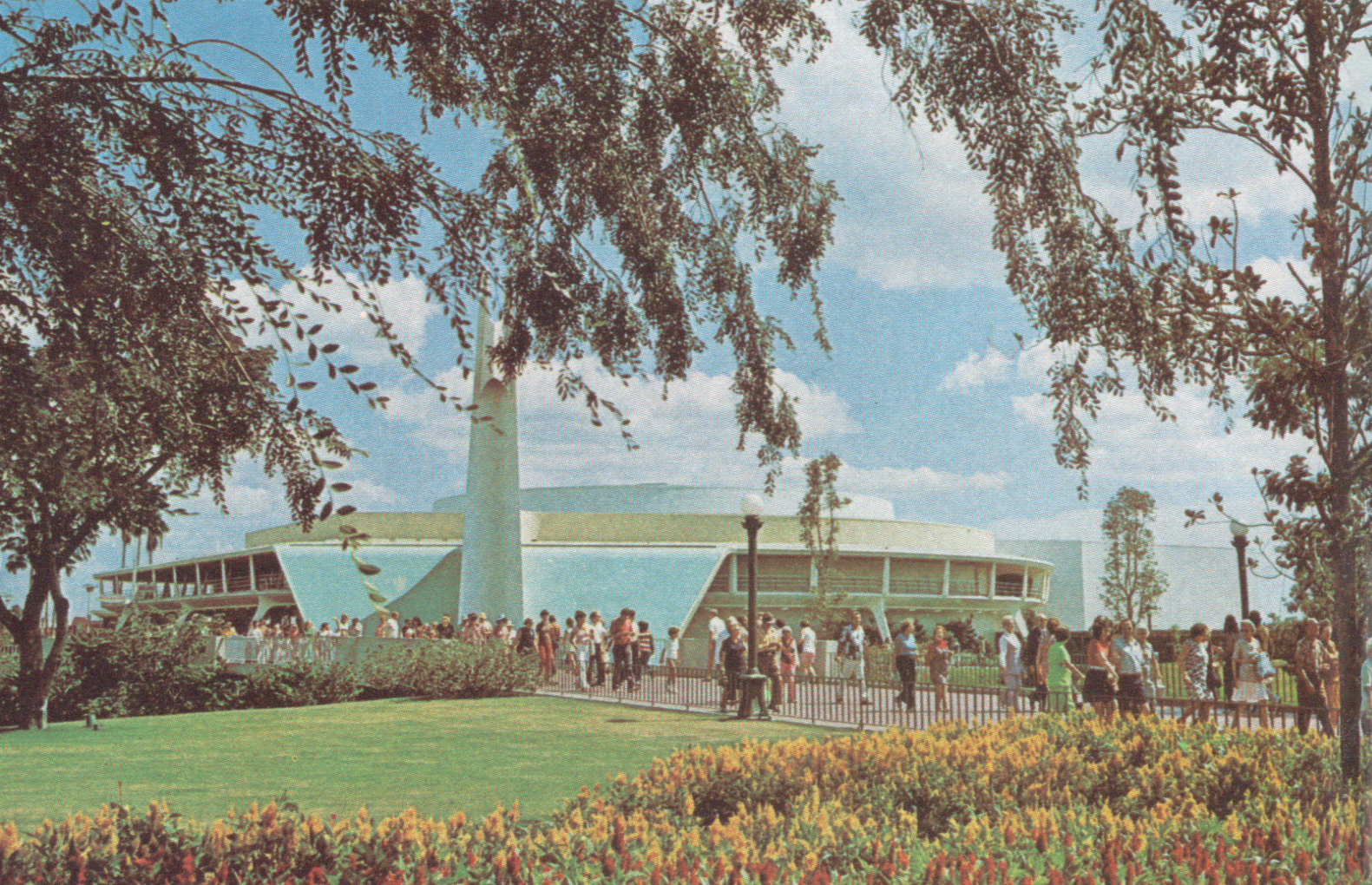
The familiar Swan Boat queue and dock suddenly appear on park maps in June 1973:

In Summer 1973, the Plaza Pavilion restaurant opens, requiring the construction of steps to replace the previous gentle "exit ramp" slope, and by December 1973, Vacationland Magazine is depicting the former Swan Boat area as a seating area for the Ice Cream Parlor:

Notice how the yellow and white striped umbrellas, which remain to this day, visually echo the original canopy which stood here.
Today we know the area which was probably once the Ice Cream Parlor seating area as the Plaza Restaurant, and although I've found one mention of the name in a Summer 1976 Vacationland, it doesn't appear in park guides until 1977:

Park maps are still vague about exactly how the two areas interface, showing both "Borden's Ice Cream Parlor" and the "Plaza Restaurant" as a single continuous space, although the overall arrangement is now closer to how we know the park today:

Today, few hints remain of the brief period when the Plaza Restaurant was the seating area for the Ice Cream Shop. The wall that joins the two locations has been filled in:
 |
| The door that wasn't |

Watch that connecting door in the back vanish before your eyes!
The "back" wall of the Plaza Restaurant is raised off an apparent original back wall to allow a place for servers to refill drinks and ring checks. It's more of a simple partition which implies that all of the Art Nouveau niceties were added the same time the partition was. There's also evidence of "In" and "Out" signs above the doors to the back area that have since been wallpapered over. How many interior designs has this space gone through?

But when did this happen? 1973? 1977? Or some later date? When did the "Plaza Restaurant" become the "Plaza Restaurant"? I've combed the pages of countless Eyes and Ears and other official documents without ever turning up a mention of the original change. For that matter, when and why were the two establishments walled off from each other?

For that matter, why on earth would you call the darn thing the Plaza Restaurant when you know it's already sandwiched between two other establishments called the Plaza Ice Cream Parlor (1971) and the Plaza Pavilion (1973)? The Plaza Pavilion is already such a troublingly generic and forgettable name that most people only know what I'm referring to when you refer to it by it's contemporary name.... The Noodle Station. Which it hasn't been called for five years now.

The Noodle Station is a terrible name, but at least it's memorable. What deficit of creative thought gave us three restaurants with the name "Plaza" as their first word right in a row?
Even more puzzlingly: did the Swan Boats relocate to make room for the additional seating, or did the seating fill in a space vacated for the Swan Boats? Since this is the 1970s, it seems hardly likely that Disney would've relocated an entire attraction just because the construction of the Plaza Pavilion required the substitution of a staircase for a ramp. After all, this was 1973, years before anyone has even thought of the idea of ADA-compliance.
When did the Swan Boats open?
Even a question as basic as "When did the Swan Boats" open - something that seems so basic, so simple - is impossible to answer. The official Disney opening date for the attraction is May 20, 1973, which is great but unfortunately demonstrably wrong. I excluded a paragraph from Edward L. Prizer's Feburary 1972 article above, because I wanted to include it here, where it would have the most impact.
"Such a deluge of Disneyphiles hasn't been without problems for Disney World itself. Months ago the top men realized they needed more of everything, and fast. But it wasn't like an ordinary amusement park, where you could bring in another ferris wheel or pitch game or two and set them up overnight.
Disney attractions are complex packages of planning and engineering talent and meticulous craftsmanship that sometimes take years to perfect. There was just no way to phone back to California and say, "Send us another half a dozen."
In due course, according to previous plans, they did get [Flight to the Moon] and America the Beautiful in operation early this year. They'll be opening Eastern Airlines' "If You Had Wings" around June. Two more shops, Olde World Antiques and Mlle Layafette Parfumerie, have just started doing business. Before too long, swan boats will be launched in the canal that flows around The Hub before Cinderella's Castle."

Maybe.
Now, if you go to the Orlando Public Library, you can look through every Walt Disney World newspaper clipping from the 1970s, including many not in English. And if you do so you will find extensive coverage of the opening of Tom Sawyer Island in June 1973, and absolutely no mention of the Swan Boats except to note that they were expected to be ready "By Summer".
The nearest I can find for an concrete implication of an opening date for the Swan Boats is a single paragraph mention of the boats in a June 1973 issue of Walt Disney World News, which abruptly adds the familiar Swan Boat Dock to the map of the hub, as seen above. The May 1973 issue includes no mention of the boats - despite hyping the imminent opening of Tom Sawyer Island - and no visual representation of the dock.
Everything points to a May or June 1973 opening, which makes it very hard to explain how this photo was appearing in Disney publications as early as 1972:
 |
| "Anybody have a map?" |
 |
| The Omnibus passes the original canopy, 1972 |
The thing is that this direction of travel makes no sense. The highlight of the Swan Boat journey was undoubtedly the trip into Adventureland - a highlight which occurred in the first third of the attraction as it operated from 1973 to 1983. But if the boats traveled in the direction indicated by the above photograph, concept art and Hartley fun map, however, the Adventureland section would become the last third - after which the boat would immediately dock by the Ice Cream Parlor. Isn't this a more sensible and dramatic way to arrange an attraction?
What's even more puzzling is what happened to the Swan Boats after they opened in 1973 - Disney ran them only during Summer months, and even removed them from the GAF park guides in 1975. After only ten years, the boats closed.
So let's review. We have an attraction which looked ready to open in 1971, was reported to open in 1972, finally opened in 1973 in a different place with no fanfare after its original boarding area became an ice cream patio, then was closed with no fanfare after only ten years after being operated only in fits and starts.
 |
| "Off to your right, you'll see the site of our future loading dock!" |
Why did they move?
I've considered all of the possibilities here. Was it because the boats needed to load from the opposite side of the river? Seems unlikely, since they had entrances from both sides. Was it because there was some kind of technical problem with the boats or ride path? At first I thought the waves generated by the Tomorrowland entry slopes and spires (they used to spit water, you know) could've caused issues with the Swan Boats, but the boats in operation had no less than two wave breaks and the Tomorrowland entry wasn't re-engineered to produce more water until 1974, anyway. There's no way that moving the attraction closer to the waves before they were a problem could've affected the decision. In fact, directly above and to the left you can see a 1972 Swan Boat blissfully drifting through the area that would later have wave breaks installed around it.
Was it for crowd control?
This seems like a more likely choice to me. The spot outside the Ice Cream Parlor can become a traffic jam even 40 years later, so relocating the boat dock north may have eased congestion in a spot that was becoming unmanageable - and this was back when Disney was still actually trying to operate the Plaza Pavilion as a restaurant all day instead of just letting it become the fanciest covered walkway in the park. Were the Swan Boats causing traffic jams?
Remember what Edward Prizer said - they needed more of everything. In fact, there is some evidence that the Swan Boats were and continued to be an operational nuisance. On Widen Your World we learn:
"A cast member who worked this attraction during its last season said the ride was closed due to operating costs, which stemmed largely from the maintenance of the boats. This would make the Swan Boats the first ride to contract the disease that laid 20,000 Leagues Under The Sea to rest in 1994. All manner of other reasons have been given for the Swan Boats' closure, including that the ride was "just too popular." When I first heard that, I presumed it was entirely untrue. According to Greg Scott, however, the ride's popularity was actually a problem. Scott staffed the ride as a Lead during its last few summers and in 2003 recounted that even with six boats running the queue could easily reach 45-60 minutes."In a park that had two theater shows to offer guests as reward for entering Tomorrowland, no roller coasters, no Pirates of the Caribbean or Tom Sawyer Island, no Peoplemover, and an apparently unreliable submarine ride, it's easy to imagine a queue for the Plaza Swan Boats spilling right out into the Main Street parade route at this crucial juncture. In fact, when you get right now to it, isn't the most striking difference between the two boat landings - besides the more attractive and permanent nature of the 1973 canopy - the fact that the newer version has at least three times as much queue space?
 |
| Top: 1971 Bottom: 1973 |
Ah-ha! And now it becomes possible to fit the story of the Plaza Swan Boats into a narrative we've already covered at Passport to Dreams: the early attractions with out of control lines. We already know that new structures and crowd control devices had to be built for Country Bear Jamboree, Hall of Presidents, Haunted Mansion, Jungle Cruise and 20,000 Leagues Under the Sea; now we can add Plaza Swan Boats to that list.
In fact we now know that their unreliability was evident from the start, making their closure in 1983 much more understandable. Premiering two years too late, being prone to always being broken and causing inestimable crowd flow damage is not a way to get on Disney's good side. In fact, the mere fact that Disney only ran them during summers is itself a huge red flag for their era. The Plaza Swan Boats were open less often than the Plaza Pavilion, a restaurant that today is open perhaps six weeks out of the year. You have to be a pretty lousy ride for Disney in the 1970's to give up on you so quickly. In fact, it's now easier to place the swan boats alongside something like the Fort Wilderness Railroad: it was a disaster, and it closed quickly.
So that's the story of the ice cream parlor that wasn't and the attraction that wasn't, and who knows exactly what happened but it's still around to haunt us today. We may never exactly know when the Swan Boats opened for real or why they ran them in the wrong direction for a decade or exactly how they got messed up in the first place. Just as we may never know what those original Magic Kingdom guests had to look at while they ate their fancy crepes and ice cream sundaes in the spot that was not yet the Plaza Restaurant. And we'll never know why they just had to have three restaurants in a row starting with the name "Plaza".
I was going to end with this familiar photo of a Swan Boat in 1972, pulling towards the original load dock - already tracing the "backwards" route, with no 1973 landing visible in the background:

Until I noticed something in this photo I never had before:

Is... is that a tow line?
It can't be. Nobody attaches a line to tow a boat under the water line.
Could this be the mythical early electrical guidance system which caused the attraction to close in 1972 after it failed?
And does this early photo, showing the Swan boat ride path under refurbishment, perhaps betray traces of that original, failed ride system?

If this is true, then the May 20, 1973 date given by Disney probably refers either to the opening of the new landing or the conversion of the Swan Boats to the new guidance system - underwater jets, just like the modern day Friendships at EPCOT. But which is it?
The Magic Kingdom refuses to yield up all of her mysteries.
This page was updated on March 16, 2013, with new photos and information.


