Now Available! My newest book!
Showing posts with label Film Theory. Show all posts

Monday, May 18, 2015

Song of the South: Disney's Loaded Gun

"Don't you know you can't run away from trouble? There ain't no place that far."

In 2012, two books were published within two weeks of each other, each with dueling viewpoints but which come to similar conclusions. The first, Disney's Most Notorious Film: Race, Convergence, and the Hidden Histories of Song of the South by Jason Sperb, is an excellently written cultural history. Sperb, however, falls into the trap so many other Disney critics have fallen into since the 1940s by working himself into an aesthetic lather over the racism of the film, and the presumed racism of Walt Disney. Contrasting the Sperb book, Jim Korkis' Who's Afraid of Song of the South? is a production history from the perspective of an unabashed fan who comes down on Disney's side.

Every Disney blog, it seems, has a post about Song of the South. This is mine. Now, of all of the eras of Disney animation, the period of fevered creativity and pinched budgets between 1941 and 1949 interests me the most. I own three bootleg copies of Song of the South, because each has slightly different visual qualities. I've been showing it to everyone who will sit for it for over a decade.

I'm not convinced of the film's greatness, but I think it's a really interesting movie.

And I'm not going to come down on the side of either Sperb or Korkis. I'm not convinced that Walt Disney was as malicious - or as naive - as he's often portrayed by film academics. However, I'm also not going to follow in the footsteps of so many other Disney bloggers and act the know-nothing when it comes to having to confront the problematic aspects of the film either.

Song of the South is not an easy movie to level with. Merely watching it requires that one take a position, and ask tough questions that don't yield ready answers. These are generally the criteria for a deep dish cinema masterpiece, not a frivolous nostalgia piece occasionally touched with brilliance. It would hardly seem to be worth the effort for a film whose cultural expiration date is long past. But engaging those questions and coming out the other side is the reason it's still worth discussing.

Let's begin by prodding the sensitive underbelly first. It all began a long, long time ago...


1) The Song of the South Problem

The default position of many Song of the South advocates is to either ignore or hand-wave at the basic problem of racism in this film. After all, it's easy to counter, the film was reissued in 1986 and met with no real opposition, the concerns of racism in the film are just overly sensitive allegations. No problem. Don't see any problem here.

This is bullshit.

The key issue comes down to representation, which is still something worth fighting over, because images carry power. Non-white, non-straight people are still fighting for better representation in films and popular culture. But truthfully, the fact that representations of persons of color onscreen have improved dramatically in the past few generations does not enter the Song of the South equation, either. The key character in question, Uncle Remus, no longer is forced to stand alone amongst a relatively narrow group of peers.

In 1946, Remus represented a complex, unusually central role for a black entertainer in a major Hollywood production. By 1986, an era when black actors were striving to escape from a screen ghetto of limited representation, Remus was an impossible throwback. In 2015, when we expect diverse and complex casts in major motion pictures, Remus looks more like a figure of fantasy, which isn't too far from how he was perceived in 1946.

This isn't to suggest that strides cannot still be made in these areas onscreen, but simply to point out that Remus, taken in isolation, is no longer the gigantic problem he once was. We're more likely today to admire Baskett's dignified, moving performance in the midst of a maelstrom of a film of absurdly old-fashioned attitudes than to perceive this sort of Uncle Tom stereotype to be a normal or common perception of a black man. He's so far from our modern reality he's become fiction again.

No, it isn't Remus, it's his context in the movie which is problematic, and the reason it's problematic is because the film splits its black characters between the "culturally black" animal comedy trio of Br'rer Rabbit, Br'er Fox and Br'er Bear and the "manifestly black" cast of actors who represent the labor force on the plantation. The "Br'er" critters have craft and power - they have an agency in their own plot which is not reflected in the plantation laborers, Remus included.

This lack of agency in the story is exactly why it's possible to mistake Song of the South for a film set in the Antebellum period, before the Civil War. There's plenty of scenes between the white, upper class family and the black laborers, but if the word "slave" never appears, neither does the word "employee". We never even find out what they're growing on the old plantation, nor do we ever see Uncle Remus doing any real work, or are told how he gets by or what he's retained, exactly, to do.

We do see him living in what appears to be slave quarters near the house, although we never discover where the rest of the labor force lives. There isn't even a date to clue us in to when the film takes place. All we see are black laborers doing something, white people running the place, and a living situation that looks like it dropped out of Gone With the Wind, David O' Selznick's 1939 bad taste extravaganza. The title actually cues us to think of Gone with the Wind. They even sound kinda similar. It's a clear cue to the movie buying public: "Did you like that film? Here's something similar."

In other words, the film doesn't do anything to dispel the impression of Remus as an old slave, perhaps one beloved and trusted as a member of the family, but undoubtedly a man treated as a piece of property. His attempt to leave the plantation at the climax of the movie is so underdeveloped that it hardly seems to matter, and arrives long after most of the damage has been done.

Not helping matters is Hattie McDaniel, a wonderful actress familiar from films of the 1930s, essentially reprising her role of Mammy from Gone With the Wind. Like most vintage movie fans, I love Hattie - any appearance by her is a reason to celebrate - but she isn't given much of interest to do here. Her character may be hired help, but all the film ever gives us images of Hattie singing and baking. Simply put, to expect post-Gone With the Wind audiences not to process such an image as "slave" is the equivalent of putting Anthony Hopkins in an orange jumpsuit behind a Plexiglas wall and asking us to remember that he's not a serial killer. It doesn't work that way.

Many commentators also like to bring up the happy singing field workers, although this is a case where I'm not sure if this accusation isn't somewhat off base. Truth is, we don't see them clearly enough or often enough to decide if they're jolly or simply singing. But the fact is that by then in the film, it's given any critic looking for a racism angle more than enough rope to hang it. Audiences and critics turn to Song of the South looking for evidence of the racism of noted white guy Walt Disney, and the film over delivers. I've even seen multiple online articles indicate that the reason the father leaves suddenly at the start of the film is to fight for the Confederacy!

But if we want to point accusing fingers anywhere for this state of affairs, it isn't at lazy audiences or inattentive critics, it's at Walt Disney himself. Disney hired left wing screenwriter Maurice Rapf to temper the unfortunate inclinations of the screenplay by Dalton Reymond, and Rapf told Walt directly: he would have to be very clear about the situation and social context of the film, or risk appearing to endorse slavery. This, incidentally, is the key event for Jason Sperb, who takes Walt's "refusal" to clarify the situation as evidence that he didn't care if the film offended anyone.

And so, in maybe one of the worst story decisions ever made at Walt Disney Productions, Walt gifted us millions of words of commentary on a film that in some ways seems hardly deserving of it. How simply it all could have been, if not avoided, then greatly reduced. All it would take is uttering the word "sharecroppers" or giving us a date. But the film refuses.


The sad fact is that there were likely other factors playing into all of this. In the 1940s, with home video still a generation away, films were basically temporary things. They were expected to go out, make their money, and then probably vanish forever. The possibility that future generations from a very different culture would be sharpening our rhetorical knives over this film was not even a realistic consideration. Walt had to do what was right for the film in 1946. And, the fact is, in 1946 and even well into the 60s there were many places in the South where films had, historically, been given a hard time at the box office due to their perceived progressiveness.

MGM released Cabin in the Sky in 1943 and 20th Century Fox had Stormy Weather in 1944, two all-black musicals which today look like two of the best Hollywood musicals ever. In the Jim Crow South, there's places where these wonderful films were refused distribution outright, which meant they had no chance of returning a profit to the studio in certain sectors. Disney met with 20th Century Fox producers to discuss Stormy Weather, so right there goes Sperb's fantasy that Disney simply didn't care. In this case, he may have simply chosen the path which guaranteed a financial return for his shaky motion picture studio, which, shamefully, was to choose no path at all.

Is Song of the South racist? By our modern standards, yes it is. It's foolish to ignore this, because it's the whole reason the film isn't available, which by extension is the whole reason to discuss it. It's reductionist, naive, and to most modern eyes, about blissfully servile slaves. To try to pretend that that just isn't there in the film isn't fooling anybody.

And yet! And yet.

And yet it's also just as foolish to insist that that is all that Song of the South is. Because for all of the cultural hand-wringing over Uncle Remus, he is undeniably Walt Disney's surrogate in this film. He's the most compellingly drawn character, and the only character in the film to have an emotional arc.

The film allows us nearly no empathy for the white characters: Bobby Discoll's character is an annoying wimp and spends most of the film wearing a "dramatic" expression that suggests constipation. His mother is a hysteric who consistently makes the wrong decisions, and his grandmother does nothing to prevent a bad situation from getting worse. We don't blame Johnny for wanting to spend all of his time with Remus; we do, too. Baskett's Remus and Glenn Leedy's Toby are the most likable characters in the movie.
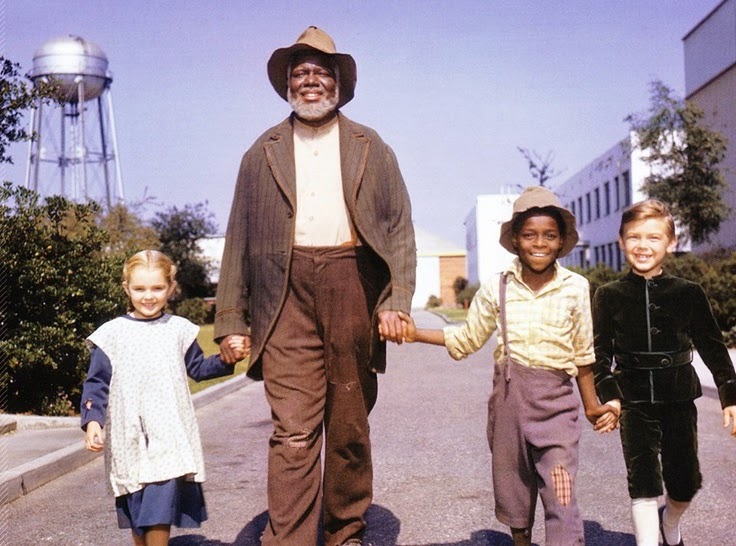

Remus is our identification point, and he's Disney's too. He's a wise but humble storyteller whose stories not only teach valuable life lessons, but save the boy's life and even appear to reshape reality. We can also enjoy the way in which Remus is a master manipulator of his white employers, always making careful allowances to maintain the fiction that his suggestions were their ideas, all along. That's not exactly progressive, but it's something.

This does not obliterate everything I've said before, but it does complicate it. I'm in no position to judge if the Walt Disney of 1946 was racist or not, never mind the Walt of 1926 or 1966. You aren't, either. People aren't that simple. All we have is the film, an alarmingly troubled work about a heroic stereotype. It's not simple enough to come off as a total fantasy, but it's not complex enough to allay our modern unease and easily put the film in its place. So now we have to deal with that.

2) Song of the South Into the Present Day

Audiences in 1946 didn't see it the same way we do. Coming out the other side of a world war, the American film  industry was at an all-time productive high. The post-war era in American pop culture is a fascinating one, and tough, serious film making like Rebel Without a Cause sat cheek to jowl with blistering satires and totally absurd escapist fantasies. The all-star movie musical roared back to life with a vitality it hadn't had since the pit of the Great Depression. Song of the South is one of these escapist films.

If we pay close attention to fashion and dress, it's possible to realize that Song of the South is set right about the turn of the 20th century, or in other words the world into which Walt Disney was born. The 1950s saw a revival of interest in "The Good Old Days", visible in such films as The Jolson Story, The Music Man, Night and Day, Man of a Thousand Faces, and reaching its most immortal expression in Disneyland's Main Street, USA.

Song of the South represented to 1946 audiences an escape into a pre-modern fantasy world, of a world before automobiles and airplanes and mechanized warfare, a dimly remembered cultural fantasia. Today's audiences are, depending on one's perspective, either more informed or more cynical, which makes the acceptance of these nostalgic fantasies tougher to take. We're more likely to look for and expect to see the downsides of a reconstruction south presented even in a fantasy film in ways that 1946 audiences likely would not. This would not last long, however.

According to my first edition copy of Leonard Maltin's The Disney Films, Song of the South was reissued without incident in 1956. Throughout the 1960s, Disney kept Song of the South more or less out of view. The Br'er Rabbit animation segments were featured in episodes of Disneyland and Br'er Fox and Br'er Bear could be found in New Orleans Square, but it would not be until 1972 that it was reissued.

Many modern commentators have opined that Song of the South was not reissued during the 1960s due to the turbulent political situation at home, but I think that's stretching the point a bit. If there's any secret reason the film didn't re-appear during the 60s, it may be because Walt Disney remade it - as Mary Poppins, in 1964. Now, Poppins is quite a different film, but the basic situation of a central, mythologized figure who brings animation and magic to a young boy and girl and in doing so mends a broken family strikes a familiar cord.

It's possible that Walt saw a way to recycle a mythology he found special meaning in into a less controversial, more technologically sophisticated film, and he was willing to do it with either Mary Poppins.... or Eglantine Price. Poppins in the finished film is actually extremely remote and mysterious, not at all like the jovial, magnetic presence of Remus. At the suggestion of the Sherman brothers, the emotional core of Mary Poppins is the father, who isn't even present for most of Song of the South.

Given the comparative excellence and sophistication of Mary Poppins, it's possible that this film could have totally eclipsed Song of the South. Today Song of the South could be one of the studio's many obscurities from the 1940s, like So Dear To My Heart or The Reluctant Dragon. But, in 1989, Disney did the one thing that will ensure that demand for Song of the South will never dry up and its legend will loom ever larger - they opened Splash Mountain.

From the perspective of 2015 it seems incomprehensible that Disney would green light an attraction based on a film they had no intention of releasing, but things were different back in 1985.


Back in the 80s, Song of the South had become a perennial money maker for Disney. Reissues in 1972 and 1980 had been wildly successful in a way the film just wasn't in the 1940s, and another was slated for 1986. In other words, audiences in 1989 were expected to recognize the Disney Uncle Remus characters alongside such characters as those from Cinderella and The Jungle Book.

In fact, the entire original version of Splash Mountain at Disneyland is designed based on this assumption. The characters are introduced very casually - the dynamic between Br'er Rabbit, Fox, and Bear isn't even set up, visually or verbally, since we're just supposed to know who is who. Pumpkins, red earth, mint juleps, willows and cattails belong unambiguously to the deep Georgia south of the film.

At Disneyland, the journey through Splash Mountain begins in an old barn, pointedly one of the few structures explicitly built for the interaction of humans and animals. From there, the queue moves past a fireplace with a cast iron pot, and is routed so guests must walk across the hearth. This represents the fireplace where Remus tells Johnny the Br'er Rabbit tales in the film, and to make the connection clear, a direct Remus quote from the film is painted on the wall above the fireplace. Although Remus is never referenced or seen in the attraction, to the familiar observer, the signposts and connections to Song of the South are many.

Daveland at Disneyland
I'd give a lot to know when exactly Eisner instituted his ban on Song of the South. If the stories told about that key visit to Imagineering are correct, then the design for Splash Mountain had been solidified by 1985 in time for it to be seen by Michael Eisner and Breck Eisner and green lit. Song of the South was re-issued both in theaters and internationally on home video in the 1980s, and of course the Disneyland ride is a direct continuation of what riders would be expected to recognize from the film.

But when Splash Mountain appeared at Walt Disney World in late summer 1992, there were changes both obvious and subtle that reflect Song of the South's status as banned goods. Relocated to Frontierland from a dedicated "Critter Country", holes and tunnels became mine shafts and saw mills. A musical score which previously was a fairly conservative recreation of Daniele Amfitheatrof's 1946 orchestral arrangements was re-imagined as homespun, bluegrass ditties. The final version of "Zip-a-dee-doo-dah" employs a gospel singer.

More pointedly, the Florida version of Splash Mountain works overtime to introduce riders to the core characters as if they had never existed before. Disneyland's Splash Mountain starts in media res; Br'er Fox and Br'er Bear are out to get Br'er Rabbit because that's what they always do. Comparatively, Magic Kingdom's version uses framed portraits and signs to introduce us to the cast of characters and locations before the ride even begins, then makes all of the characters chatterboxes. We splash down into the cartoon world and see Br'er Fox and Bear spying and plotting about Br'er Rabbit; Br'er Rabbit sings about leaving home and then a porcupine sings about his decision to leave home being a bad one. Two rabbits and a roadrunner six feet later repeatedly remind us of what Br'er Rabbit is up to. Absolutely nothing is left to chance.

Perhaps even more pointedly, the Florida Splash Mountain removes nearly all of the Uncle Remus quotes from Disneyland's queue and jettisons the hearth, making the film's central character seem more like a distant echo. Instead it creates a character who functions as a sort of replacement Remus - Br'er Frog, an incidental character from the film, now sets up the story seen in silhouette in a (brilliantly framed) introductory queue tableau.

In other words, the Magic Kingdom Splash Mountain goes to great lengths to cut its ties with Song of the South, giving us a new world for Br'er Rabbit, Br'er Fox and Br'er Bear to exist in, one unique to Frontierland. They even changed the color of Br'er Rabbit's fur from brown to grey, almost as though they were afraid anyone riding would make the connection.


Despite appearing in its own Critter Country separate from Westernland, the Tokyo Disneyland Splash Mountain repeated the "bluegrass" aesthetic of Magic Kingdom's version, thus creating a "Splash Mountain Universe" that the Disneyland version doesn't quite belong to.

Generally, I view creative decisions as just that - decisions, existing in a timeline of the creative process, which must be made because decision must be made, but I can only conclude that the 1992 Splash Mountain seems to be a deliberate attempt to remove the ethnographic origin of the Uncle Remus characters from the "Disney Splash Mountain Universe". Br'er Rabbit and Br'er Fox, in particular, speak in the 1946 film and 1989 attraction with cadences, phrases, stammering and stuttering very obviously directly descended from African-American comedy conventions of a bygone era. And let's not forget that James Baskett himself appeared on Amos 'n Andy.

Jess Harnell's Br'er Rabbit sounds a great deal like Johnny Lee's Br'er Rabbit, but what he doesn't sound like, is black. Br'er Rabbit's attractive sass and swagger is totally gone, as are his memorable film dialogue lines retained for the 1989 Splash Mountain, like "'I'm gonna bust you wiiiide open!". With his grey fur and stock hijinx, the 1992 Br'er Rabbit could just be a Bugs Bunny clone with all of Bugs' gender queerness removed.

Even with a core cast that's been literally whitewashed, Splash Mountain is the single thing that's probably kept Song of the South alive in the public consciousness. As Bob Iger said in 2009, the film actually is "antiquated" and "fairly offensive", yet literally thousands of people can ride through a major thrill attraction based on it every day of the year. And these same people can now go on the Internet and discover that those clever, well realized characters and world come from a film Disney doesn't want you to see. In any other circumstances Song of the South probably would've ridden off into the sunset reserved for all entertainment whose cultural expiration date is long past, but Splash Mountain is like a billboard off a major highway advertising a place you can't go to.

And yet despite all of that, there's one defiant scrap of Song of the South left in the Magic Kingdom attraction, and everyone who exits the ride walks past it. It's a tiny, framed black and white photo of Br'er Rabbit gesturing to the Briar Patch from the film. More people likely see it in a single day than have seen the film in three decades.


1986 reissue poster
3) Give Us Dirty Laundry

Nothing spreads faster in our Internet culture than bad news.

Now, in my decades of talking about this movie to people, I've come to the conclusion that most Disney fans, and indeed most people born during or slightly before the ban was instituted, have never seen the Song of the South. They haven't sought out the bootleg DVDs or watched it on YouTube. Disney fans are, if nothing else, above all loyal. But everyone, and I mean everyone, knows about the movie.

Or at least they know that it's "banned". What I've realized is that fewer seem to know what it's banned for. Unacceptable racial attitudes, yes, but that's where the understanding ends and the hyperbole begins.

Since the early 2000s and the wide spread of Internet culture, one of the default understandings of Walt Disney has become popularized by shows like Family Guy and Robot Chicken. Charges of racism, juvenile exploitation, and antisemitism are seemingly bolstered by the fact that there's a "forbidden" Disney film out there - Song of the South - so racist, so I've been told, that the NAACP picketed the film upon its release.

 In other words, there's a popular mythology growing out there which positions Song of the South as Disney's version of Birth of a Nation - an abominable film of undisguised hatred. And that doesn't describe Song of the South at all. For starters, the bulk of the film it isn't even entertaining enough to be offensive.

Part of this comes from the fact that Walt Disney hasn't been a fashionable guy to admire in a long time. Today, admiration for filmmakers behind the scenes like David O. Selznick or Daryl Zanuck is limited to a subset of movie fans, and today we're more likely to speak about directors like Alfred Hitchcock and John Ford than the money and organization men who believed in them. A great deal of Disney history today seeks to highlight the geniuses who worked for Walt. This very blog is as guilty of it as anyone - look at the number of posts I've tagged Marc Davis and the number I've tagged Walt Disney.

Since the 1970s, renegade geniuses who did their own thing and beat the odds have replaced the kind of unusual institutional bodies who made films through the end of the 1960s. Walt Disney couldn't even draw Mickey Mouse and is only credited for directing one film - and it's a lousy one. It takes some knowledge of film history to understand him as the creator of so much of the first half of the 20th's century's most potent popular art.

The Walt Disney Company has largely allowed this to happen in the past fifteen years. The Walt Disney Story was closed before Splash Mountain even opened. One Man's Dream, which opened in 2001 and has been updated only once, gives people an overview of Walt's accomplishments but no real personal sense of the man. Neal Gabler's 2005 biography of Walt Disney, positioned by Disney as a definitive Walt book, is a crashing bore, thicker than the complete works of Shakespeare, and seems to be written from an ambivalent perspective about the man's legacy. Saving Mr. Banks, the 2013 film, is widely derided by fans as a fantasy but at least attempts to give some sense of who Walt Disney was.

This means that in popular culture the character of Walt exists in a vacuum, and it's pretty much filled up with the kind of rumor mongering and character assassination that popular culture has been pumping into that vacuum for some time. If you're a Disney fan you've likely been asked point blank if Walt Disney was an anti-Semite (or a Nazi sympathizer) by somebody in the past fifteen years. Walt Disney, noted white guy, has become Walt Disney, likely racist, and Song of the South is his dirty laundry.

This is why I worry that keeping Song of the South out of circulation does as much damage as it does good. By removing consumer's ability to choose for themselves, then the choice to keep it under wraps becomes an eternally self-renewing cycle. It isn't available because it's racist. It's racistand so it isn't available.

This decision to withhold it is really our loss. We're being denied the pleasure of James Baskett and Hattie McDaniels' performances, and the voices of the Hall Johnson Choir. We aren't allowed to see the perfection of Ub Iwerks' special effects, 40 years before Who Framed Roger Rabbit. Song of the South is the first Disney animated film stylized after Mary Blair's artwork, and the character animation is among the best and funniest the studio ever gave us. It's also the only color film and one of the last films shot by Gregg Toland, on the short list of the greatest cinematographers of all time. This last point, in particular, is very painful for cineastes because Toland is famous for his dark chiaroscuro effects in Grapes of Wrath and Citizen Kane, and the dark, fire lit passages of Song of the South turn into a blurry mess in all available copies of the movie.

Surely all of those positives are worth something to history. They can't be worth tossing out entirely. But how do you reconcile a film whose reputation requires handling with kid gloves with the massive, moving target of a modern multinational corporation in the shooting gallery of pubic life?

4) Disarming the Loaded Gun

But to get to the core of the reason why Disney hasn't let Song of the South out yet, we have to compare the problem that Song of the South represents to how they've handled similar problems.

Disney has a spotty record when it comes to self-censorship. Things pop on and off the forbidden list randomly, more or less depending on who's paying attention. In the early 2000s, Roy O. Disney requested that cigarettes be removed from certain cartoons - Saludos Amigos and Melody Time - while permitting the cigar smoking in Three Caballeros and Pinocchio to remain. At the same time, he asked that the opening sequence of Make Mine Music - The Martins and the Coys - be removed due to offending sensibilities, but more likely because of cartoon violence and gun play that no child who's ever seen a Tom & Jerry cartoon would bat an eye at. Melody Time and Make Mine Music are still censored in the United States, while Saludos Amigos was presented without cuts on the "Walt & El Groupo" DVD release a few years later.

On the Walt Disney Treasures DVD releases, much stronger material was presented with little but a comment or two from Leonard Maltin, including a number of suppressed Pluto cartoons where his master is a bossy Aunt Jemima type, and several examples of pretty hardcore wartime propaganda like Education For Death.

In a similar vein, the VHS release (and as far as I can tell,  subsequent home video releases) of The Lion King have zoomed in several shots in the "Be Prepared" sequence to make the goose-stepping hyenas a little less apparent.

Closer to home, at some point Disney did major censorship to Dumbo, removing entirely the jive-talking crows from all but their final appearance in the film to sing "When I See An Elephant Fly". And the famous black centaurettes have been missing permanently from Fantasia since the 1960s. Yet despite this, there's never really been any attempt to remove the humiliating "What Makes The Red Man Red?" sequence in Peter Pan.

The reason Disney can't - and I'm not saying they won't, I'm saying that they cannot - release Song of the South has to do with, surprisingly, the success of their home video department.

If I asked you to, I bet that it'd be easier for you to come up with a list of places where you cannot buy Disney movies and DVDs than places you can. Electronics shops, mega marts, pharmacies, gas stations, automotive repair stores, supermarkets... children's entertainment on home video is a gigantic market segment and, best of all, it's recession proof.

During the DVD boom of the early naughts, films of all stripes were flying out the door, but once the market collapsed, home video has returned to levels of business fairly comparable to what it was like in the 1990s. If you grew up in the VHS era, as I did, think back to what movies your friends and family likely owned on VHS, and you're going to be picturing rows and rows of movies in those distinctive white puffy clam shells - Disney movies. Mixed in there was going to be, say, your friend's dad's copy of Goodfellas, or maybe Indiana Jones and the Last Crusade or something. In other words: hit movies, and kid's films. Then as now, that's what moves copies of films on home video.

Why? Because kids are easily bored and any parent knows that a bored kid is a recipe for disaster, so it's good practice to keep a bunch of them on hand. To kids, the word "Disney" means a good way to spend time. For adults, it means nothing more than "probably safe for your kids".

As Disney fans we tend to forget this, but for the vast majority of the consumer population Disney movies are used as electronic babysitters. Disney even has a special feature on their discs to facilitate this, and they market it like it's a huge benefit - Disney's FastPlay, in which an inserted disc will play assorted trailers, ads, the feature film, and even bonus material clear through, exactly like a VHS.

They've been using it for 12 years now, and if you look carefully, most other animation studios have followed suit with their home video releases, so they must be hearing from people that this is what they want.

This is the market that Disney fears. It isn't the people who are going to line up to attack a 70-year old movie, and it isn't pointy headed geeks like we who are worried about the aspect ratio of Melody Time, and it isn't the think piece in Huffington Post they're worried about, it's Joe and Jane Blow.

Disney movies are sold everywhere, which means they've locked their product into a massive distribution network that empties out into places like a Publix in Hollywood, Florida. It just isn't practical for them to do a small release of a film like Song of the South, because for Disney releasing a product - any product - on video is the equivalent of pressing a huge red button that vomits 10 million copies of everything into every store in the United States.

If you were collecting the Walt Disney Treasures DVD releases, you've experienced this. If you wanted one of the discs, you had to get to your retailer of choice money in hand on release day. The Treasures discs came in on the truck with all of the other Disney releases for that day, and when they were gone, they were gone.
 
Given this scenario, it's easy to see Jane Q. Public thoughtlessly throwing a shiny new Blu-Ray copy of Song of the South into her basket at Target because there's a fun looking rabbit on the cover, and turning into a raging consumer volcano upon discovering that the film features less than flattering depicting of - are those slaves? It's not nerds, but Moms, that Disney lives in constant fear of. They have spent generations building up goodwill and brand recognition to potentially degrade it by releasing something that's not really okay to most Americans.

So, if Disney is even going to think about a release of Song of the South, they have to find a way of releasing it in such a way that nerds can find it but casual Disney consumers cannot.

They could, for instance, sell it directly to fans at the D23 Expo, which given the cost to get in is all but guaranteed to screen out anyone who's going to be walking into Song of the South blindfolded. This would certainly bolster D23's tenuous claim to be "by fans, for fans", although it would encourage scalpers and bootleggers - but doesn't the current strategy do that already? If anything, the opportunity to purchase a legitimate copy of Song of the South direct from Disney could be a powerful incentive for some to attend.

Disney could also contemplate a limited distribution strategy through, say, their Disney Movie Club, which they're already using to make available such less-marketable titles as Pollyanna and The Computer Wore Tennis Shoes. Using this method it's still not impossible that Song of the South could end up in "The Wrong Hands", but the risk is far less than a wide release.

An even safer bet could be a direct digital download with, say, a click-through acknowledgement and an attached video disclaimer with Leonard Maltin.

Or, they could use a DVD boutique label.

Boutique labels are an interesting abnormality in the history of home video. The basic concept dates from the laserdisc era, when laserdiscs were an expensive product with a limited consumer base. The true money was in the inferior VHS format and the video rental business, and so while studios poured money into releasing their movie titles on magnetic tape, they often pawned off the rights to release their cult or classic films of more questionable commercial prospects to companies like Image Entertainment or Voyager on laserdisc. This, in turn, allowed these companies to lavish more time and attention on these cult items, and market them especially to collectors and nerds.

The long term benefits of this splitting of the market segment had undeniable benefits in film culture. Successful laser releases of catalog films meant that more and more older films were going to be restored and preserved. At the same time, the cinephilic bent of the format meant that more and more consumers were demanding not only better, but definitive releases of films.

Laserdiscs introduced the notion of alternate cuts, like the duelling versions of Jacques Tourneur's Curse of the Demon, and the now highly marketable Director's Cuts, like the long version of Lawrence of Arabia. Films which had previously existed in altered and truncated versions began to be put back together. Our modern, improved opinion of directors like Sam Peckinpah and Sergio Leone stems from reconstruction efforts which began as attempts to sell laserdiscs.


This is the model the industry is returning to, by the way. Video stores no longer exist, but the big multi-million dollar agreements of today are over streaming services, while the shrinking video market is increasingly being split up amongst boutique labels. Three of the best today are Olive Films, Twilight Time and Shout! Factory. And then there's Criterion. If you've come all the way to this blog I likely don't need to tell you what Criterion is, but just in case, here it is.

Criterion was the label for art house movies. Their first release ever was Citizen Kane. They pioneered the concept of added-value content on disc, recording the first ever commentary track - for King Kong. They printed essays about the films on the rear on their laserdisc sleeves. And they cleverly assigned each release a number - subtly encouraging collectors, like Pokemon, to get them all.

The impact of Criterion on our modern cinephile culture cannot be underestimated. For the first time, fans like Quentin Tarantino and Paul Thomas Anderson could watch a movie and then listen to its director speak about it on a commentary track. Criterion releases were film school in a box and paved the way for our current home video standards - director involvement, correct aspect ratios, high picture quality, and bonus features. As a result, each Criterion film release has, for some, acquired the character of the canonization of a saint.

The respect and prestige conferred on Criterion means that a Criterion release of a film or director can actually turn the conversation of the film around. In the late 1980s Criterion released a gigantic laserdisc set of Terry Gilliam's costly, controversial Brazil and it's probably on the basis of their release, and then again on DVD and Blu-Ray, that the film has graduated slowly from curious cult item to established classic.

Isn't this what Song of the South needs? A careful release that will turn its image around while keeping it out of the hands of casual consumers? A release will confer instant prestige on a troubled film?

This strategy comes with a certain degree of insurance against wandering hands. To begin with, Criterion goes to great lengths to design unique covers which reflect the films inside, a world away from Disney's standard "a bunch of characters looming" method. The upshot is that the release would look nothing like a normal Disney movie. And, of course, Criterion releases are priced at a premium price point - more than twice the price of other movies. All of these factors tend to keep Criterion discs out of mass market retailers like Target and Wal-Mart, where the majority of Disney product moves.

Well, that's how I'd do it. There is no perfect solution to the problem. As I said at the start, Song of the South is a film which demands an interpretive scheme - it demands that the viewer have a point of view. You cannot watch it passively. Even with a careful release and thoughtful roll out, those who want to view Walt Disney as a racist and The Walt Disney Company as an evil corporation will find plenty of ammunition in it. But what does it matter? They were going to take that position anyway. Meanwhile others who may have judged the film harshly based on reputation will be given a chance to re-evaluate their position and make up their own mind. It won't happen right away, but bit by bit the film can be pulled back into respectable company. Hey - it happened for TRON.

Disney's point of view is that the film doesn't exist. By keeping it out of sight they hope it will eventually just go away. It isn't going to work this way. Escape From Tomorrow was allowed to go out unchallenged because Disney correctly guessed that it wasn't a good enough film to be more than a passing novelty.

But Song of the South is a film they advertise to tens of thousands of people a day inside their parks. And what's more, most people who see it tend to like it. By failing to take a position, Disney is fleeing the problem like Br'er Rabbit hopping away from the briar patch. And, just like Uncle Remus said, any place they go will never be far enough away.


Do you enjoy long, carefully written essays on the ideas behind theme parks, like this one? Hop on over to the Passport to Dreams Theme Park Theory Hub Page for even more!

Friday, August 15, 2014

The Age of Not Believing: Week Ten

 "The Age of Not Believing" is a movie review series tracing the history of Disney in the years following the death of Walt Disney. It covers three films a week in an effort to see all theatrical Disney films released between January 1967 and December 1973. The entire series can be found here.

June 20, 1973 - One Little Indian

That kid's face on the poster pretty well summarizes how appealing this movie is.

On February 27, 1973, members of the American Indian Movement occupied the town of Wounded Knee, South Dakota, in a bid to raise awareness of their cause and protest the ineffectual American government. It was, in a larger sense, the start of a new era in the United States for an awareness of ongoing discrimination against native peoples.

The Western, the traditional carrier of the Americans vs. Natives dramatic conflict, was dying out, and even if it hadn't been, the general perception of the Wounded Knee protests as a turning point would have made the form totally untenable, except in revisionist westerns.

As it is, Hollywood wouldn't even touch the subject until the early 90s wave of "enlightened" Westerns which either featured exclusively white on white violence (Tombstone) or extended the treacly branch of peace (Dances With Wolves). Disney themselves fanned the flames by producing Pocahontas in 1995, a star-crossed lovers fantasy which just so happened to be set against the backdrop of the European colonization of North America. This time the general American population protested loudly, while some Native groups gave the film a tentative thumbs up for its message of cross-racial cooperation.

Back in 1973, while all this was just beginning, Disney was producing a low budget Western called One Little Indian. Do you think they were using these political events to tap into the zeitgeist and produce a film of lasting meaning? Nope. This is a movie where a guy gets dragged by a camel crotch-first into a cactus.


Starting in medias res, One Little Indian is a well-shot and fast paced adventure that never colors outside the lines. The film is structured as a chase, with military defector James Garner being pursued by a villain who's so poorly sketched we're not even sure why the guy goes to such great lengths to catch his prey. But this is a Western and the driven, obsessive villain has been around since the earliest days of these "oaters".

The One Little Indian of the title, incidentally, isn't so much an Indian as a kid on the lam effecting a handy disguise. There's some vaguely defined objective to his quest - he has to get to a reservation where his mother awaits - but the film blows past this so quickly it never registers as a real end goal. Meanwhile, James Garner is set to be court-martialed for refusing to destroy an Indian village; he's captured and hung but the not-Indian boy manages to destroy the gibbet and save his life. Perhaps seeing an opportunity to cut twenty minutes out of the film, the commanding Army officer decides he's already been hung once and spares his life.

This, incidentally, did happen in real life often enough, but never to my knowledge with this result. Usually they'd go back and keep trying to hang the convicted until it worked.

The real star of the movie is Rosie the Camel, the tempestuous steed Garner chooses to escape with. In what appears to be an awkward attempt to append a Disney cute-crazy animal story to a mediocre Western, Rosie gets the bulk of the better scenes and even dies in the final reel. Although One Little Indian is fast moving and never unpleasant, this conceit just plain doesn't work. We don't care for the camel half as much as the
film thinks we do. Even the poster has the camel as the star, as if the idea of a camel in a Western is inherently hilarious. These are the sort of conceptually mediocre touches that consistently drag Disney product down. "Oh ho ho, look, a camel in a Western!" "Oh oh boy, Tim Allen has a spider on his head!"

Bernard McEveety is back in his final film, and to be fair he acquits himself much better than he did in Napoleon & Samantha. Many shots in One Little Indian have a pleasantly Fordian quality, and Jerry Goldsmith (!!!) turns out a decent score which classes the whole enterprise up a good deal.

About halfway through the picture, Garner runs across an isolated farm where Vera Miles and her daughter Jodie Foster are packing up to leave on the next stagecoach following the death of Miles' husband. For an extended sequence at the dinner table, the rest of the film melts away... the not-charming kid, Rosie the camel, the deserter subplot, the need to watch this Disney movie and the entire Age of Not Believing blog series vanishes and we see Garner and Miles, two good actors playing a scene with humanity and warmth. It's old-fashioned film values that work as well today as it did in 1973. It's the sort of simple pleasures that more Disney films could stand to have.


November 8, 1973 - Robin Hood

The early passages of this review concerning the context and development of Robin Hood is indebted to Andreas Deja on his blog Deja View, which is a treasure trove of animation history and theory. I'm honored to be able to present some of his observations and material in this new context.

Robin Hood is very much the inverse of The Aristocats. Aristocats is full of good material that never coalesces into a satisfying whole. Robin Hood is a mixed bag of the inspired and the mediocre which somehow becomes greater than the sum of its parts.

I really like Robin Hood, but I'm not really sure why. It's wildly inconsistent. The story is an absolute mess. Of all the Disney feature films, this one feels the most like a Saturday morning cartoon.

Yet posterity has largely reflected my inflated opinion of it. It's the only of the Disney 70s films to be still widely watched. If you asked people to start listing Disney movies they'd eventually hit Robin Hood, well behind the major 90s hits but still ahead of something like The Fox & the Hound or The Rescuers. It's well remembered and it's one of those Disney movies that gets a new video release every few years without having to be retired to the "Vault" to artificially inflate demand.

What's more, in speaking to others about this film, I got fairly near-unanimous agreement: it was generally well liked and mostly acknowledged for not being very good. So, we must ask: what is it about this particular film that manages to overcome its limitations - and the toxic reputation of Disney in the 70s - to work, generation after generation?

We'll get there, but first, I'd like to go back in time to discuss what made this movie what it is. To say Robin Hood was a troubled production may be a mild understatement: it was a mess.

In his episode of the early 80s Disney television show "Disney Family Album", Ken Anderson describes the genesis of the idea this way:
"I thought I'd put everything together. What did the animators most enjoy doing? They most enjoyed working in the manner we did on Song of the South. Where could I get animal creatures that were somewhat like Song of the South and in what kind of a picture? Sort of a charade - a burlesque of some well known fantasy story - like a Robin Hood - ah ha!"

A great deal of Anderson's early development work on Robin Hood is very interesting. Ken worked hard on getting a variety of shapes and forms into his characters - Robin is a small, scruffy fox who is virtually loomed over by the villainous Prince John. The Sheriff of Nottingham is fat but forward-heavy and tall whereas Lady Cluck is short and bottom-heavy wide. Nearly all of the Robin Hood characters have brilliantly iconic silhouettes - shapes that define and sell their personalities.


Ken's early design for Robin has a youthful appearance: a hat too large for his head, thin neck, and long nose (he also wears pants, which the final Robin does not, because what's better than a pantsless criminal?). This early model sheet has the cavalier attitude down pat - I especially like Robin shooting arrows with his feet. In a 1973 interview Milt Kahl casually revealed that they went through eight different models for Robin Hood in the film, and three different voices - Tommy Steele, Brian Cox, and the final choice of Brian Bedford. This early version is clearly the Tommy Steele version.

Now, as cute as these Robins are, to me the champion in the film Robin Hood is Milt Kahl, who animated Robin and Marian and had his fingers in a lot of other character designs and actions as well. Milt's early passes on Robin retained Ken's youthful fox, with an effect that reminds me a bit more of a character we'd see in An American Tail than in a Disney film from 1973. To his credit, Milt fought to push Robin in an older, more handsome direction - with a thicker neck, less pointed nose, and more mature body language. Milt also went to great lengths to retain the sense of an anatomy of a real fox, which he was relatively alone in the production for insisting on. Robin Hood carries the picture on his confident shoulders, which I'm not sure the jangly Tommy Steele version could have. Milt's perfectionism saved the picture.

Equally brilliant although less frequently seen onscreen is Kahl's Maid Marian. A worthy companion of Kahl's other great leading lady - Lady of Lady and the Tramp - Marian manages to be vivacious and romantic despite remaining 80% covered in a ludicrous outfit the entire run time (if you think it's easy to draw over-dressed characters, try it sometime). Kahl improved Anderson's interesting design - which fluctuated radically between a two-eared headdress and a typical princess cone hat - by adding a virginal veil framing her entire upper body, suggesting flowing feminine hair and simultaneously handing himself a nightmare technical job of having to animate loose material flowing and shifting weight. Despite being a floating face and hands inside a dress, Marian has the screen presence of a star. Robin's festive reds and greens contrast and compliment Marian's oranges, pinks and purples. The two have real screen chemistry and are the two most accomplished and interesting character designs to hail from the animation unit in the 70s.

 As a production, Robin Hood is just plain unfinished. In the opening sequence, the animation unit hearkens back to past glories of the Walt era with the traditional "storybook" open; but this turns out to be a ruse. The book that opens is the classic story of Robin Hood - not the story that will be told - and we zoom in, past the text, towards the ornamental rooster at the top of the page. The zoom ends with an abrupt cut to an animated image, strongly suggesting that a planned transitional effect where Allan-a-Dale would've come to life on the page during the zoom was budgeted out for time or money. That's in the first minute of the film, and it's a fairly accurate summary of what's coming.

Past Disney animated films had cut corners. In 1959, Walt wanted to shutter animation production entirely in the wake of the failure of Sleeping Beauty, and the 60s films are full of small scales and smaller ambitions. But Robin Hood has an unprecedented amount of stuff that's recycled, reused, or just plain old jettisoned. The most infamous of these is in the "Phony King of England" number, which has new animation here and there but is mostly made up of action reused from The Aristocats and Jungle Book. There's a small cottage industry made up just of YouTube videos showing splitscreens of these recycled shots, so there's no reason for me to go over them again here.

(Milt Kahl)
What's interesting to me isn't that these shots are retraced animation, it's the suggestion they supply that this sequence was not intended to appear in Robin Hood at all. Written by Johnny Mercer, an enormously talented songwriter with no Disney credits until this one, it's written in a way that suggests an imitation of Roger Miller's three effective folk songs fused with a hoedown sensibility that comes out of nowhere.

"Phony King of England" is funny and effective and it peps up the end of the second act very nicely, but the actual production of the number remains suspicious, especially in light of a discarded expanded (and greatly superior) ending presented on the Robin Hood DVD and Blu-Ray. Not presented on the discs but shown in episodes of Disney Family Album are snippets of animation for this sequence, so we know it at least entered production. At some point it was then removed for a streamlined ending which reprises the exact same "is he dead or isn't he" gag from the end of The Jungle Book and jumps directly to the wedding. To me, "Phony King" looks suspiciously like a late addition to bring the running time back up from this deletion and add a song for Phil Harris. Or, a less conventionally "Disney" film was pushed into a more conventionally successful shape with a low-stakes finale and crazy song.

Maybe one of the most intriguing things about Robin Hood is its complete refusal to play by the traditional beats of the Robin Hood legend. Robin doesn't even have a band of Merry Men in this one; he spends all of his time bumming around in the forest with Little John. There is no traditional quarter-staff fight over the stream; Robin and Little John begin as friends. Instead of a disguised criminal, Friar Tuck is an actual Friar with an actual church and congregation. Will Scarlet is nowhere to seen, having been cut with the rest of the merry men. The geography doesn't even make much sense: we see Prince John, presumably a fixture in London, traveling into Nottingham to collect taxes. Then a castle in Nottingham, housing Maid Marian, suddenly seems to belong to John, as if he's based out of Nottingham. Most versions make it clear that the Sheriff of Nottingham is the local governing official and so the castle presented in the film belongs to him; the Disney version treats the Sheriff as more of a police captain, ie the Sheriff in the traditional American old west style. The film plays less like a standard Robin Hood telling and more like somebody's half-remembered, half made up version of the story.


In a way, however, Disney's alterations go far in making the Robin Hood story less of a specific historical fantasy and much more of a fairy tale, their traditional genre. Nearly every previous screen version of Robin Hood eventually becomes a story of politics; Anglos versus Saxons, rural areas versus city areas, and noble born versus low born. The Disney version dispenses with all that and basically turns the story into a Western. Robin is the good, disguised avenger, like the Lone Ranger. Prince John could easily be a corrupt governor or a congressman. Allan-A-Dale is basically just Roger Miller, voice of the people and wandering folk singer, Bob Dylan surrogate. There's even a stage coach heist. Supposedly Woolie Reitherman disposed of the Merry Men because he wanted Robin Hood and Little John to be like Butch Cassidy and the Sundance Kid. In the process of making this alteration, the film was successfully deformed into an entirely different generic convention. This is why nobody balks at a hoedown in the middle of the movie: it's the same old trope in an unfamiliar setting.


Pretty much the one thing that was carried over intact from the traditional Robin Hood tales is the archery tournament, and in his one case Disney's Robin Hood is very, very close to the scene in the 1939 film, close enough to suggest that somebody remembered it well or had seen it recently. The procession of archers, the disguise, Lady Marian in the box, the splitting of the arrows, and Robin's capture and escape are represented faithfully, even if Errol Flynn did not have a chicken who can double as a line tackle against rhinoceros.

Even so, the Disney Robin Hood gets up to some pretty strange capers. Remembered from the 1939 film was Robin's disguise at the tournament; the fox Robin is practically a master of disguise. Making good use of the potential for crazy outfits and weird accents, the Disney animators turn him into a veritable Professor Moriarty of Sherwood. Ken Andersen's concept art for Robin's disguise as a stork is a visually wonderful contrast between a short Marian and absurdly tall stork; the final animated form simplifies this greatly. Elsewhere, the Disney animators introduce the traditional vaudeville comedy convention of the drag act to the myth. Robin Hood seems to appear in absurd disguises and with crazy voices more often than not. Singular to the Disney version, this hasn't caught on in any other telling of the outlaw myth.

Given all of the above, why does the darn thing work at all? What makes Robin Hood more easily digestible and more popular than any other Disney film of its decade?

That simplicity has drawbacks, but it has benefits too. With the situations entirely stock, the film narrows in on the animated performances like a laser beam. Despite the myriad charms of the film, I think the performances in Aristocats are pretty weak. It's hard to remember a single unique thing
about O'Malley, for example. Robin Hood has terrific heroes and three great, unique villains in a story and setting that's just so-so. Roger Miller's opening "Whistle Stop" tune sets just the right lazy mood: Robin Hood is, as ever, just an excuse to hang out with Robin in the forest. There's no danger because there's no stakes and the arrows always miss.

There's the fact that Robin Hood is easily the most approachable of the Disney films for very very young children. It's the first Disney film I can remember in complete detail. There's nothing really scary and the storytelling is easily comprehensible. Most other Disney films put kids through the emotional wringer, but Robin Hood is lazily companionable.

In the process of extracting a narrative skeleton from Robin Hood, Disney created something new: the idea of Robin Hood as a stock fantasy situation. Largely presented as a historical epic since the pioneering 1922 Doug Fairbanks movie, Disney's version paved the way for a million generic Robin Hood stories since. Muppet Babies Robin Hood. Backyardigans Robin Hood. Veggie Tales Robin Hood. Take your pick. This is why Disney's film feels like a Saturday Morning cartoon to us today; we grew up in the wake of this vastly simplified version of the tale.

Yet really the remarkable accomplishment here is that Disney made a film where talking animal characters have as much on-screen gravity as human characters. Marian is severely underused but she has the charm and magnetic screen image of a beautiful woman. Robin Hood himself was the first animated crush of many young women. This is a real accomplishment on the part of Milt Kahl, suggesting that animation had moved beyond requiring human characters to create audience sympathy. These animated animals are thoroughly human, and thus attractive. They're the first non-human animated characters to have..... sex appeal.


And once we hit on that, we come to the reason why, in the Age of Not Believing, Robin Hood must come last: in a sea of tepid comedies, unadventurous adventures, and tedious formula, Robin Hood is, against all odds, the one film to have a genuine artistic legacy: modern anthropomorphic art.

--

At this point I have to break the article with a bit of a warning. I'm going to venture down a path that a lot of Disney fans try their best to ignore: the real links connecting the Disney film Robin Hood to the modern-day Furry community. Indeed, just talking about the Furry community is unreasonably difficult, given the various ways in which salacious bad press has gathered around what's more or less just another nerd subset. For several years that was one of my social scenes, and although I did not then nor do I now easily identity as such, I still have many friends who are self-professed Furries. They're not deviants, they are warm, intelligent, interesting people.

The Reputation.
I'm going to try to do this as even-handedly and fearlessly as possible. If you've come this far with this blog series without giving up, you've faced much tougher challenges. This is only about 70% as tough as sitting through Boatniks, for example. Still, this is a crucial part of Disney history that most fans try to rush past, lest the beatific reputation of their company be tarnished. It's nothing to be ashamed of. It's a complex and interesting story.

It's worth pointing out, to begin with, that in 1973 there was still no truly commonly understood genre as "furry characters". Indeed, it's very hard to draw a firm line in the sand between Robin Hood and, say, Lady and the Tramp to say "this is where the idea originated". Robin Hood is still very much in the traditional "funny animal" style of Brer Rabbit or Donald Duck - human-like animal critters who could talk and wear clothes. Bugs Bunny is another early "funny animal" who is alarmingly close to the modern understanding of "furry", but then again even Bugs' early design and attitude is a rather obvious lift from another Disney film - the 1935 Tortoise and the Hare.


What can be said about Robin Hood is that its characters mostly do not resemble the strongly humanoid body types of modern "furry" characters, putting them more firmly in the "funny animal" category. Kahl fought to keep Robin's shape expressively foxlike: he has cute short legs and a long, gangling midsection that bounces expressively when he moves. Allan-a-Dale and Lady Cluck are extravagantly avian, and look and move nothing like people in animal suits. Just about the most
humanoid morphic element of any character in the film is its visual treatment of female characters: Robin and Little John don wigs in their gypsy disguises (nowhere else to we see any indication that female characters in this animal world have long hair in the human fashion). Little John also dons fake breasts. Later on we see Lady Cluck, who has an ample bosom, despite being a chicken. Putting boobs on birds may be an unlikely first, but this film went there.

It's interesting to visually compare the designs of Robin Hood with those of their nearest precedent, Song of the South. The animated character designs for Song of the South were done by Marc Davis, who had just come off several years working on Bambi trying to find the appropriate middle ground between animals and people. He went in a super cartoony direction with Song of the South, focusing on contrasting sizes and body types to create three comedy characters in a parable setting. His Brer Fox is basically a lanky guy in a funny hat with a fox head. Fast forward to the 1970s, and Davis is still more adept at anyone at using funny animals in unique ways, although this time it's in theme parks - at Country Bear Jamboree and America Sings. Of course, perhaps the link between Davis' approach and Robin Hood can be attributed to Ken Andersen who worked with Davis on Chanticleer, an aborted "first pass" at an animal-only fantasy at Disney.

Davis sketch - note "real" bear up top.
So it's fair to say that Robin Hood isn't really a "furry" movie in the strictest sense - it's still a funny animal movie, a tradition that runs through the 19th and 20th centuries very strongly. But it's absolutely a turning point, and not just because Lady Cluck had boobs or because Maid Marian was attractive. It's the first time that humanistic animal characters were used in a dramatic situation without undermining its effect.

Now, yes, I know, I've already characterized this film as low stakes and companionable, but at the very least we can say that we are concerned that Robin may not survive his leap into the moat in a way that we are not when, say, Goofy falls off a building. The animals of Robin Hood are both identifiably human and identifiably mortal. And they did set precedents. When Don Bluth left Disney in the late 70s he took the tricks developed in Robin Hood along with him. For Disney, Robin Hood was a one-off fluke and they went back to animating funny but anatomically correct animals in The Rescuers and Fox and the Hound, films much nearer the style of Bambi or Lady and the Tramp. Bluth, conversely, took the confident waggle and body shape Milt Kahl gave Robin and used it for the heroic Justin in The Secret of NIMH.

At that time Disney was still pretty much the only game in town and Robin Hood the only real example of a certain type of funny animal. In discussing their upcoming film An American Tail, Steven Spielberg told Bluth that he wanted it to be a film of humanoid animals, and the example he used was Robin Hood. Bluth begged the contrary - he wanted it to be a film like The Rescuers. Spielberg had to go see The Rescuers first, and then he agreed. It's a little known but telling anecdote from an era when Spielberg was trying very hard to position himself as "The Next Walt Disney".

Back to our main story here, The Secret of NIMH was a seminal event in the nascent furry community, as was the release of Animalympics in 1980. Hopelessly counter cultural to the end, it's hard to even find a timeline of events about the development of the Furry community, but a quick look at this useful article on the Furry Wiki shows that the community was still calling itself the "Funny Animal Fandom" in the mid 70s and wouldn't even develop the word "Furry" until the late 80s. This places it evenly paced with the development of other early nerd groups like Trekkers and comic fans in the mid-70s, and there's always been a lot of messy overlap between Furries, Fantasy, Sci-Fi, D&D, and, yes, Disney fans. We're all part of the same cultural stew.

How did furries organize enough to start developing 'zines by the late 70s and conventions by the early 80s? In the pre internet world how did enough people find each other with an interest that's always been sort of an awkward secret? Well, we can thank Disney for that too.


In the process of researching Walt Disney World I've spoken to enough people who were there and seen enough old photos of Funny Animal Fans at Disney to have gotten an idea of how this happened. First, some context. Back in the early seventies, what we now know as the Entertainment department wasn't as carefully monitored or controlled as it is now: practically anyone who could fit into one of those character suits was pressed into service at one time or another. The daily "parade", known as the Walt Disney Character Cavalcade, was presented throughout the 70s and basically consisted of whomever they could find to throw in an animal suit piling into various Main Street vehicles and heading down the street just doing whatever.  I've spoken to a woman who worked in the Tomorrowland Terrace who left twice a day to be Peter Pan in the parade; she'd run around the parade route, run into shops, whatever.

This means that anyone who was young, clean shaven, and enthusiastic could get a job at Disneyland or Walt Disney World and if if your particular dream was to wear an animal costume, then Disney needed you even more. It was a mecca for young men with a certain set of interests, literally the only place you could be paid to dress up as characters like...... Robin Hood. Furries are famous today for hand-making elaborate mascot outfits and this is the root of this part of the fan community. After all, getting a Starfleet Insignia shirt and Spock ears was no huge feat in the 70s, but where else could you actually be Goofy?

The Furry community coalesced from there, out of these pockets of like-minded individuals who found themselves doing the same thing for the same reason at Walt Disney World and Disneyland.  It's no big secret in Orlando that the city is a prominent Furry Community hub, and one of those reasons is because, them as now, people move across the country for an opportunity to get paid for wearing a Pluto suit.

(The other big component, lest I be accused of dispersing incomplete information, was Sci-Fi conventions. The mid-70s Star Trek cartoon prominently featured Lieutenant M'Ress, a shapely woman with a cat head and tail. The first "Funny Animal Fandom" APA, Vootie, showed on its cover a furry Mister Spock. Themed room parties held at Sci-Fi conventions developed into full-scale specialist events.)

This history is also Disney's history. Although Funny Animal Fans and, later, Furries, are a bigger thing than just Disney, it's rare for a corporate entity to be so heavily involved in the creation of a massive fan group. And Robin Hood is just the middle act of the evolving history of Disney's impact on Furries starting with the Silly Symphonies, on to Song of the South, then Jungle Book and Robin Hood, then The Disney Afternoon and The Lion King, to whatever the next touchstone will be. It's just one word and facet for a part of a basic art genre - anthropomorphic art - that's been around for millennia.

Looking on from the Disney community side of things, I will say this. One thing the Disney community often craves is validation. After all, Disney is often synonymous with "dumbed down", and cartoons with "juvenile". That's why you see Disney people drawing connections to fine art, or urban design - subjects which already have polite company's "seal of approval". To this way of thinking, insisting on the links between Disney fans and the Furry community is counter productive, given the reputation Furries have not just in the wider world, but in other nerd groups. But just like the views that see only infantile simplicity in Snow White and the Seven Dwarfs or lowbrow carnivals in Disneyland, these views are reductionist and wrongheaded. Even years after the company's ascent to successful corporate conglomerate and cultural touchstone thanks to a wave of Disney films in the 90s, Disney's still kinda an embarrassing thing to like.

I suggest that it's time the early history of the furry community and the influence of Walt Disney Productions on the notion of what a "funny animal" was and what they could be in the 20th century be folded back into the Disney historical narrative. Once we accept that not all furries are crazed sexual deviants the links between Disney and Furry become less creepy and more fascinating. Could John Hench have foreseen the world of the "fursuiting" community his character costumes for Disneyland would help create when he first sat down at the drawing board in the sixties? Could Walt?

Robin Hood and Maid Marian and the film and world they inhabit still stand tall in the Furry pantheon for good reason - they're wonderfully realized characters. The links between the film and the Furry subculture flatter the film, not demean it. The Disney Animation staff made such compelling people out of those animals that even today they can stir interest and recognition in people who otherwise have no interest in anthropomorphic animals.


Hey, it's okay, you can admit it. We're all a little Furry for Robin Hood.

This concludes the main series of posts in The Age of Not Believing. The next post on this blog will be a look back at the entire series, with rankings of best and worst films. There will also be a bonus film review - Superdad. See you then!

Phil Harris, Andy Devine, and Robin.