"'Course I'm respectable. I'm old. Politicians, ugly buildings, and whores all get respectable if they last long enough."
- Noah Cross, Chinatown
Every so often I'm asked to write an analysis piece on New Tomorrowland, the Tomorrowland reboot from 1994 in Magic Kingdom. I'm even somewhat interested in trying, but the fact remains that I am not the person to write that article, because New Tomorrowland was never my Tomorrowland. It never meant anything to me besides garish decorations and disappointment; it never got inside me in any meaningful way. And so I knew I couldn't discuss what was good about it without sounding condescending.
I also knew if I waited long enough, the "Tomorrowland gap" would close itself, once somebody just a few years younger than I was when Tomorrowland was still "New" - young enough to see its strengths over its weaknesses in ways I couldn't - came along.
The newish blog "
Progressland" has stepped up to bat and filled that void, in admirable fashion - I suggest that any and everybody read "
The Future That Never Was" whether they be convinced of the greatness of the area or not. New Tomorrowland was nothing if not ambitious, in ways that Disney seems genuinely incapable of being today, and no moping and complaining from any number of Unnamed Bloggers on this very site can take that away from it. And so this article is not going to be about New Tomorrowland, but it
is going to proceed directly from the notion that the area was, in the final analysis, a failure.
Maybe not an artistic failure, but it was a failure to realize its stated goal, which was to create a version of "Tomorrowland" which would not require wholesale removal within twenty years. Twenty years are coming up now, and New Tomorrowland starting to look pretty shopworn and dire.
I call this The Tomorrowland Problem: how do you keep up with the future, when Tomorrow keeps becoming Today?
It's an issue which Imagineering thought they had licked back in the early 90s. Surely the fatal flaw, that bungled line of code in Tomorrowland's essential DNA, is that it's trying to predict a
realizable future. Instead, they thought, we shall predict an
unrealizable future, one rooted in the ideas of the past. Surely this will add the charm back in, add the thing that the rest of the Magic Kingdom has and Tomorrowland lacks.
Conceptually, the idea is sound - in execution is where it went all pear shaped. But we shall come to that later. It's time to unpack the Tomorrowland Problem.
Ugly Buildings
We ought to start, I suppose, by coming to terms with what Tomorrowland is on the basic level of visual identity. And by "Tomorrowland", of course, I mean the "white" Tomorrowland that still mostly dominates Disneyland and dominates over half of Magic Kingdom. So long as WDI isn't going to slap a new skin on the outside of the iconic white Space Mountain and significantly change its visual identity, it seems that as various "tomorrow" fads come and go - browns and earth tones, bolts and sheet metal, green lights - the area keeps backsliding to its pure "white" incarnation, even if the actual
shades of white are an ever-evolving project. Space Mountain seems to always control the look of the area.
But when you go looking for descriptions of Tomorrowland, nobody really seems to even agree on what they're kind of buildings they're looking at - search online and you'll find everything from Googie, Industrial, Institutional, Streamline, Futurist, Brutalist, and every genre of "Modern" from Neo-Modern to Mid-Century Modern and Post Modern. Let's take a close look at some close contenders:
Googie - Googie architecture was a regional phenomenon of Southern California following World War II which today we would probably call "entertainment architecture": structures which sought to tap into the cultural zeitgeist by using modern shapes and construction materials made possible by the war to evoke spaceships and aerodynamic shapes. Googie appeared on coffee shops, bowling alleys, diners and all sorts of structures generally considered Suburban Blight throughout the 50s and 60s, and following the maturation of Generation X was generally considered, along with Tiki, to be desirable for its evocation of a bygone age.
"White" Tomorrowland was not Googie, although some aspects of the two styles are complimentary - both invoke space flight, moon rockets, and optimism. What's interesting is that when Disneyland opened in 1955, Tomorrowland very much
was built in the Googie vernacular - and all of this was torn down and rebuilt in 1966, before Googie had even really become unfashionable.
Today Googie enjoys a very strong reputation, so it's an easy shorthand in written analysis to describe the 1967 and 1971 Tomorrowlands as Googie as a way of
legitimizing them, but it is not an appropriate fit.
Streamline / Streamline Moderne - Streamline Moderne is famous as a style fashionable from the decades predating Disneyland, so what is it doing here? Well, conceptually, Tomorrowland owes a lot to Streamline architecture, even if our received visions of Edward Hopper diners and the glam era of rail travel don't quite seem to connect.
Streamline Moderne is often mistaken for Deco or Art Deco, which is ironic because Moderne was supposed to be an architectural revolution
rejecting the concepts of Deco. The idea was that Art Deco was only a mildly updated version of the Victorian and Art Noveau fads from a generation before: a style which used the iconography of the machine era but not its ideas: true Art Deco architecture still is, even after all these years, an eyeful. Streamline Moderne was supposed to strip away all that shellacked-atop layers of decorative detail, a symbol of bourgeois conservatism, and create truly modern structures. Streamline buildings are quite severe, almost plain, save for their distinctive horizontal lines and ridges, almost like aerodynamic grooves.
What's interesting is that as Victorian styles turned into Art Noveau, which turned into Deco, which turned into Streamline Moderne, which itself turned into Googie, traces of each step remained along the way, and Tomorrowland combines them all like a cocktail - keep this in mind, which we will return to eventually.
Futurist - if you want to provoke a fight amongst architecture enthusiasts, ask a group of them whether a famous, sleek building - say, the Chrysler Building in New York City - is futurist, deco, or modern, then sit back and watch the carnage.
Futurist architecture, in its strictest sense, is an Italian genre with - troublingly for Americans who wish to follow Walt Disney's lead and identify Disneyland with Democratic institutions - a strong hint of fascism floating through it. Futurist manifestos will forever be written and re-written because the Future is an ever-evolving horizon-line, but the imposing, institutional quality Tomorrowland inherited in 1967 can be traced to Italy of the 1930's.
What's interesting is that the more you try to define the "Tomorrowland look" you realize that it doesn't look like
anything -- except itself, and that this itself accounts for its longevity even while it dates the area immediately. There's just no nailing it down with any definable terminology we have available to us, but all you have to do is describe any building as "looking like Tomorrowland" and a host of relevant associations spring to mind. In looking for probable contemporary sources for Tomorrowland's look, besides the World's Fair of 1964, there is this:
The "Theme Building" of Los Angeles International Airport from 1961.
Why the Theme Building strikes me, besides its local nature and date of origin, is that it goes so much farther than Googie or Futurism ever went: it goes
really far out there to create an organic suggestion of line and motion flowing free. So, following the example of the Theme Building, I have decided to call Tomorrowland's look
Theme Architecture.
Not so much because it is strongly
themed, at least not in the way that the Enchanted Tiki Room or Plaza Inn are themed to a
specific place and time, but because the architecture itself suggests
themes - futurism, dynamism, the conquest of frontiers. This is Theme Architecture, not
themed architecture.
What's interesting is that as Theme Architecture combines aspects of many other styles, many examples of those disparate styles are today treasured as classic contributions to world art. Buildings that were once considered ugly and torn down en mass are today restored and preserved. It took around twenty to thirty years - about two generations - which is right about the time when Disney began to tear out their Tomorrowlands.
Is it possible that Disney tore out their Tomorrowlands just on the threshold of when those ugly buildings were about to become respectable?
The Dangers of Specificity
What, then, is the essential component that causes visions of the future to date badly? Popular culture has been generating new ones every few years, and each new edition is more or less an extrapolation of current trends and varying degrees of pessimism. "The World of Tomorrow" has always been a rich ground for social critique, given the theoretical - if always remote - possibility of that future coming true. However, one of the defining traits of visions of the future is that they inevitably
get it wrong. After all, if somebody actually accurately predicted the future, say, 70 years out, it probably wouldn't be a widely digested text, because we'd see it as more of a documentary than anything we define as "Sci-Fi".
Indeed, one of the most important appeals of "futures" past is that they got it wrong. We like to look back from our privileged vantage point and see what they got wrong, what they got right, and how the fantastic predictions and obsessions of a past generation are still relevant to us today. The fact that Tomorrowland is always becoming Yesterdayland is, in fact, absolutely essential to its appeal.
And once we say that, once we float the notion that most valuable future visions have been remembered despite presenting a dated version of the future, the scope of the "Tomorrowland Problem" starts to narrow exponentially. The question becomes now how to present a future that never dates, but how to present a vision of the future which dates gracefully.

Magic Kingdom's Tomorrowland of 1971/75 was never meant to last forever - in fact, it was dated the second it opened. Rocket/Flight to the Moon, a cornerstone Disneyland E Ticket, became science fact while the Florida version was still a hole in the ground, and it happened only a few miles from where Disney was building, necessitating a quick swap-out in 1975, adding some whimsy and changing the destination to Mars. And while in the 50s the Rocket to the Moon was a fairly serious depiction of what space flight could be like, by the 70s Mission to Mars hostesses were already asking viewers to bring "their imaginations", offering hopeful apology for something already so obviously old fashioned. One wonders when Walt Disney would've pulled the plug on it had he lived even, say, four more years.
 |
| It's that darn albatross again! |
No age will ever be the past generation's future age, and an accurate prediction of any future is difficult to pull off, but one of the reasons Disney's "white" Tomorrowland ran dry so quickly is because it was presenting a nearby,
realizable future, one promoting ideas and services from contemporary companies.
Furthermore, Disney's "Tomorrow" was weirdly narrow and specific - Carousel of Progress was a rotating furniture gallery tracing the increased automation of a dozen home furnishings like, say, ovens. Adventure Thru Inner Space, besides being a crazy head trip ride, ended up being as much about Monsanto chemicals, fabrics, and home wares. Circle-Vision only made sense when it was new, as an answer to things like Vista-Vision and Cinerama. If You Had Wings was an airline advertisement. Nobody knew just what America Sings was doing there. One of the reasons the EPCOT Center attractions dated much more slowly is because they were big picture dialogs - not about what new high-strain fiber Monsanto was brewing up, but about the history of the whole of man's technological progress. Probably the only attraction ever put into Tomorrowland that never needs anything but aesthetic updating is Space Mountain, because the scale of its concept is so abstract - Space is Weird, and Fast.
Specificity has its advantages and disadvantages, although the disadvantages outweigh the advantages the longer the product is supposed to last. In the era when films, for example, were supposed to enter and leave theaters in a year or two, then specificity could be a virtue - "torn from the headlines" tales of war feats, criminals, and social concerns were important selling points of many movies. Theme park installations, a sort of mutation of cinema, were sort of an early version of home video... the product would be preserved so long as people paid to see it. Whereas films were expected back then to retain their value for a relatively short span of time, theme park attractions can and have been running for going on three generations, assuming that their themes and ideas are universal enough to seem ever-new.
For a comparable example, look at
Destination Moon, a film from 1950. Today,
Destination Moon is almost completely obscure, although Tomorrowland fans should proceed directly to it - lavishly produced and one of the most expensive independent films of its era,
Destination Moon was, for 1950 audiences, an epochal film which opened the flood gates for screen Sci-Fi. Producer George Pal would go on to make such pivotal genre pieces as
When Worlds Collide,
The Time Machine and
War of the Worlds.
Although rights disputes kept
Destination Moon off TV and video for generations, the popular appeal of it today is somewhat questionable anyway -
Destination Moon is "hard" SF, without any space cruisers, wookies, or death rays. In fact, it's nearly a documentary, although one from an alternate dimension where the first space shot was made in 1950 and funded by industrialists - the government has to buy their technology to stay ahead of the Reds.
Besides the social context, however,
Destination Moon is eerily similar to how it was actually done in 1969, and makes for gripping viewing. It seems to be the true inspiration for John Hench's 1955 Rocket to the Moon, for one, including the idea of making the actual count-down and lift off the dramatic center of the action. Disney's roughly similar
Man in Space shows which provided the "official" televised foundation for Tomorrowland look like fairly obvious
Destination Moon retreads in retrospect. And in fact, just like
Destination Moon, the
Man in Space shows were not available for generations - not due to rights issues this time, but because Disney probably correctly sensed that the commercial possibilities for them were limited. Both are extremely detailed, technically oriented discussions of theoretical space launches that we now know were
only very close to what actually happened; that's not going to be an easy sell for audiences. Audiences kinda do need those spaceship battles and death rays to keep them interested sometimes.
Moreso than maybe any other film,
Destination Moon ought to be the poster child for the Tomorrowland Problem: your product can be detailed, exciting, technically brilliant, and influential, but when you only just fall sort of predicting a realizable future, obscurity eventually follows. Audiences seem to want their Sci-Fi wrapped in weird places and technology, and being totally wrong in your "predictions" may just be the key to longevity instead of being mostly right.
Two Defining Examples
To further explore the dilemma, I'd like to pick on two widely seen, evergreen examples of Sci-Fi film making which influenced not only Tomorrowland and New Tomorrowland, but legions of films which came after.
There are, in my opinion, only about a half dozen key Sci-Fi films which permanently informed our vision of "The Future". Some of them forged new ground, others summed up the genre and set it on a new course. Two of the most influential -
Star Wars and
Close Encounters of the Third Kind (1977) - are outside the realm of our discussion of the "Tomorrowland Problem" for obvious reasons - and Star Wars is self-consciously set in a fairy tale world anyway. The fact that there is now a Star Wars ride
actually in Tomorrowland itself points more ironies than I care to elucidate.
Two other seminal films,
2001: A Space Odyssey (1968) and
Blade Runner (1982) did have a measure of influence on both Old and New Tomorrowland, although that influence was largely visual. A discussion of their relative complexities and messages, especially
2001's totally abstract modern myth or the ethical limits of corporations and technology found in
Blade Runner and echoed in Alien Encounter seems to demand more elaboration than the scope of this article permits. Both use a measure of real-world prediction to carry ideas of identity (personal or cosmic) in a film of primarily visual pleasure.
 |
| Top: Space Mountain Bottom: 2001: A Space Odyssey |
 |
| Top: Blade Runner, Bottom: Tomorrowland 1994 (photo by Tom Bricker) |
Instead I'd like to look at the two granddaddies of the Sci-Fi cinema, Fritz Lang's
Metropolis (1927) and H.G. Wells'
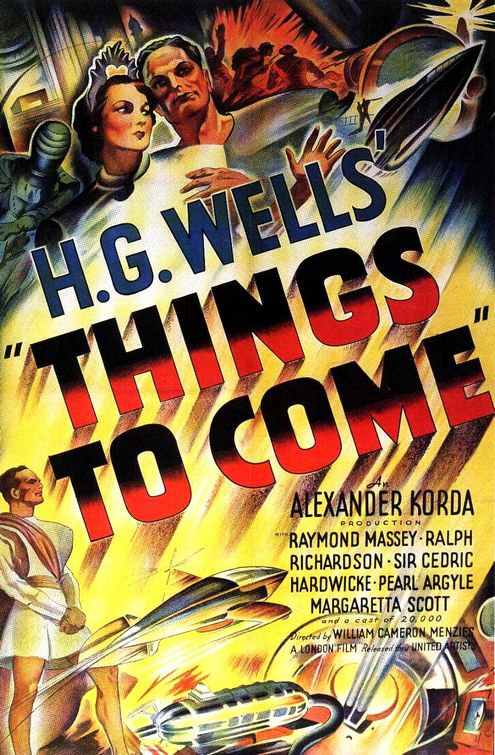
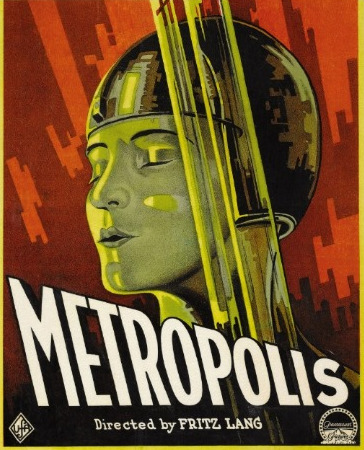
Things to Come (1936). Both films are visually spectacular and dramatically ludicrous cinematic monsters which were insanely costly in their day and huge box office train wrecks. Both films rose out of relatively poor reputations to become some of the most influential films ever made. But while one is one of the most recognizable and widely seen films of its time, the other has largely been forgotten by posterity, beloved by only a small legion of admirers. I believe that by looking at these two films in detail and as representatives of the problems inherent in depicting the future, we can nail down the basic challenges facing Tomorrowland.
Interestingly, you can't even make sense of
Things to Come without
Metropolis, since H.G. Wells explicitly intended
Things to Come to be a refutation of
Metropolis.
Things to Come is exactly what it says on the box: it is Wells' predictions, as a historian and futurist, of what the world can expect in its next 100 years. Specifically, it's a very accurate depiction - almost a documentary - of an impending real-world disaster, which slowly veers off into speculation as Wells shows how the troubles of mankind can be eradicated by a coming new world order.
Things to Come is basically Wells' blueprint of how to save the world, and the film is his how-to guide of how to rebuild following the global disaster.
I'm going to summarize
Things to Come in its entirely here because most people have not seen it and an understanding of its overall message is important to have on hand. This isn't really a movie you can "spoiler" - the events are less happenings and more excuses for characters to pontificate - but even so, if you insist, the next three paragraphs can constitute "spoilers":
Things to Come opens in 1940 in Everytown (London). Everytown is on the brink of war with an overseas nation, a war which many predict will never come (sound familiar?). War beaks out on Christmas Eve and Everytown is shelled nearly to rubble. The war becomes a drawn out battle of attrition which lasts twenty years and reduces most of the Western World to desolation. Near the end of the war, the unidentified enemy unleashes a toxic gas which causes a plague - The Wandering Sickness - which decimates half the world's population. By 1966, mankind is back at a point analogous to the Dark Ages.
Following the end of the plague in 1966, feudal warlords take control of territories, determined to rebuild and continue hostilities. Unknown to them, in Basra (!) the surviving scientists and engineers from the old world are building airplanes to form Wings Over the World - a benevolent technocracy which removes these dictators with the harmless "Gas of Peace" and unites the world under a single flag. From there, Wings Over the World rebuilds civilization harnessing all of the earth's natural resources as a series of futuristic underground cities where war and want is eradicated.
By 2036, mankind is engaged in a fierce debate about the ethics of a moon launch, while a disgruntled artist rallies a mob to stop the manned space flight and demand a return to the old ways, where life was passionate and short. The launch is thwarted and the first living humans are shot out of a giant rifle (!) into space. The film ends with an impassioned discourse on the destiny of mankind to inherit the stars.
Okay, if you could read those paragraphs without laughing at several points you are a stronger willed person than I. Yet despite the absurdity of the film, both in summary and while watching it, the film is completely serious about the grave nature of these predictions. How the film ultimately loses modern audiences is that, by positioning itself as a straightforward prediction of events which we know very well did not happen, the film proves to be consistently, sometimes bizarrely wrong.
For example, in the terrifying and gripping opening sequences - the parts of the film which do seem spookily prescient, almost a documentary of the near future - a great deal of debate occurs about the role of war on technological progress, a concern that Wells, the great pacifist that he is, places no stock in - he introduces a buffoon who continually reassures us that there will be no war, and whose rejection by the main character is a salient dramatic point. This blustering comic character does bring up the idea that wars can be a start to great technological advancement, which the noble main character immediately rejects - this same character will soon go on to become part of Wings Over the World and rebuild society. Only the characters who take Wells' position are depicted as being remotely sensible.

From our perspective, we know that World War II, in fact, was a spur to technological progress, and that these military projects eventually gave rise to the Information Age, which most futurists never saw coming. We know that the war did not last twenty years and that the immediate fallout was the Cold War and the space race, which put man on the moon some seventy years ahead of Wells' predictions. Space Race technology fueled innovations in home furnishings, food, drink, clothes, communications technology, the computer processor and that very same technology that put men on the moon was used by Walt Disney to make tiki birds sing and flowers croon.
Much of the unintentionally comic aspect of
Things to Come rises out of the gap between the film's urgent messages of warning and our own knowledge of what did actually occur. A portentous title card looms out of the rubble of Everytown:
1966, and as the film fades to the last vestiges of humanity scrambling through the wasteland, we smile and imagine teenagers listening to
Revolver in their bedrooms.
Despite this, H. G. Wells' faith in humanitarianism shines through every frame of the film, making
Things to Come simultaneously absurd and exhilarating, reassuring us even as it depicts the total destruction of our way of life. This makes it prime Tomorrowland material, even if Wells was a genuine futurist while Walt Disney was more of a industrial optimist: Wells wants to tear down all national and personal distinctions while Disney believes in the power of capitalism to achieve a future utopia. Interestingly, they seem to arrive at the same place, with Wells' Everytown of 1936 bearing more than a few passing resemblances to Walt Disney's Experimental Prototype Community of Tomorrow. There are even moving sidewalks which remind us inevitably of Peoplemovers. And while Disney's estimation of the need to start fresh is less extreme than Wells' wiping clean of the slate, the idea of staking out virgin land in the swamps of Florida is not too different, in the end, that Wells' escape via international disaster.
 |
| Things to Come, 1936 |
 |
| Walt Disney's EPCOT, 1966 |
In fact, if
Things to Come is unwarrantably but understandably obscure today, it may have more to do with the fact that the film's constant emphasis on its seriousness and specificity makes it seem like a fantasy to modern audiences even while its rhetoric and warning insists that it is not and thus creates an unbridgeable gap: What is the point, we ask? Audiences generally follow the film through its Christmas Eve, wartime and plaque scenes - The Wandering Sickness sequence looks like a primitive precursor to our modern zombie movies - but start to tune out once Wings Over the World, who strike us today as nothing but fancy Nazis, assume control of man's fate.
If it plays best as a total Buck Rogers fantasy, then the immediacy of Wells' message is lost. Once we lose Wells' message and think of
Things to Come as being set "once upon a time" instead of "happening at your house
tomorrow", the effect is diluted. Despite a fantastic new edition of the film by the Criterion Collection,
Things to Come is likely to remain a remote and faintly ridiculous cult item, a warning from the past of a future that did not come anywhere close to reality.
In contrast, let's look at Fritz Lang's
Metropolis, perhaps the most famous and accessible of all films made in the silent era.
Metropolis tells a story set in a gigantic city of skyscrapers where the rich idle aimlessly in arenas and gardens of light while the poor labor below in an underground city where they slave on dangerous machinery. The son of the god-like master of Metropolis falls in love with a Virgin Mary-like Maria who pleads the workers to peacefully wait for a "mediator" to bring the city together. Discovering this, the master of Metropolis goes to a mad scientist who has created a humanoid robot. They agree to kidnap the saintly Maria and disguise the robot as her. The false Maria incites the workers to riot, and they attack and destroy the machinery of Metropolis, inciting a biblical apocalypse. In the end, order is restored and the son of the master of Metropolis steps forward to be the mediator between management and labor.
First, you probably noticed how much simpler that story is, despite
Metropolis being a full hour longer than the longest available print of
Things to Come. What you may
not have noticed is that
Metropolis is not set in the future. Ironically, despite being one of the most influential works of science fiction of the 20th century,
Metropolis isn't so much about the future as it is about modernity in general, and Germany of the 1920s in particular. The film is an allegory for contemporary society, and indeed Germany in the 1920s actually was spiraling into a real life apocalypse. This is why Lang and his team of designers don't include many key elements of the visual lexicon of science fiction, like crazy vehicles - the cars and planes of Metropolis look like cars of the era. The clothes look like 1920s fashions instead of jumpsuits or
Things to Come's weird toga-robes. Yet weirdly this "fashions of 1927" effect also enshrines Metropolis in its own timeless look: the fashions look just universal enough to belong to anytime in a way that "futuristic clothes" in many SF films only yank us out of the period.
But really, do we need to look any further than the very first page of the novelization of
Metropolis, written by screenwriter (and Mrs. Lang) Thea Von Harbou?
"This book is not of today or of the future.
It tells of no place.
It serves no cause, party, or class.
It has a moral which grows on the pillar of understanding:
'The mediator between brain and muscle must be the heart.'"
So far as I know, the first author to propose seeing Metropolis as an allegory rather than as a Science Fiction film was Tom Gunning in his book "
Fritz Lang: Allegories of Vision and Modernity", and when we take this tactic, a number of questions which otherwise seem unanswerable begin to fall into place. For example, the lack of traditional SF trappings beyond the robot:
Metropolis' robot may have inspired C-3PO, but it has only a few minutes onscreen before it is turned into the "false Maria". Similarly, the film's overall structure counterpoints very sleek, modern visions with very ancient ones - catacombs, the Tower of Babel, the Moloch god of sacrifice (Von Harbou seems to have lifted this from
Paradise Lost), a Grimm's fairy tale cottage, a church, the Biblical apocalypse itself.
Metropolis combines and codifies all of the impulses of its day into one meta-text of modernity, everything from abstract sculpture to Mendelsohn's Einstein Tower.
 |
| The Einstein Tower, Potsdam |
Despite its numerous chases, explosions, and special effects, its message seems to be no more complex than this poster, which could be seen everywhere around Berlin in the 1920s:
 |
| "Berlin, stop and think! You are dancing with death!" |
 |
| Metropolis, 1927: The dance of death |
The poster's imagery of a young woman and a bare skeleton is even closely repeated in the film's famous catacombs sequence.
This, then, is the basic root of the bulk of the complaints the film has raised over the years, including by H.G. Wells, who took offense to its ludicrous action-adventure pulp. Wells was convinced that audiences would leave the theater insulted that such a wildly improbably version of the future was being presented -- but then of course depicting any future was never Lang's goal.
And here's the kicker, the big joke: we are a lot closer to Lang's future than Wells'. While
Things to Come may evoke unintentional laughter,
Metropolis brings shivers of recognition. We
do live in a world sharply defined between haves and have-nots, of riots and organized protest. Our lives
are governed by technology and we are being replaced by our creation. Our cities don't look like the organized, air conditioned, plastic Everytown of 2036, but like Lang's modernistic hellscape of concrete, glass, traffic jams and elevated highways. And despite what we may like to pretend, those old impulses and that old religion keeps bubbling up through the cracks of civility like the destruction of the workers' barracks. We all live in
Metropolis today, and this is why this film, nearly ninety years old, still obsesses and enthralls audiences to this day. Wells was blinded by his belief in his infallibility and missed the mark almost totally; Lang just wanted to make a movie about robots and invented a crazy fantasy to justify it, but he correctly read the course. This is why
Metropolis is, paradoxically, both much more dated and much more relevant than the somewhat comparable
Things to Come.
It's also why
2001: A Space Odyssey seems ever relevant. Kubrick and Clarke didn't correctly predict everything - their
2001 depends on the everlasting continuation of the Cold War - but in the end, their monolith is a vision that never ages, because it's nothing but a black board, a visual placeholder for something unfathomable. Similarly, Lang's
Metropolis looks like nothing else so it doesn't date. Both films deal with abstract ideas more than they do with the practical possibilities of, say, inventing new textiles or determine what a 2036 airplane would look like.
Because here's the key lesson: all the great movies
set in the future aren't
about the future at all. This is the Big Point that Tomorrowland keeps missing. Ideas, fashions, cool shapes, colors, all of those variables change, and even ugly buildings and politicians can, one day, become respectable. But all great Sci-Fi and any great Tomorrowland must be built on
thematic concerns, not visual concerns. We can keep painting the buildings different shades to match the fashion of the moment, but if the basic buildings underneath that paint don't express something universal, the problem will just keep on renewing itself, like a mobius strip.
Humans don't really change all that much, and this is what the best SF material understands. We are not the world we create. This is why the most dated SF material isn't dated because it fails to invent a crazy enough world, but because it is based on an outdated view of society. A truly timeless Tomorrowland needs to address everlasting human concerns.
What Tomorrowland should really be about is people, and the problems we face as people. This is why so many of EPCOT Center attractions (the ones WDI closed in so much haste) still seem so far ahead of us while Tomorrowland always seems so far behind us. More than any other area of the "castle" style theme parks, Tomorrowland, at its core, doesn't need to be about predicting "the future" so much as the timeless and tireless human struggle. The whole "future" thing is just a shopworn literary conceit - it allows us to imagine ourselves out of the narrow space of our bodies, this theme park, our lives, and allows us to imagine ourselves as beings of the infinite. We can take a God's-Eye-View on our progress as a race.
That's why the "Theme Architecture" works so well. In a theme park which depicts diverse locations and styles, the "Tomorrowland look" is a loophole that allows us to pass easily into abstraction. It's not a British colonial boathouse, an American wild west saloon, or a medieval European village; Theme Architecture is line in motion, architecture as vision. It should challenge us to think outside of the boxes in which we place ourselves. And Tomorrowland, and Space Mountain, like any church, is white, and covered in spires, all of them pointing up.
To heaven? Or beyond the infinite? What is our destiny?