Now Available! My newest book!

Saturday, October 16, 2010

Good News from the Vacation Kingdom

It all started with... Marty Sklar, believe it or not.

No, not the Walt Disney Company, and no, Marty has not regressed through time to usurp Mickey Mouse as Walt Disney's greatest creation. But anybody who knows Sklar and especially vintage Disneyland promotional publications knows the strong hand Sklar had in shaping the public "voice" of Disneyland and, later, Walt Disney himself. As relayed in issue 30 of the late, great E-Ticket Magazine, Sklar's very first job for Disney was in creating the "Disneyland News" paper souvenir sold on Main Street, USA for the first few years of the operation of the park. As Sklar says in his interview,

"The original summer, we sold 75,000 copies of the Disneyland News at ten cents. That was what Walt wanted. He wanted people to have it, and to get the world out about Disneyland, so ten cents was the price. [...] The newspaper was initially used and distributed to motel and hotel operators in the Southern California area, and then we decided we needed something a little slicker than that. That's how the Disneyland Holiday magazine came about, and we broadened that out and distributed it to Arizona... to anyplace that was within a day's drive of Disneyland. We started the Disneyland Holiday magazine, and then when Holiday Magazine threatened to sue us, we changed the name to Vacationland Magazine."

Our article today does not focus on Disneyland publicity, but in this story we can see the seeds of the Walt Disney World publicity machine coming into being. Walt Disney World did indeed open with editions of Walt Disney World Vacationland magazine, and it was distributed throughout the southeast -- I have one stamped "ST. PETERSBURG KOA" and each issue featured advertisements from local area attractions such as Busch Gardens and a Disney-penned article about places and things to see in the Florida area, such as Tampa Bay's Gasparilla festivities or Old Key West. The back page of every issue was a full page ad for Cypress Gardens, an attraction Disney would help put out of business 35 years later. So Walt Disney World Vacationland was directly descended from Disneyland News, but perhaps surprisingly, Disney would also print a promotional newspaper - not for external circulation, but internal - and this time, it would stick around for some twenty years.

Walt Disney World News, as it was initially called, was a basic but richly detailed four or eight page "periodical" published once a month, detailing what to do and what to see around Walt Disney World. It was distributed to hotel guests in their check-in folder and also to Magic Kingdom visitors at City Hall and the Gulf Hospitality House, and may have in fact been the first ever Magic Kingdom guide map, as the familiar GAF guides did not begin publication until 1972. The center of Walt Disney World News issues featured a luxurious two-page spread on the Magic Kingdom, her attractions and facilities, and a very large map.

In a way this was a smart idea because one cannot go anywhere near a Walt Disney World News without absorbing an enriching wealth of detail, and being forced to leaf through a newspaper to find your way around a theme parks means you're going to be thumbing past pictures and text about recreation, golf, the Contemporary Resort and the Polynesian Village, and in those early days Disney was especially concerned about getting the world out about all the other great things in Walt Disney World beside the Magic Kingdom. One of the great treasures of these publications are the faux ads, comic strips and assorted silliness they featured on a regular basis for the first ten years, either as "ads" or just strange asides to the reader.

So let's turn back the pages of history and flip through some of Walt Disney World News' highlights. And of course no look at the first ten years of the publication would be complete without an opening look at the headline itself.

This classy, original logo was the very first (you can see this comes from Vol. 1 No. 1 in the lower left there) and persisted until at least late 1975. Long before color invaded the newspaper in the mid 80's, Walt Disney World News was printed in a restrained dual-color system, black and white text and grey scale photos with a bold splash of colored headlines, the color changing each month. February 1972 was light blue, for example, and July 1972, shocking florescent green. It was tasteful, restrained, attention getting and pleasing.

This strange interim version lasted only one year - 1976 - but the new name, "World News", would be resuscitated for use in the mid and late 80's.

This logo closed out the first decade, from 1977 to 1981.

...before becoming this, for the resort's "year-long, smile-wide" (ugh) promotion. The Walt Disney World Tencennial, by the way, is probably Disney's best ever Disney World promotion, because it lasted an actual 12 months and ended with the opening of EPCOT Center.

Early issues of Walt Disney World News featured some strange oddities, including these memorable ads for obscure facets of the Vacation Kingdom:


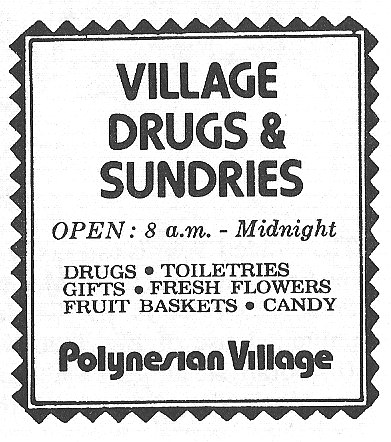
This was back when the Pro Shop was stranded way out all by herself with the Palm Lounge and Magnolia Room in the Golf Clubhouse, years before it was expanded into a hotel, and so may have needed all the advertising she could get! And don't forget to buy your daily Fruit Basket at the Polynesian Village. Mahalo!

...and an opening day television listing and advertisement brings the 1971 WDW News home. I love that that Wonderful World of Disney gets her own section of the television listing. The idea of watching that splashy, bizarre 70's intro to Wonderful World of Disney in the comfort of your brand new Polynesian Village room, Cinderella Castle glittering across the Seven Seas Lagoon, is my idea of paradise. Maybe in a former life.

These glorious and exciting advertisements come to us from a June 1975 Walt Disney World News. The color that month was a pleasant pine green, as can be seen. I can't think of a single better sell for the Hoop-Dee-Doo than we have here. In fact, it makes me want to go see it right now.

It's 1976 and things are aqua blue as the cool guy with the sunglasses attacks us because we haven't yet been to the Contemporary Racket Club! I don't know who those "Pros" are we see above us in the Golf Resort ad, but I do love the tag line "And challenging golf. For you and the pros. At the Golf Resort." Since we learn in this issue that the Trophy Room now features fondue there's a double incentive to go.

This is the byline for an "article" about the Palm, Magnolia, and Lake Buena Vista golf courses, and it simply cracks me up. Who is "Murph" and how do we known we can we trust his advice?? Certainly his name conjures up images of some old guy in a floppy white bucket hat clenching a pipe between his teeth as he sinks that perfect Birdie on hole 12, but again, why just that enigmatic name... Murph? Not Murphy. Just... Murph. Whoever he was, Murph breathlessly advises: (you should read this aloud with great importance)
"But the Magnolia's most awesome 'monster' is number 17, probably the toughest hole of all of the Walt Disney World courses. This par four beauty has frustrated scores of pros and ameaturs alike. The tee shot, past water on the left and a virtual jungle on the right, must be a long straight ball."
Murph: Walt Disney World's greatest forgotten character.

Below is the byline for "Talk from the Top", a monthly article detailing who will be performing at the Top of the World supper club and when. This makes for strange reading for those of us 35 years later who are not primed to recognize names like Marilyn McCoo or Buddy Greco. This feature had been running in WDW News since the very start, but for some reason in 1976, and only in 1976, is it a "column" complete with a byline. It's anybody's guess if Barbara Stuart really existed!


April 1978 brings the handsome 70's-looking-guy at the Racquet Club, the soon-to-be-ubiquitous "Like To Extend Your Vacation" ad, and a very nice look at the "Sun Banks" logo, now Sun Trust. Sun Banks' building across from the Walt Disney World Village was brand new back then and today survives as a rare unchanged pocket of 1970's Disney goodness.

I've always found this drawing of Jose to be fascinating, perhaps because he doesn't seem to actually be speaking into the phone. This ad is reprinted in French and Spanish directly below the English text I've scanned here, by the way. In 1982, Disney put the French text above the Spanish.


And the 1982 WDW Information Channel listing brings home our brief tour of the first ten years of Walt Disney World News. Of course it's only the smallest taste, not representative of the wealth of detail, information and evocative writing these wonderful time capsules possess. Still, I hope it whets your appetite for more or just provides a look into the distant past of Walt Disney World, an echo of an era that seems more remote with each passing day.

Sunday, October 03, 2010

Shakedown at the Magic Kingdom

Walt Disney World is full of hidden history - experiments that didn't last, ideas that didn't make it, things that have either forgotten about or totally elided. These are, of course, the areas that the intrepid Walt Disney World researcher seeks to illuminate, but more often than not she's going to find herself at some opaque but inevitable dead end. Sometimes, however, a pattern begins to emerge, and today we're going to plunge very deeply into speculation and informed guessery. Sadly the decisions which shaped the history of the Magic Kingdom are largely not recorded or, if they are recorded, they're not available to consult. But the evidence speaks loudly. Something very significant happened in the early months of Walt Disney World, something that shaped Disney's design strategies for a very long time, and that something has a lot to do.... with food.

First, some on the ground reports.
"The theme park... the Magic Kingdom, was built exactly the way Walt Disney always intended it.. [...] We called it "the vacation kingdom of the world". I wrote that slogan, too. Before this, nobody went to Orlando for a vacation... nobody. In the late sixties, we were totally focused on Walt Disney World, of course. The company had made the decision, in late 1967, to go ahead with it. From then on, we just ran as fast as we could, to get that project open. We really didn't have a breather because we had to meet some surprising demands from the public. Buzz Price had originally projected six million people for Walt Disney World's first year. By the time we were really building the Florida site in 1969, Disneyland was already getting eight million a year. We tried to increase the capacity to handle eight million, and we felt a constant pressure during the Florida development. [...] But soon we were doing over ten million the first year alone." - Marty Sklar, The "E" Ticket, Number 30, 1998

"Nearly 40,000 visitors – the biggest crowd yet – jammed Walt Disney World turnstiles Saturday as the $400 million “Magic Kingdom” kicked off its three-day formal opening celebration with the arrival of a plane-load of Hollywood notables. [...] Crowds have increased steadily since the Oct. 1 opening for a three-week “shakedown” for employees and attractions. Opening with 10,400 visitors, the park had averaged around 15,000 daily with 20,000 to 25,000 on the weekends." - Orlando Sentinel, October 24, 1971

"The day after Thanksgiving, traffic ground to a halt ten miles up International Drive. By 2:00 in the afternoon, with thousands of cars crammed in and around its parking lot and 56,000 guests squeezed inside the park, Disney was forced to close the access ramp leading off Interstate 4. All four lanes of traffic slowed to a crawl in both directions, creating a 30-mile stretch of confused, angry motorists. Inside the park, guests had to wait two hours or more to ride the submarines, Country Bear Jamboree, and other top attractions. [...] There were also not enough restaurants nor time to instantly build them. Instead, Disney set up temporary quick-service stands throughout the park. In Fantasyland, a tent-like structure went up to sell hot dogs and hamburgers, and another sold pizza." - David Koenig, Realityland
Now anybody who's been to both Disneyland in California and Walt Disney World in Florida is bound to play the comparison game; in a way it's unfair to both attractions but in another it is indeed invited. Tony Baxter describes it perhaps most charitably when he terms Disneyland "charming" and The Magic Kingdom "spectacular". Although the difference isn't too shocking when comparing strictly acreage - 85 acres versus 107 acres - Disneyland is simply stuffed to the gills with stuff. As a result we find attractions stacked on top of each other, shops wedged strangely into the spaces between and restaurants often filling as much pedestrian space as they dare. Viewed today, especially compared to the cavernous meal spaces regularly offered to Walt Disney World visitors where space is not at a premium, major Disneyland eateries seem more like upgraded snack bars with two dozen extra tables.

If we go back in time and think about major food offering at Disneyland in 1971, you basically have the Plaza Pavilion, Coke Corner and Plaza Inn on Main Street, The Tahitian Terrace in Adventureland, The Blue Bayou, Creole Cafe, and French Market in New Orleans Square, the Casa De Fritos, Golden Horseshoe, and Aunt Jemima Kitchen in Frontierland, and then the Captain Hook Pirate Ship in Fantasyland and the Tomorrowland Terrace in Tomorrowland, and none of them are especially huge. Of the twelve mentioned above, five of them are table service restaurants. And of course there were plenty of snack stands and smaller cafes located between as well, like the Hills Brothers Coffee House on Main Street.

--

Now let's compare that to what the Magic Kingdom offered in 1971. There was the Town Square Cafe, Refreshment Corner and Crystal Palace serving Main Street, with the Adventureland Veranda, The Liberty Tree Tavern, King Stephan's Banquet Hall, the Pinocchio Village Haus, and the Tomorrowland Terrace pulling for the rest of the park. Yes, that's about it. In terms of quick service, high capacity locations, the list is even shorter: Adventureland Veranda, Pinocchio Village Haus, and Tomorrowland Terrace.

Gentlemen... THE FUTURE!

The Mile Long Bar in Frontierland is listed as being open in an October 1971 Walt Disney World News, but an internal cast publication indicates that it wasn't ready until mid November. Pecos Bill Cafe next door wouldn't be on-line until December, and was therefore of little use to Disney in dealing with those nightmarish Thanksgiving 1971 crowds. Since the same issue of Walt Disney World News makes no mention of the Westward Ho shop next to Country Bear Jamboree, we can assume that it was not ready until later and that the walk from Country Bear Jamboree to the Davy Crockett Explorer Canoes landing was a long walk past seemingly empty facades. Everything West of Country Bear Jamboree was unfinished.

The single restaurant listed for October 1971 in Liberty Square is the Tavern, although Sleepy Hollow Refreshments is listed on late 1971/early 1972 souvenir maps, meaning it may have been accidentally excluded or simply wasn't ready for opening day. The massive multilevel, multikitchen (remember that there was a serving counter upstairs until the late 1980's) Columbia Harbour House would not bow until mid 1972 and hadn't even had her name decided - on an early souvenir map the restaurant is called the Nantucket Harbour House. The Diamond Horseshoe was ready but was not treated as or expected to be used as a restaurant, always listed as an attraction. The sole shop that was ready - the tiny Tricornered Hat Shoppe near Frontierland - stood alone, for the bulk of Liberty Square's shops would not open until early 1972.

Missing from early maps and listings are two fairly significant Fantasyland establishments - Lancer's Inn and The Round Table - walk-up, take out restaurants occupying the space between Snow White's Adventures and Mr. Toad's Wild Ride, meaning this stretch of facades across from the Submarine Lagoon was a possible original home for the Fantasyland Art Festival portrait artists. Lancer Inn and round Table do appear together on early 1973 maps, likely replacing the temporary tents described by Koenig. Instead, a new building near the Mad Tea Party was built to house the portrait artists, until a new juice bar moved in and displaced them once again in 1979. Lancer Inn and Round Table can today be observed in relatively untouched form as Mrs. Potts' Cupboard and The Friar's Nook.

Look in the background for a peek at The Round Table -- Photo from Daveland

Tinkerbell's Treasures, Merlins Magic Shop and the Aristocats Gift Shop didn't seem to exist, rendering the Cinderella Castle Courtyard another empty stretch of facades. Tomorrowland fared the worst of all, offering only the Grand Prix Raceway, Skyway station, a shop at the base of the Skyway station near the restrooms, and the Tomorrowland Terrace.

Now between 1971 and 1975, when Card Walker declared Phase One of Walt Disney World complete, Disney did indeed add shops and attractions all over the Magic Kingdom... but most of what they added was restaurants. Astonishing numbers of restaurants. Based on the information above and data I've compiled elsewhere, the roster looks something like this:

1972
The Fife & Drum Snack Bar
Columbia Harbour House
The Lunching Pad (inside the Space Port shop)
The Round Table
Temporary outdoor cafeteria near the future site of the Carousel of Progress

1973
Lancer Inn
Aunt Polly's Dockside Inn
Cantina (inside the fort on Tom Sawyer Island)

1974
El Pirata y el Perico snack stand
The Plaza Restaurant
The Plaza Pavilion (bridging Tomorrowland and Main St. on the south side)

1975
The Space Bar (base of the Peoplemover platform)

That's twelve additional food service locations - two of them massive and one offering table service and requiring Card Walker's elaborate Swan Boats to move to a newly built boarding location on the hub. The fact that Disney closed the original Swan Boat Landing and moved the operation of an attraction - one designed explicitly to increase capacity - to make way for a restaurant carved out of the old Borden Ice Cream Shoppe shows where Disney's priorities were.

It's easy to imagine their terror. It can be sensed in Marty Sklar's quote above. WED had given itself five years, in 1969, to exceed attendance of ten million. They succeeded in less than a year. But even worse, the park and resort was stretched to it's maximum almost immediately. Construction on Villas in nearby Lake Buena Vista began in November 1971. In 1972, the tiny clubhouse for the Palm and Magnolia golf courses was already being built out into a 151 room resort. Fort Wilderness expanded in 1974 and the Polynesian in 1978. Restaurants, bars, and dinner shows were added all along the way. It all speaks of a panicked response somewhere in Disney's corporate corridors - call it the Phantom Food Scare of 1971. The evidence is everywhere, except for the evidence of the panic itself.

If the numbers aren't compelling - opening nearly twice as many eateries as attractions in a four year span - then perhaps heading back to Disneyland will make the case clearer. Bear Country, opening just six months after Walt Disney World, was the first major addition to Disneyland since The Haunted Mansion in 1969, and existed primarily to add the extremely popular Country Bear Jamboree. Since the Florida version was then regularly commanding a three hour line which could only move every fifteen minutes or so (which means that besides the group in the theater - 350 people - there could be nine additional full theater loads of guests waiting outside and in the lobby, or over 3000 people, or about 15% of the park's total attending crowd), WED built two identical theaters back to back, and placed them in a new area of Disneyland which could accommodate a massive exterior queue. Next to the new attraction Disney placed a massive multilevel restaurant, The Hungry Bear. Even thirty-eight years later it still ranks amongst Disneyland's most massive.

In fact, everything added to Disneyland following the opening of Walt Disney World was built on a scale quite unprecedented in Walt Disney's little family park. Pinocchio Village Haus, if not quite the cavernous dining hall found in Florida, was added to the Anaheim Fantasyland in 1983 and offers seating for several hundred. The entire Flight to the Moon / Mission to Mars attraction was ripped out to make way for a huge new indoor restaurant as part of the ill-fated Tomorrowland expansion of 1998. Today even the intimate Blue Bayou is stuffed to the gills with tables and chairs, far beyond the original intentions.

Clearly Disney's facilities had been severely taxed in the effort to get Walt Disney World open and make it a success, and to paraphrase Sklar, the "surprising demands" from the public touched off a mad scramble to stay ahead. In the process, Disney's methods of evaluating the anticipated level of demand and their idea of scope had altered dramatically.

--

Today in the era of bicoastal Disney passes and special events it's easy to look at the scope of the Magic Kingdom versus the Disneyland original and see something lacking or - perhaps more pointedly - see the start of the sort of thinking that would lead to the massive, monumental open spaces of Tokyo Disneyland and EPCOT Center, and perhaps something strangely impersonal. And although the Magic Kingdom does not lack for quiet, intimate corners, those massive walkways are still dwarfed by later inventions such as Communicore Center or any old walkway between buildings in Tokyo Disneyland. In Florida the scale of the street may be wider, but the scale of the buildings are built to match. Main Street may be twice as wide but the Main Street facades are bigger and taller, and the castle is enormous, costing alone what all of Disneyland cost in 1955.

What we have here then, apparently, is not just a key moment in the operation of the Florida property or even a key turning point in attendance at Walt Disney World but an opportunity to localize at a specific time and place the moment where Disney's theme park design strategy shifted radically, and the key to uncovering this secret history is in the food offerings of the Magic Kingdom. The Magic Kingdom was built up to hold 80,000 people, and EPCOT Center can easily accommodate 120,000. It's easy to spin alternative scenarios from this. Had there not been a massive strain on Disney's resources to keep people fed and happy in 1971, would Tomorrowland have been built in the way it was? Are the massive open spaces in the east and south area of Tomorowland direct descendants of that Thanksgiving day in 1971?


This blueprint of the Magic Kingdom is dated 1971. The finished park followed this blueprint pretty much exactly... except for Tomorrowland. This is the version of Tomorrowland with an Autopia instead of a Grand Prix, a monorail running through it on its way to the Persian Resort, and a Space Mountain contained inside the railroad tracks. Even the railroad tracks followed this blueprint exactly, possibly indicating that as of 1971 Space Mountain was still going to be built inside the plot of land within the Walt Disney World Railroad's "wooden o". So why was it built outside the tracks in 1974? Why did Disney bother to tunnel under the tracks instead of build inside them? Why keep a massive open concrete area when nothing else in the park resembles it? Something changed between 1971 and 1974, and my instinct is that aesthetics was only half of the equation.

There's a famous picture of cars lined up along World Drive waiting to get into the Magic Kingdom on Thanksgiving 1971. Even Disney, ever concerned about protecting their public image of efficiency, talks about that day. If the Magic Kingdom of October 1971 is Disneyland with the "expand button jammed", simply a bigger and fancier copy, then Thanksgiving 1971 is the place and time when Disney's entire approach to the design and construction of their theme parks would change forever. If we follow that herd of cars to their end at the horizon-line, what do we find? I suggest: nowhere real, they point towards the future. Already they're queued up to enter EPCOT. The line forms here.

--

Reference:
The E Ticket Number 30, Fall 1998 "Imagineering and the Disney Image... an interview with Marty Sklar"

"40,000 Jam Disney Turnstiles; Three-Day ‘Opening’ Under Way" by Jack McDavitt, Dick Marlowe. Orlando Sentinel, October 24, 1971

"Walt Disney's Disneyland" by Martin A. Sklar, 1972
"Walt Disney World Information Guide Compliments of GAF", 1972, 1974, 1975
Walt Disney World News, Vol. 1, No. 1
Walt Disney World News, Vol. 2, No. 7
Walt Disney World Vacationland Summer 1974
"Your Complete Guide to Walt Disney World", 1977, 1978, 1979


(This post is part of the Disney Blog Carnival Number 11. Click to enjoy more Disney blogs and all sorts of other stuff!)

Wednesday, August 25, 2010

Showdown at Castle Court...

From the early 70s Walt Disney World pictorial souvenirs, comes this, one of the strangest, most memorable images ever to grace the interior of one of those little treasure troves of Disney photography...

Fantasyland was never quite the same... after Dixie-Leigh rode into town!

It may be just a photograph of a kid facing down a dwarf, you say, but I say: look closer. The strange distance. The slanting shadows. The Stimmung. What unspoken past history lies between these two? Is the child here to avenge her family? Is it pistols at dawn? So much of early Walt Disney World photography is memorably opaque such as this, photographs just suggestive enough of some unspoken larger context that you'll always remember, say, the cool guy speeding past a blurry Contemporary Resort in his Grand Prix racecar - the wind in his afro - or the girl walking, all alone through Frontierland, tentatively tugging down the edges of her massive gift shop Sombrero. The old guy, leaning out of a Persianesque window in the heart of old Adventureland, to admire a "Magic Carpet". Or the Dad with the thick rimmed glasses - who looks like Gene Hackman - spinning merrily in a yet-to-be-covered Mad Tea Party. They're strange and memorable and sort of dopey, just like real guests at Walt Disney World still are.

So go ahead. Write your own caption for this immortal bit of early Walt Disney World weirdness I affectionately call Child Vs. Dwarf.

You know you want to.

Friday, August 20, 2010

Snapshot: Olde World Antiques

"The furniture, tools, paintings, and other authentic European relics of the shop remind Disney guests of the tremendous foreign influence prevalent in our nation since its birth. These antiques, and the goods in all of the Liberty Square shops, reflect the mood of America's struggling years to independence, when immigrants from all over the world settled in the new colonies and brought with them their respective cultures and traditions." - 'Liberty Square's Yesteryear Shops', Walt Disney World Vacationland, Summer 1975
Add Image
Truthfully, we would all be very blessed if every seemingly minor aspect of early Walt Disney World were as well documented as that longtime mainstay of Liberty Square, Olde World Antiques. It gets rather extensive coverage in almost every Walt Disney World souvenir publication up until the early 1990s, usually warranting at least an interior picture and a mention in the body of the text, an honor which was rarely granted to attractions such as If You Had Wings or Mr. Toad's Wild Ride. And while Disney apparently never bothered to publish photographs of the early interiors of something like the Heritage House or the Magic Shop, it's startlingly easy to find documented evidence of what Olde World Antiques was all about.

In a way, this may be a reflection of the prestige Disney attached to this shop in particular. David Koenig relates in Realityland: "Resort-wide, the [Merchandise] department was led by Jack Olsen, a heavy-set old-timer, who usually dressed in shorts and a golf shirt and constantly preached that his stores were not factories. He wanted them operated first and foremost as part of the show, rather than designed and operated to maximize profit. Even though souvenirs imprinted with Mickey Mouse and other characters were the best selling merchandise in the park, none were sold in Adventureland, Frontierland, or Liberty Square. Everything had to be themed to the period."

Koenig then quotes a manager of one of these shops, who says: "Disney had very little business knowledge. Anything Jack Olsen wanted was okay. It didn't matter what it cost.... The antique shop in Liberty Square made about $100,000 a year - but spent $1 million! Money didn't mean a thing. They were movie people, there to put on a show."


So obviously some of the prestige of Olde World Antiques comes from its status as "part of the show", if a very elaborate and fanciful version of the show. Some of the emphasis may also be placed because of the shop's connection to the Disneyland original, the One-of-a-Kind Shop, apparently a Walt Disney creation. Stories of Walt Disney scouring the Crescent City for real antiques for his miniature New Orleans circulate to this day, and his haul apparently included furnishings for Club 33 and a big brass espresso machine for the Creole Cafe (Kevin Yee tells funny stories about being assigned to polish the huge and totally inoperable thing). Being in the antiques business even became something of a tradition for Disney, which at one point operated three distinct antiques shops - The One-of-a-Kind Shop, Olde World Antiques, and Von Otto's Antiques at the Walt Disney World Village. The Liberty Square shop outlasted them all.

Olde World Antiques was really three compact shops in one - Mlle Lafayett's Parfumerie, accessable directly from the rear of the shop facing Main Street, the Silversmith to the West, with the antiques shop rambling between and into them both. Vacationland had this to say about the Parfumerie in 1975:


"Time has not softened the desire of ladies and gentlemen to dab on a essences of imported perfumes and colonges. Sweet and spicy scents, drifting into Olde World Antiques from Mlle Lafayett's Parfumerie, entice guests into this little French-decor shop.


Among the crystal and china atomizers, soaps, pressed powder sachets and potpourri, are hundreds of popular and hard-to-find perfume products, including famous French lines. Yet, if a guest prefers a more personal fragrance, the hostess will custom-blend a perfume, choosing from the shop's seven basic perfume oils, ranging from the sweeter floral and citrus notes to the more heady scents of spice and musk. Then, each custom blend is numbered and recorded so that the guest may later re-order that same perfume without being present."
In light of this sort of thing, perhaps it's more understandable now why Disney once offered Shopping-Only passes to the Magic Kingdom around Christmastime. I have no photos showing the full interior of this cramped little nook, but here's an unusual image of the exterior entryway from the backside of the building, photographed totally by accident as part of the background of a picture of the Fife and Drum Band The Ancients doing their show:


The Silversmith, of course, existed mostly to lend atmosphere to the square, and any long-time Magic Kingdom visitor who remembers the beautiful silver pieces lined up in the windows, glinting in the Florida sun, will likely best understand the tactile loss this shop represented when it switched to generic Christmas items. Aside from that rather abstract addition, the Silversmith also name-dropped Johnny Tremain as the proprietor, which forged a very strong link to the nearby Liberty Tree via the fictional history of Tremain's apprenticeship, hanging of the lanterns in the liberty tree in Boston, and of course the Disney film made from it.

(Of course this detail may also have brought consternation for those of us forced to read through that book in elementary school, since obviously Johnny Tremain could hardly own his own silver shop because his hand was totally crippled in the first third of the book and most of us stopped reading it halfway through and cheated on the test. Either way, you remembered it when you were a kid, which can't be said of every detail you'd run past on your way to the Haunted Mansion.)


As for the antiques themselves, Disney took their stead quite seriously, and even hired an antiques buyer especially for their three shops: Otto Rabby (left), who was interviewed for Walt Disney World Vacationland in 1973. You may find the opinions expressed so long ago by Rabby and by the Disney company themselves to be refreshing and just a bit saddening:
"The antique shop at Walt Disney World deals exclusively in objects from abroad. Once, and sometimes twice, a year, Otto spends eight weeks searching for unusual items in Italy, France, England, Denmark, Holland, Austria, Spain and Germany. He deals only with reputable agents who, through long association, have learned to anticipate his requirements.

'Primarily,' he explained, 'I try to find objects that will interest, amuse, and attract as wide a variety of people as possible. The joy of my work is in finding the truly unique item that one sees perhaps once in a lifetime. Of course, I always look for certain qualities in a piece - good design, craftsmanship, authenticity, and an intangible thing I call "personality." An antique, by its very nature, in intriguing. It has a story to tell. I try to find out the personal history of every item I buy - who made it and for whom? Why was it sold? What happened to the original owners? If antiques could talk, they would put novelists out of business.'


Well, possibly. But as one looks at the bronze, 18th-century chandelier, complete with coiling cobras and gruesome gargoyles, that hangs in the shop, fantasies reminiscent of Edgar Allan Poe are brought to mind. And the gay but silent rocking horse from England, still bearing the scuff marks of its tiny rider in 1780, stirs up memories of Jane Austen nurseries and comfortable nannies.

'Our shops are essentially attractions for our guests,' continues Otto. 'We want people to feel free to visit and to browse, to ask questions and to share antique anecdotes with the shop host and hostesses. It isn't nessicary to buy antiques to enjoy them. We have many guests who return time and again, simply to look at an item that has struck their fancy.'

Guests not only return to visit with Otto and his associates but telephone from as far away as Australia to order antiques they have seen and can't forget. The shops have excellent shipping and crating facilities and will deliver anywhere in the world. Any antique purchased at Walt Disney World is guaranteed to be exactly what it purports to be - and that includes place and year of origin, quality of craftsmanship, and authenticity."

Olde World Antiques continued to meander along until the mid 90s, when the plug was finally pulled to make way for an expanded version of a shop which had been operating in Fantasyland under the name Mickey's Christmas Carol since the late 80s. The Mickey's Christmas Carol location became Sir Mickey's at the same time and so Otto's antique collection, all the silver, the perfume, and the antique rocking horse left the Magic Kingdom forever.

(look to the right for another view of Otto's 1780 rocking horse)


(This post is part of the Disney Blog Carnival. Click to enjoy an onslaught of Disney news and info!!)

Sunday, August 01, 2010

The Art of the Hall of Presidents

"The skills of the sculptor, the talents of the artist, and marvels of space-age electronics make history 'live' inside The Hall of Presidents in Liberty Square. Sculptors spent two years creating life-size heads of all 36 American Presidents; a dozen artists painted 82 scenes in the style of famous painters of the period portrayed. Walt Disney originated the show concept in 1956, searching for 'a different and exciting way' to dramatize our American heritage." - The Story of Walt Disney World
"Literally hundreds of Disney artisans, designers, craftsmen, and technicians collaborated on 'The Hall of Presidents' attraction. Painstaking research, exacting execution, and technical innovations were required in order to achieve the degree of perfection demanded by Walt Disney.

A new five-screen, 70mm cinematic process was created which literally places the audience at the center of the action, sweeping it into the historical arena where the ethical, idealistic, and constitutional conflicts of the nation were raised and resolved.


More than a dozen internationally renowned artists working under the direction of four-time Academy Award winner John DeCuir worked daily for two years to create 85 masterpieces - some more than 40 feet long - in the style of the period when each specific action takes place.

Music, narration, and special sound effects accompany the images on the 'wrap-around' screen. For example, as an impressive composition of the Founding Fathers, based on a historical painting of the period, fills the screen, the words of George Washington echo through the theater..." - Walt Disney World Vacationland, Spring 1973

The following is a direct transcription of a seven-page memo intended for Walt Disney World Hostesses working at the brand new Hall of Presidents attraction. Although for the last decade or so the "Rotunda" waiting area of the attraction has featured portraiture of the Presidents, originally framed, mounted reproductions of the original WED art for the attraction hung on the walls. To this I have added notes, visuals of the artists and art styles noted for comparison, and, whenever possible, the original WED art itself. Click on the WED paintings for high resolution versions.


--


HALL OF PRESIDENTS

PRE-SHOW AREA

BACKGROUND INFORMATION FOR HOSTESSES

WED ENTERPRISES, INC.

SEPTEMBER 27, 1971

PAINTINGS


1. WASHINGTON ADDRESSING THE CONSTITUTIONAL CONVENTION SEPTEMBER 17, 1797.

(Note: although the painting I have reproduced above is not the one that this paragraph refers to, it is representative of the style of art depicted in this segment of the 1971 film. The actual WED portrait in question can still be seen in the 2009 version of the show.)


The location is the East Room, (Assembly Room) of the Pennsylvania State House – now known as Independence Hall. Both the Declaration of Independence (1776) and the Constitution (1787) were signed in this same room.


On September 17, 1787, four months after the Convention had assembled, the finished Constitution was signed “By unanimous consent of the States present”. Fifty-five members of the Convention signed the Constitution.


The moment depicted in the painting is one of great satisfaction to those assembled. A confederation of sovereign states have banded together to form a Federal Union.


The painting is in the style of colonial artists like John Trumball, John Singleton Copley and Charles Willson Peale.


"Declaration of Independence" by John Trumbull.

(High Resolution version may be seen here, via Wikipedia)


2. PENNSYLVANIA STATE HOUSE AND VICINITY – PHILADELPHIA, 1778.


The State House circa 1778 (taken from background of Charles Willson Peale painting of Conrad Alexandre Gerard). The State House became famous as Independence Hall (see #1).


George Washington at Princeton (1779) by Charles Willson Peale (via Wikipedia)


3. BENJAMIN FRANKLIN

In the style of the French Artist, Joseph S. Duplessis (1725 – 1802). Duplessis actually painted Franklin in 1783.


Benjamin Franklin (1706 – 1790) played a pivotal role in the Constitutional Convention. Already over 80, Franklin’s humor and willingness to act as an alder statesman helped the Convention over many rough spots. Probably his two most famous quotes during the Constitutional Convention are as follows:

1) At the signing – pointing to the gilded half-sun on the back of Washington’s chair, Franklin said, “I have often and often, in the course of the sessions and vicissitudes of my hopes and fears as to its issue, looked at that behind the president without being able to tell whether it was rising or setting; but now at length I have the happiness to know that it is a rising, not a setting, sun.”

2) Urging all delegates to sign the proposed draft, “In these sentiments, sir, I agree to this Constitution with all its faults, if they are such; because I think a general government is necessary for us, and there is no form of government but what may be a blessing to the people if well administered, and believe farther that this is likely to be well administered, and believe farther that this is likely to be well administered for a course of years, and can only end in despotism, as other forms have done before it, when the people shall become so corrupted as to need despotic government, being incapable of any other. I doubt, too, whether any other convention we can obtain may be able to make a better Constitution; for when you assemble a number of men to have the advantage of their joint wisdom, you inevitably assemble with those men all their prejudices, their passions, their errors of opinion, their local interests, and their selfish views. From such as assembly can a perfect production be expected?...

On the whole, sir, I cannot help expressing a wish that every member of the convention who may still have objections to it would, with me, on this occasion doubt a little of his own infallibility."


Benjamin Franklin by J. Duplessis

4. ABRAHAM LINCOLN: CANDIDATE FOR U.S. SENATOR
A portrait of Abraham Lincoln – this painting shows Lincoln as he appeared in 1858 at age 49 during the Lincoln-Douglas debates. At this time, Lincoln was running for U. S. Senator from Illinois – an election which he lost. However, the debates he conducted with Stephen A. Douglas during this campaign propelled him into national prominence.

5. PRESIDENT ABRAHAM LINCOLN IN THE WHITE HOUSE – 1861

In this painting President Lincoln stands in the East Room of the White House. He has just been inaugurated and war clouds swirl about the United States. Will the southern states make good on their threat to secede from the Union?


The painting is accomplished in the style of Winslow Homer. Homer represented the school of naturalism, the realistic picturing of the contemporary scene. Homer painted by eye more than by tradition and he was an independent American pioneer of the impressionistic vision, then developing also in France.


"Artists Sketching in the White Mountains" by Winslow Homer


6. CITY OF PHILADELPHIA – VIEW FROM THE HARBOR, 1787.

A panoramic view of the City of Philadelphia in 1787. Shows the Delaware River in the foreground – with windmills and vessels – main bldgs (sic) shown are the Pennsylvania State House (site of the Constitutional Convention), Christ Church and Carpenter’s Hall.


Christ Church was completed in 1753-4 when the tower and steeple were built. During the time that Congress and the Federal Government were in Philadelphia a pew was retained for the Presidents of the U. S. – Washington and Adams. Franklin had a pew at Christ Church for many years as did Robert Morris, financier of the American Revolution.


Carpenter’s Hall – the first Continental Congress met here in 1774. This hall was built in 1771, by a guild of carpenters and architects, for the accommodation of its members.


Windmill Island – so called because of the windmills upon it.


This painting shows the influence of the colonial artist, Charles Willson Peale.


7. UNITED STATES HOUSE OF REPRESENTATIVES IN EVENING SESSION, 1832

The painting depicts the lower house in session during the Nullification controversy of the early 1830’s.


The south under the leadership of Robert Hayne and John C. Calhoun, both of South Carolina, attacked high tariffs and the land stakes as discriminatory against their section. The doctrine of Nullification they prepared claimed that each state retained the right to interpose and nullify “unconstitutional” acts of the national government. When Andrew Jackson was re-elected in 1832, he found himself facing a Nullification Crisis regarding South Carolina. The state declared that federal tariff laws would not be enforced. Jackson in his “Proclamation to the People of South Carolina” asserted that no state had the right to annul a federal law. “To say that any state may at pleasure secede from the Union is to say that the United States is not a nation”. With the passage of the Force Bill, Congress made ready to employ military means to collect Tariff duties. South Carolina, faced with the might of the U.S., backed down.


This painting is based upon one of Samuel F. B. Morse’s works “The Old House of Representatives” completed in 1822. Morse (1781 – 1872), perhaps best-known as a portrait artist, actually had all of the 88 assembled legislators pose for their portraits. At age 41 Morse turned to tinkering with electricity.


8. PRESIDENT ABRAHAM LINCOLN REFLECTS ON THE COURSE OF THE CIVIL WAR

This painting showing a pensive Abraham Lincoln shows him in either his study or the cabinet room. As is true of painting #5 the loneliness of responsibility and command decision seems to fill the canvas.


(The painting described here did not appear in the original version of the attraction and may have been one of the many paintings of Lincoln Sam McKim executed for Great Moments with Mr. Lincoln.)


9. BENJAMIN FRANKLIN CONVERSES WITH ALEXANDER HAMILTON

This cameo of Franklin and Hamilton talking at the signing of the Constitution is based on a Trumbull painting.


The personalities of Franklin and Hamilton provide an interesting counterpoint. Franklin was experienced, warm, philosophical, reasonable and homey while Hamilton was young, brilliant, cold, absolute and ambitious.


10. THE LAST SIGNATORY TO THE FEDERAL CONSTITUTION (See #1)

--