Now Available! My newest book!
Showing posts with label Promotion. Show all posts

Friday, October 07, 2016

Nine Essential Disney Theme Park Books

You know what everyone loves? Disney books. There's entire websites dedicated to them. It's not an uncommon activity on social media to post photos of your growing library. Every year, new and desirable Disney books are released - independently, and also through official channels.

But - you know what a lot of people are getting rid of? Books. Whether you want to blame the e-reader revolution or larger cultural changes, many people are divesting themselves of large collections of things.

On top of that, changes in online commerce have led to the creation of huge, vertically integrated book resellers on sites like Amazon who take in massive collections of used books and make their money back on shipping and volume. Today, you can buy practically any older book you can think of online for less than the price of a good lunch.

So it's a great time for collectors like me, because it means that books are available online from huge companies for basically nothing. No more waiting for something to list on eBay, no more hoping you land the winning bid, no more waiting for the seller to ship it - the way I got most of my Disney library ten years ago.

But I've been buying Disney books online for long enough now that it's easy for me to forget that not everyone knows what these things are. And, judging by social media, it seems as if somebody discovers one of these great old Disney books every few months that they never knew existed. Perhaps this humble blog can fill in a gap, raising awareness of these great books as well as providing some background on what they are and what to expect - and how not to be ripped off!

So I put together a list of what I consider to be (roughly) nine essential, affordable vintage theme park books. These aren't books that were published with informational purposes in mind - they were sold as keepsakes, and their pleasures are largely aesthetic ones. Please keep in mind that I'm limiting my discussion here to widely available books - Disneyland: The Nickel Tour is amazing, and badly in need of a reprint, but also costs $400. The books I feature here won't break the bank.

But, you know, you should get these while they're affordable. They're also books that have been out of print for decades, so there is a finite number of them floating around. I've got a lot of Disney books, and I've looked through many more - these are ten that always bring me pleasure, no matter how often I pop them open.

The Story of Walt Disney World

Also known as the "Big D" book - because the front cover looks like a big black "D" with the center a cut-out window showing the castle. The interior of the book is a class act - a behind the scenes look at the construction of the Vacation Kingdom, presented with the most charming late-60s promotional writing and typefaces possible. Some of the photos in this book are commonly seen, but just as many are still likely to be new to you was they were in 1971.

So here's the thing to know about the D Book. This book was in print through the entirety of the 1970s - it was sold alongside the "Pictorial Souvenirs" as the main keepsake book available in the Vacation Kingdom through at least 1980. As a result, the book is very common. It's far easier to come across than the original Pictorial Souvenir, and far easier to obtain than any of the GAF guides or ticket books. It's the most easily accessible piece of early Walt Disney World to purchase, because it was in print for so long.

The interior of the book hardly changed that whole time - at some point in the mid-70s, a few of the photos inside were changed, and the resort map on page 14 was changed from the Paul Hartley original map (the one that hung in hotel rooms) to an updated, and less interesting, "fun map" showing the Golf Resort and various tourists cavorting around the property. The text of the book is the same, but the photos chosen for the early 70s edition are a bit more idiosyncratic - fewer shots of sailboats on the Seven Seas Lagoon.

One thing that never changed was the banner reading "Commemorative Edition" on the front, which has led hundreds of eBay sellers who think they've got a real find on their hands and to ask absurd prices for this thing. Every single one of these things says "Commemorative Edition". Very few of them are from 1971. Every one of them has a printing run listed on the inside front cover. I've seen dates ranging from 1972 to 1979.

Even if I feel that the print quality and the photo selection make the pre-1976 version slightly more desirable, this is a terrific book, and well worth something in the neighborhood of $15. Beware of scalpers, but well worth the effort.

Walt Disney World: The First Decade

Printed in 1980 ostensibly as a counterpart to Disneyland: The First Quarter Century, if I had to choose a single object to put into somebody's hands which explains what the company was hoping to do in Florida and how sophisticated the place was for its first few decades, it would be this handsome book. Nearly forty years on, I'm still not sure there's been a better Walt Disney World book.

Printed on thick, glossy paper, with durable binding and filled with uniformly beautiful, evocative photographs, Disney intended this book to last, and it has. Much of the spine of the book later became the basis for the hardback souvenir guides in the back half of the 80s, but the text is denser and more serious in The First Decade.

It stops not only to discuss the attractions, but their design and how they fit into the park itself. It devotes four pages to a smart discussion and beautiful photos of the Magic Kingdom's hub. Following the park tour, the book touts the backstage operations, communications and waste disposal systems, and other innovations. It bothers to print photos of the Utilidors, and makes a better case for their importance than most enthusiastic fans can. It's probably the best Walt Disney world book ever printed, and perfectly preserves the spirit of that distant, early decade in amber.

This book is widely available, and hasn't seen the jumps in price that others on this list have in the past ten years. It's so well printed that any copy you buy will probably have held up very well. Although it's not tough to find copies below $20, I can't see anybody who loves theme parks, public spaces, urban planning or just plain beautiful books being unhappy with this book after paying as much as $30. It's an essential volume.

Steve Birnbaum Brings You The Best Of Disneyland

Steve Birnbaum Brings You The Best Of Walt Disney World

Oh, Birnbaum. I grew up as an Unofficial Guide loyalist, partially because by the 90s the Birnbaum guides had become generic and corporate in their text and message. But if you can get your hands on one of the early Birnbaum guides - red for Walt Disney World or blue for Disneyland - you will find one of the best books ever written about these places. These books are so good that Steven Fjellman interrupts himself in Vinyl Leaves to gush about them.

You know you're in for something special when you open up these early guides and the first page reprints a memo from Dick Nunis approving of Steve's efforts. Things get stranger when, in his introduction, Steve describes his wife jumping up and down and screaming at the prospect of "riding all the rides". Throughout, these early guides have real character as Birnbaum guides you through the parks with wit, a little bit of sarcasm, and an obvious love for a stiff drink.

The amount and variety of information Birnbaum has gathered up from all corners of the company and presented in this guide is staggering. While later day Birnbaum guides present some tidbits of information ensconced in some fairly bland discussion of each ride, Birnbaum's admiration for Disney fairly leaps off these pages. He doesn't just give you an overview of each area of the park, he goes into the architecture, landscape, and atmosphere of each in detail. He doesn't just summarize what's available at each restaurant, he tries to create a sense of its design and offers some smart remarks about how stand-out dishes actually taste.

Some caveats. Birnbaum's 1983 guide, which advertises EPCOT Center on its cover (above), was completed in a rush to get the book to print and so the information on EPCOT is brief and incomplete. EPCOT Center fans will want to pick up his 1984 guide for a much better overview of that park. Also, around the time The Disney-MGM Studios was getting ready to open, the text was already starting to become compressed to fit in the new offerings. While the late-80s guides are still enjoyable, it's those red and blue covered guides that are truly remarkable.

You can see why Dick Nunis approved. These things were written to be ephemeral little books, used for one trip and then discarded, but they're so well done they've survived as both souvenirs and historical records. Not bad for a travel book.

It's always been kind of tough to find old editions of these books exactly for the reasons I described, but if you see a red or blue cover Birnbaum, grab it!

Walt Disney's EPCOT Center: Creating the New World of Tomorrow

Here it is, probably in the running with The Nickel Tour for the greatest theme park book ever published. This was written by Richard Beard, who worked directly for Disney and to be sure, this is definitely a promotional publication. Disney did their best to disguise this - publishing the book through Harry Abrams in New York - but that is what it is.

But what a book, and what a park.

Even die-hard EPCOT experts will be staggered by what's inside this book. Huge, colorful photographs accompanied by an intelligent text, this book makes the best possible case for what Disney hoped EPCOT Center could be. The print quality is excellent, and there's even fold-out pages for large format art and photos. The book traces the design and construction of the park - there's no real attempt to make excuses for the failure of Walt's future city to materialize. But this is an unusually compelling text, has excellent and abundant photos, and is a quality publication - Disney was making the case for why and how they built EPCOT through this book.

It speaks for a park that no longer exists. For kids to whom EPCOT was love at first sight, looking through this book can be emotional. It's much more like going to EPCOT than going to Epcot is. And there it can sit on your shelf forever.

This is the book that is seemingly re-discovered on social media every few months, and combined with a perhaps bland title, word has clearly not gotten out that this book is essential. Prices were high for a few years around the 25th Anniversary of Epcot, but have seemingly come down. So here's what you need to know when you go shopping:

First, there are three editions of the book, and they are all distinct. The first edition is simply called "Walt Disney's EPCOT", and pre-dates the opening of the park. The second is called "Walt Disney's EPCOT Center", and was published after the park opened. Both of these editions are large-format hardbound books - measuring 9.5 inches wide and 12 inches tall. They're both 240 pages long and have basically the same text and layout. The 1981 version consists entirely of models and artwork, while the 1982 version has replaced some of these with photos of the finished park.

The third edition is designated below its ISBN on the interior front page as "Special Edition", but it's easy to distinguish from the first two on sight. It's a smaller, thinner book, with a simple board hardcover front instead of the full dust jacket the 1981 and 1982 editions have. It's just 8.75 inches across and 11 inches tall, and has about 125 pages. The front cover includes the EPCOT Center "flower" emblem, and uses the actual park logo (right). This is a slimmed down version of the 1982 edition, and was published to be sold inside the park as a souvenir.

Some people, of course, will want to have all three. I suggest picking up the slim "Special Edition" first, which is the most common and a darn great book on its own, no excuses needed. From there, I think the 1982 version of the big book has a slight advantage for its mix of photos and art. It's not too tough to find the larger versions as library cast-offs.

However you find them, these books are wonderful and there's simply no good reason for ownership of them to be as confined to EPCOT super fans as it is. Seek them out, and the rewards will be well worth the effort.

Disneyland: The First Thirty Years

Yeah, I know. So far this list has been very East Coast-centric, but what can be done when you've got heavyweight hitters like Walt Disney World: The First Decade all lined up? The early 80s were just a darn good time for theme park books.

One of these excellent books was Disneyland: The First Quarter Century. That book is something of an outgrowth of a souvenir publication available at Disneyland through the late 60s and early 70s, usually simply called Walt Disney's Disneyland. Written by Marty Sklar and published in a hardbound edition, it was an early attempt to give a historical overview of the park. Disneyland: The First Quarter Century revised that book, re-organized the text, added better photographs and a few bells and whistles, like card stock section dividers. I think The First Quarter Century is a terrific book, but I'm going to direct you to its updated version from five years later as being slightly better.

To begin with, it includes New Fantasyland, which is for this author a crucial component of Disneyland's appeal. The card stock section dividers have become plain decorative pages, which is not a deal breaker. And the rest of the text is absolutely intact and unchanged.

Disneyland: The First Thirty Years is really more of a photo book of memories, especially when compared to its superb counterpart Walt Disney World: The First Decade. It includes historical photos of Disneyland laid out chronologically, with special attention given to celebrity and world leader visits. The last section is devoted simply to beautiful photos of the park from another time. In many ways, these books set the template for the kind of Disneyland book that still gets published today.

Disney did update the book one last time in 1990, now called Disneyland: The First Thirty-Five Years. I find this version to be by far the least compelling of the three, with few changes besides an even more compressed text and a few new photos. Additionally, the 1990 edition is often significantly more expensive than the 1980 or 1985 versions. So much of all 3 of these books are identical that you really only need one, and to me The First Thirty Years is the best compromise.


A Pictorial Souvenir of Walt Disney's Disneyland

I knew I had to include at least one of these books, which were a staple of the theme parks until around 1990. But which one? The late-70s Walt Disney World version, with the globe cover, came close to iconic, but I knew this list would lean too heavily towards Walt Disney World publications. Of the rest, I liked this mid-80s Disneyland book the best, in futuristic silver!

There isn't much that these books need to do besides contain lots of photos and be beautiful, but this particular edition has a dense, elaborate interior which is especially pleasing, with classy calligraphy lettering and some truly unusual photos.

On top of that, this book represents Disneyland at a specific moment in time worth remembering. Back when Bear Country was still Bear Country, before Captain EO and Star Wars invaded Tomorrowland and America Sings was still spinning, and Cascade Peak was still standing. It was a park on the razor edge between eras - with promotional pages in the back trumpeting EPCOT Center and Tokyo Disneyland - before the real changes began.

Disneyland: Inside Story

You know those websites that cover the history of Disneyland? They all originate with this book.

Now, if the Richard Beard EPCOT book is somewhat under-rated, then this book is somewhat over-rated. This is a book which is so influential that practically its entire spine has been disseminated online in the form of trivia posts, "do you know?" articles, tweets and other digital noise. This is not a book you're going to want to because it contains amazing information; there are more compelling books about the creation of Disneyland which have been built on the back of this one. This is a book that's worth owning because it's a beautifully created object.

Just like with EPCOT Center: Creating the New World of Tomorrow, Disney produced Inside Story as a prestige product, intended to glorify their park. Once again published by Abrams in an oversize glossy edition, this is a park book which just plain looks beautiful. It's easy to imagine an entire generation of Disneyland kids pouring over it repeatedly (the way I was doing with my edition of the Imagineering book ten years later) before logging onto Usenet to talk Disneyland history. It's arguable that Disneyland: Inside Story, with its embrace of the parenthetical and adulation of Walt Disney, is the foundation of the online community.

Taking a step back, it's easy to see how Randy Bright combined aspects of Marty Sklar's Walt Disney's Disneyland book with aspects of Disneyland: The First Quarter Century to build a better mousetrap. Many of the stories from Sklar's book crop up again here, the same ones you've heard over and over again about cars parked in Frontierland and color blind tractor drivers. What Bright did was he added interviews with the designers who built the place and an extra layer of journalistic integrity. Most Disneyland books report briefly on the doubt and challenges related to creating the park in the 50s, but Bright takes the time to bring them to life in a way which makes them into genuine concerns instead of the quickly disproven complaints of negative nellies.

But it's also worth remembering that Bright was writing this book at an opportune moment in history. In 1987, Walt Disney had been dead a mere twenty years. Indeed, the sections of his book break down into Design, Construction, Very Early Disneyland, Pre-1966 Disneyland, and Post-Disney Disneyland. He even stops to describe the corporate takeover attempts of the early 80s with surprising candor.

The importance of this book means it's often sold for vastly inflated prices by those who primarily sell to Disney fans, but thankfully thrift stores, second hand book retailers, and used library copies are becoming more common. Unless price is no object, there's no reason to pay $60 for this book. It may take some hunting around, but I can't imagine than any theme park fan wouldn't find the effort worthwhile.

Walt Disney World (Souvenir Hardcover)

Here we go. This is the book that began my fascination with Walt Disney World. It's also still the most handsome souvenir book I've ever seen. These are truly obsession-worthy books.

I'm speaking, of course, of the hardcover souvenir books produced at Walt Disney World between 1987 and 1992. They don't really have a title, but their covers are instantly recognizable: embossed art around a central photograph of Cinderella Castle; pages and pages of remarkably classy photographs of the park; big Walt Disney painting in the front pages.

There's a couple of them. The forest green version was the original, published in 1987. The second edition has a cream cover and has been updated to include the Disney-MGM Studios, Typhoon Lagoon, Pleasure Island and the Grand Floridian. After that came the "20 Magical Years" edition, with a cover in blue and silver embossed art.

Here's the good news: all of these books are practically identical in layout and content. The book was expanded over time without sacrificing content. The deep basis for the book is Walt Disney World: The First Decade, of which this is something of an updated, slimmed down version. It's definitely more of a mass market souvenir than The First Decade, with less text and more pictures. But what pictures!

As an extension of the exemplary First Decade, these books really generate a feeling of what Walt Disney World was like before the booming 90s added too many things that were too poorly thought out. Visitors must have thought so too, because there's a lot if these out there, for relatively little money. As far as pictorial souvenirs go, this is amongst the most evocative to lose yourself in, and well worth the minor investment.

Since the World Began

If three of the previous books help to tell the story of Disneyland in all of its variance, then Jeff Kurtti's Since the World Began tries to do the same for Walt Disney World, and more or less it's still the best attempt at delivering the full package.

Walt Disney World is so contradictory and complex that in reality each of the parks could fill its own massive book, and such a collection of books would likely still gloss on the resort infrastructure, the dozens of hotels, Lake Buena Vista, Bonnet Creek, the golf courses, the water parks, and all of the rest of it. As a one-stop shop, Kurtti's book is limited in terms of what it can include, but in terms of giving a complete overview, it's still.... still the best effort available.

There are parts of the book where simply the same old facts and trivia about the parks are repeated, which is where the links between this book and, say, the souvenir hardcover are most apparent - I'm sure Disney provided the same packets and lists of information I looked through as a Cast Member. Since the World Began is not a research project, it's a very well done souvenir book.

Although published in 1996, the book is basically still pretty up to date. It includes sections on Animal Kingdom, the sports complex, and Coronado Springs, and since then (setting aside the expansion of DVC) the changes have not been as extensive as they were in the first 25 years of the resort. Since the World Began could be easily updated for, say, the resort's 50th and be fairly similar.

Somebody still needs to write the Walt Disney World history book extravaganza. I've done my best to fill in gaps in the early years, and much of the rest is a matter of public record. Since the World Began is not the telephone directory-size history book that Walt Disney World probably demands, but it's a really superb overview.

This book is also unique amongst souvenir books in that it's more text than images, by a huge margin.  Not even Disneyland: Inside Story seems so committedly... verbal. The book could probably benefit from a slightly more expansive layout and larger photos, and a slightly more in depth text, but this is the one and only place to start for anyone who wants to start learning about Walt Disney World, for two decades and counting.

--

Love the Disney World of old? Drop by our Walt Disney World History portal to see all of this site's history articles gathered in one easy to access place.

Saturday, July 26, 2014

The Age of Not Believing: Week Nine

"The Age of Not Believing" is a movie review series tracing the history of Disney in the years following the death of Walt Disney. It covers three films a week in an effort to see all theatrical Disney films released between January 1967 and December 1973. The entire series can be found here.

December 22, 1972 - The Magic of Walt Disney World

This film was released bundled with Snowball Express, for those who want to recreate the experience at home.

Promoting the theme parks with documentaries is an old idea, going back to at least 1954, but the two Disney theme park theatrical films are really in a class of their own. Relatively widely known today is the terrific 1956 Disneyland USA, thanks to a pristine transfer for DVD in 2008. The 1956 film is great and invaluable, but the one I'd do unspeakable things for a perfect copy of is the 1972 Magic of Walt Disney World. It's the Citizen Kane of theme park promotional films.

For longtime fans of the Florida property, the opening of the film is almost unbearably poignant. Narrated by Steve Forrest in what is bizarrely enough his final Disney gig, as Buddy Baker's melancholy "Walt Disney World" theme rises and the camera soars over a brand new Cinderella Castle, it's impossible to not get a little choked up.

Compared directly to the Disneyland we see in Disneyland USA, which is often unrecognizable, The Magic Kingdom has changed comparatively little since 1972. Things are missing all around - no Tomorrowland, no Pirates, no mountain range - but even a casual visitor would readily identify the bulk of the park. As a result, Magic of WDW has something Disneyland USA doesn't quite rise to, which is nostalgia. It may be because the early years of Disneyland today seem so alien and remote, a park a bit closer in tone and execution to something like Pacific Ocean Park than the space-age wonderland it became. Disneyland USA is consistently mind boggling and through, but it doesn't quite make the leap to lived experience that you get in Magic of WDW.

If you watch enough theme park promotional film of the era, eventually you get to where you've seen all of the same shots over and over. The same basic footage found in From The Pirates of the Caribbean To The World of Tomorrow or Disneyland Showtime ended up being used over and over until well into the late 80s. If you're a fan of theme parks this means you spend a lot of time seeing the same stuff. The film which this is ostensibly the companion piece to is The Magic of Disneyland, a 1968 16mm compilation of all of the best shots of Disneyland in the Disney film library. The Magic of Disneyland is terrific, but for seasoned fans, it's also all literally been seen before.

The Magic of WDW greatly benefits from being entirely new footage and also benefits from  being obligated to cover a wider scope of material in a limited amount of time. The attractions which receive the most luxurious coverage are The Hall of Presidents, Country Bear Jamboree, Mickey Mouse Revue, and Jungle Cruise, where not a single reused shot from Disneyland may be found. By leapfrogging over something like Haunted Mansion, the film is able to spend its time highlighting the recreation and lagoons which have always been Walt Disney World's secret weapons - the shots of the sunlight sinking below Fort Wilderness or a sidewheeler steaming across a dusky Bay Lake are extremely powerful evocations.


The distinctions between what's a great sell and merely a good one are hard to delineate. Perhaps ultimately the most marvelous thing about The Magic of WDW is what's not there as much as what is. With wide, circling shots of the park, the barren Tomorrowland, the empty Frontierland, the dead-end Adventureland are all on full display. The park we see here is similar enough to be affecting but different enough to be novel.

Disney made other terrific promotional films - there's A Dream Called Walt Disney World, from 1981, and A Day at Disneyland, the early 90s in-park souvenir video. A personal favorite of mine is Disneyland Fun, a Sing-Along VHS that has enough of a following to have attracted a DVD release. But for my money none of them quite touch The Magic of Walt Disney World for the indefinable quality that brings viewers there. And it does it all without a single appearance by a Disney character squawking into the camera.

December 22, 1972 - Snowball Express

We've reached a milestone here with Snowball Express: this is the final Dean Jones film in our series, and with the conclusion of this entry we have watched the bulk of his career at Disney.

There's two films he made for Disney before the death of Walt - That Darn Cat and The Ugly Dachshund - and he'll return in a few more years for two more dips into the well, with The Shaggy D.A. and Herbie Goes to Monte Carlo. In both of those films, Dean is a sort of second banana to another Disney star - a fairly convincing older Kirk Cameron in D.A. and yet another spin as the third ring in a circus dominated by a crazy mechanic and prop vehicle. As a result, it's fair to say that we've seen the section of Jones' career which fixed him in memory as a representative of the era at Disney. With Snowball Express, he passes that honor onto Don Knotts.

Yet looking at the world of performances in Disney films, it's both a better and more diverse field than you may suspect. Take Steve Forrest, who for a few years seems to have been groomed to be a Disney star in the vein of Fred MacMurray - the Classic Dad. He's excellent in Rascal and fine in The Wild Country, But that's where the trail ends before Forrest goes back to TV work. Then there's David Tomlinson, the "secret weapon" packed into Mary Poppins and Bedknobs and Broomsticks. Other actors did similarly excellent work in less distinguished movies - Brian Keith is terrific in Scandalous John, but that film was a flop and is rarely seen today. And of course Kurt Russell is terrific in everything he's in but we think of Russell's career as a bigger thing than just Disney whereas Dean Jones is thought of exclusively for his time at the Mouse House.

Make no mistake: if this blog series had a mascot, it would be Dean Jones. So what makes him the definitive Disney actor of the era?

Well, for one, I've found that these Disney films tend to rise or fall on a strong leading actor and a sense of some kind of atmosphere. Jones was, strictly speaking, reliable. I feel that calling him "reliable" is almost an insult in light of the work he did in impossible situations: how many other actors could realistically have a reconciliation with a car? Watch the other Herbie movies: plenty of other actors failed where Jones succeeded.

So we can also say that Dean was reliable in ways that were complimentary to the kind of movies Disney made but probably seemed an unmarketable skill set in other studios.

And, Jones had some range. Not a lot, but the movies he starred in didn't require much. He could be dramatic on cue, evoke sentiment, and quietly carry the story with dignity. The actor Jones most often reminds me of is Jimmy Stewart, especially in his younger years. Not a performer of incredible range, with the right material and director Stewart could be incredibly effective, even scary. Jones has a similar physical build, a similar common-guy persona, and a similar skill set.

In that vein, Snowball Express may be the best use of his talents of them all. With no talking dogs, cars, or invisible pirates to distract, Jones carries the entire film, and he does it very well. Paired again with the master of lackadaisical wide shots Norman Tokar and producer Ron Miller, who inexplicably were allowed to continue making films after the abominable Boatniks, Snowball Express is fondly remembered for good reason - it's the most watchable and enjoyable Disney comedy of its era.

A ten minute prologue which begins with a defeated Dean Jones as another Man in the Grey Flannel Suit surrogate and ends with Jones stalking towards the camera shouting "Silver Hill, Colorado!" shows Jones receiving an inheritance and saying goodbye to his hated desk job in a way most of us dream we could. His "Grand imperial Hotel" turns out to be a rambling dump, but he's determined to turn it into a ski resort - against all odds.

That almost everything in Snowball Express works is a surprise. Perhaps enervated by the unusual climate and location, Tokar and cinematographer Frank Phillips create an endless winter, the snowdrifts visually offset by the decaying Hotel Imperial in a way which, bizarrely, puts me in mind of Doctor Zhivago. The art department really went to town on the decaying Hotel Imperial, and that hotel has more atmosphere than the last three Disney movies put together. Johnny Whitaker, who spent most of last week proving that he cannot carry a film alone, provides a perfect comic foil for Jones and his wife Nancy Olson. Harry Morgan is nearly unrecognizable as a washed out drunk living in the barn behind the house. Even the resolution is somewhat surprising - the film allows Jones to lose, over and over, even when we're positive he's about to succeed, only to demonstrate that he's already won.


Snowball Express is a difficult film to write about. It works well, but it's hard to describe any comedy with little on its mind besides good natured jokes without stepping on the jokes by describing them. What can be said is that Snowball is literally the product of plugging together every component that ever worked in another Disney movie into one film. There's an unexpected windfall (Million Dollar Duck) of a property inheritance (Monkeys Go Home), computer antics a'la Dexter Riley, a beleaguered but determined father (Absent Minded Professor), a sassy son (take your pick), a climatic race (The Love Bug), and the grizzled sidekick who saves the day (Blackbeard's Ghost). It shouldn't work at all, it should feel like desperate tire spinning like Million Dollar Duck does, but the unusual location, snappy editing, a funny script, and Dean Jones all conspire to pull it off.


If anything the comparative excellence of Snowball demonstrates that Disney already had all of the elements of a successful version of that one movie they kept making laid out in front of them and for one reason or another failed to capitalize on the constituent parts. Snowball Express makes it all look easy. Along with Now You See Him, Now You Don't it's the most successful and purely enjoyable "Disney Live Action Comedy" of its era.

February 14, 1973 - The World's Greatest Athlete

Comedy is a fickle thing. For every W.C. Fields, Marx Brothers, Buster Keaton, or Jerry Lewis, there's a whole herd of comedians waiting in the wings to whom time has not been as kind to. Some are forgotten but still talented, but a great deal have simply been rendered obsolete by social change and taste. A relic like The General may be one of the few silent films of its era to command audience attention, admiration, and money today, but in 1927 it was a bomb. The comedy that beat it at the box office? Hands Up!, a forgotten (and lost) western, roundly praised in tones much more glowing than those afforded Keaton's masterpiece.

I'm saying all of this in the earnest hope that at one point in time, The World's Greatest Athlete was at least... funny. That may be needlessly optimistic. The New York Times wrote of it in 1973 as it inexplicably played at the Radio City Music Hall: "It should be stressed, however, that this ribbing of the Tarzan myth runs a good, clean course that should grab all red-blooded sports fans up to and including the 14-year-old group. It might be added that everyone from coach Amos to Jan-Michael Vincent, in the title role, athletically tries without much success to make all this good-natured nonsense funny."

The World's Greatrst Athelete stars John Amos as a beleaguered college coach on the ropes with his employers who discovers a (white) Tarzan surrogate during a safari to Africa which mostly involves Amos and his irritating henchman Tim Conway standing in front of process screens. If nothing else, it's momentarily heartening to see Amos as the comedy star of a Disney film. Black actors in Disney films prior to this moment appeared in roles ranging from invisible to demeaning, with the exception of James Baskett in Song of the South, and the years between the release of that film and our own time has made appreciating his performance very difficult. Amos' race isn't even a peripheral concern in Greatest Athelete - it only seems to be there to get Amos to Africa where he can discover Nanu, the athletic jungle boy who runs faster than a cheetah. Whatever good will is generated by Amos, however, quickly dissipates as the film introduces an African Witch Doctor, played by Roscoe Browne, in full cartoon mode.

Athlete unspools for a soul-deadening 93 minutes through every expected stock plot situation. The only surprise comes at the one hour point when the Witch Doctor Gazenga shrinks Tim Conway, for no reason whatever, to three inches tall. Conway stumbles around through unfunny situations in impressive "giant size" sets, in a complication that seems to have been invented to get an extra ten minutes into the run time. I laughed at all of this exactly once - in a gag where Conway tries to "muscle into" the frame during a TV interview with Amos, and even that joke was repeated again - and again - and again - grinding what was the only funny, spontaneous moment of the film into submission.

About halfway through this most supremely unfunny of comedies I began to get an alarming feeling that all of this was starting to feel familiar - the endless panning shots, the endless zoom shots, and the endless panning shots that end as zoom shots were too much like something I had seen before.

A quick check on IMDb proved me to be correct - Robert Scheerer also directed the inane, endless Grand Opening of Walt Disney World TV special, a 90 minute extravaganza that reportedly sent Roy O. Disney into a rage. Badly, quickly shot in a Magic Kingdom still under construction and punctuated with lousy wide shots and crash zooms, The World's Greatest Athlete is just what you're looking for if you want more of the comedy stylings from the team behind this:

"Life is a kumquat!" "What?" "As somebody said?"
And this:

"Come on , Herbie!"
World's Greatest Athlete wears out it welcome at about minute 40 but it keeps on trucking like the titular character. It quickly becomes a sour experience. The tenacity of coach Amos and Conway quickly becomes exploitative and unsympathetic, and we end up wanting to see Nanu return to Africa, which he ultimately does. Amos quits his job at Merrivale and travels to get away - this time to China, which we know because he sits right by the Great Wall, because this film trades almost entirely in generalizations. There, he sees a young Chinese boy who runs faster than a horse, and the see-it-coming-a-mile-away joke complete the cycle as he takes off after the boy to bring him back to America.

I'd like to point out in 1966, Disney changed their plans to feature Louis Armstrong as King Louie in Jungle Book for fear of causing offense by casting a black man as a monkey. This same company made a movie in 1973 where an African Witch Doctor stops a photo shoot to place a bone in his nose. Progress?????

Comedy may be hard, but watching The World's Greatest Athlete is even harder. It features not one funny joke, one amusing scene, or one likable character. It's embarrassing to see Disney trading on the goodwill generated by their name to be passing stuff like this off on the general public.


March 23, 1973 - Charley and the Angel

One of my favorite movie stories: in the early 80s, a young director named Robert Zemeckis had a script for a lighthearted fantasy comedy script he was shopping around town. Every studio turned him down; in the early 80s in the wake of Animal House, the only comedies studios were interested in making were raunchy sex comedies. "Take it to Disney!", every studio suggested. Out of options, Zemeckis took the movie to Disney. Card Walker flipped out. "Are you crazy? You've got this scene with the guy and his mother in the car -- this is incest! We can't make this movie!"

That script was called Back to the Future.

At a certain point from the 60s onward, as movie studios raced to stay ahead of social trends, Disney was the only studio in town for a certain kind of movie. The early 70s was the era of disaster movies, The Godfather, and The Sting. The Exorcist was causing what can be mildly described as mass hysteria in theaters. The highest grossing comedy around was Blazing Saddles. Nothing the rest of the motion picture industry was doing was remotely compatible with Disney's simple comedies.

So for a script like Charley and the Angel to have a shot at getting made it really had to be a Disney movie. As far as Disney movies from the early seventies go, it's a good one, and it dominated the box office throughout Easter 1973. Still, being a Disney film comes with come conditions and Disney sometimes giveth as much as it taketh away. Charley & the Angel compactly demonstrates the upsides and downsides of being Disney in 1973.


Set in the Great Depression at the tail end of Prohibition, Charley features an alarmingly hoarse sounding Fred MacMurray as an uptight hardware store owner who's visited by an angel played by Harry Morgan sent from heaven to deliver his final judgement. Heaven, however, can't quite make up its mind how and when it will do Charley in, and in true Hollywood tradition the imminent end of his life gets Charley to thinking about all the things he wishes he'd done....


You've probably seen one of these movies before, but what you probably don't know is that they have an official name: film blanc, derived from the better known film noir. Both styles emerged from the golden age of Hollywood and both styles deal with folly and mortality, but while film noir is all deceit and annihilation, film blanc is about transcendence, ennobling the human spirit in its darkest moments.

The most famous film blanc of all, and the film Charley & the Angel most resembles, is It's a Wonderful Life, but there are many others. There's the well-remembered Topper and Topper Returns, as well as Blithe Spirit, representing one common variation on the theme that protecting angels are ghosts. Others play on a Faust variation, such as the charming but non-PC Cabin in the Sky, while others such as Peter Ibbetson play on darker themes. Morality is a common thread: Ernst Lubitsch's Heaven Can Wait beautifully redeems a kind-hearted playboy but makes no judgement on his sexual profligacy.

One reoccurring theme in Film Blanc is heaven-as-bureaucracy. In Fritz Lang's film Liliom from 1934, Charles Boyer ascends to heaven past mechanical-looking angels after committing suicide and finds himself in a celestial duplicate of the Paris police stations he'd haunted in life - down to the same old guy behind the desk with the same defective stamp. Maybe the grand daddy of all films blanc is Powell and Pressburger's over-the-top A Matter of Life and Death, where heaven is some weird black and white stentorian Tomorrowland observatory looking out over a Technicolor world.

There's a bit of this left over in Charley. Charley's angel reports secondhand confusion in heaven as Charley continually avoids heaven's fatal blows, the official decision on his doom, is, as they say, mired in delays. This is exactly the sort of uncertainty films blanc often play with - as the creepy, Nosferatu-like angels in Liliom say, it would be too easy if death were the end of everything.

Not to detract from MacMurray, but Harry Morgan as the angel is nearly the whole show here. Morgan delivers his lines in an amusing clipped dialect that I suppose is intended to recall the era he hails from - the turn of the 20th century. He occasionally offers insight into the afterlife of an angel - he only vaguely recalls his life on earth - and gets into some amusing hi jinx with roller skates. Occasionally only his iconic hat, cane and gloves materialize, briefly turning the film into an Invisible Man movie.

The film gets into murky water the Disney studio is ill-suited to traverse in the final third, when Charley's young boys are encouraged to get jobs and end up running liquor to a speakeasy. The operation is overseen by Richard Bakalyn, who by now has become Disney shorthand for "=gangster". Then the Big Boss unexpectedly arrives to take over the operation and a harebrained car chase ensues, introducing a horrible Vito Corleone impersonation and deflating the easygoing mood.

This is what I mean when I say that Charley & the Angel represents the benefits and drawbacks of Disney in 1973. No other studio would touch a film like this, but Disney is repeatedly stuffing things into Charley just because, well, it's what they do. There's a gangster because, um, it's a Disney movie. There's a lame car chase because, um, it's a Disney movie. One reason why films blanc have found and retained a loyal fan base is because the supernatural subject and heavy atmosphere often bring out the best in film art. The movies aren't just uplifting and lighthearted; the subject matter nearly demands cinematic audacity.

Compared to even a studio sausages like Cabin in the Sky or Peter Ibbetson, Charley is remarkably tamped-down. While it never affects the film badly from the perspective of a Disney film, as a film fan I was disappointed to see promising material end up so predictable. As it stands it's a rare dramatically successful film from this studio in this era, but with a bit more dramatic weight and a director unburdened from the need to make a film of a certain look and house style, Charley could have been exceptional.

The film is based on a book called The Golden Evenings of Summer, which I've looked for details about online, and the book seems to be a Dandelion Wine-style nostalgic reverie with no angels of any kind. If this is true, then Disney deserves credit for building a film up around it that plays well to their strengths just as quickly as we point out their weaknesses. Charley's main pleasures may be atmosphere instead of incident, but it's a fairly pleasant way to spend your evening.

  The Final Week of The Age of Not Believing will be coming soon. The films are One Little Indian and Robin Hood.

Monday, September 30, 2013

Orlando Welcomes EPCOT Center


It was December 1971 and Orlando didn't know what hit them. After seven years of speculation, drama, finagling, doubting, and panic, Walt Disney World opened on October 1 as expected and nothing in Orlando was ever the same. The sleepy cow town atmosphere was invigorated by a land rush of colossal proportions.

Suddenly the hamlet of retirees, farmers and good old boys was invaded by strange creatures: tanned Westerners, young people, hotel men, land speculators and developers descended like wasps. Barefoot, long-haired hippies were spotted lounging in Eola Park. Residents decreed that the area around Walt Disney World would become a Sodom and Gomorrah, full of prostitutes and teen pregnancies. Orlando would have to build another jail just outside World Drive. The freeways would be clogged with cars.

What a surprise, then, when Walt Disney world opened with a wimper in October. In November and December there was a shakedown, with cars lined up on I-4, but within a few months Orlando had adjusted itself to the economic growth brought about by Disney. Offices and malls opened. Cheap hotels and gas stations sprung up like crab grass. But in reality, the "disaster zone" was contained because Walt Disney World was contained inside its land parcel.

Then, in 1975, almost ten years to the day after Walt Disney's famous press conference, Disney announced plans to move forward with something called E.P.C.O.T - and the cycle repeated itself. Only this time, Orlando was ready.

The October 28, 1982 Orlando Sentinel devoted four sections of its newspaper to EPCOT Center, the "EPCOT Keepsake Edition" sections. These included overviews of the park, articles about the ideas behind the park, and even some opinion sections - voicing the same opinions that are more or less voiced today.

It's all very nice, but what personally knocked me for a loop were the advertisements that filled this section - advertisements for local businesses, all full of ebullient praise for EPCOT Center. Florida businessmen weren't blind to the danger of Walt Disney World, but they gambled that it would be a victory for Orlando instead, and their predictions turned out to be true. And yet EPCOT Center's opening turned out to be the moment when Orlando ceased to be a Florida town with a theme park and Sea World and began to move towards being the tourist mecca it is today - drawing in crosstown rivals Universal Studios and all that came with them.

As a result it's interesting to see Orlando hailing EPCOT Center at a pivotal moment in the area's history - not quite yet the hospitality metropolis it is today, just shaking out of the Mom and Pop atmosphere of the 60s and 70s. A great deal of the well wishes from small businesses found within those pages were simple in nature, clearly using the new park as a tool to get the word out:


Originally WORZ, WDIZ changed to their current call sign in 1971 for the opening of Walt Disney World, playing an Easy Listening/Beautiful Music rotation, switching to Adult Rock by the late 70s. WDIZ can still be found on Orlando radio dials at FM 100.3 today.

Other advertisements were very classy:


Burdines was a Florida department store chain based in Miami. A subsidiary of Federated Department Stores since 1952, also the owners of Macy's and Bloomingdale's chain stores, every Burdines location was converted to a Macy's in 2005. Many Macy's are still identifiable as former Burdines locations due to the distinctive Burdines Florida motifs such as palm trees, gulls and sea shells.


This poignant ad is from Robinson's - yet another defunct Florida department store chain, this one was absorbed into Dillard's.


Tire World didn't put too much effort into theirs, and neither did Tokyo House. Tire World, Tokyo House, and Albertson's have all vanished from Orlando.


This full-page spectacular by SunBank almost counts as an operating participant ad. SunBank had operated a bank lobby on Main Street to the left of City Hall since 1977, had leased space in the first and only building in the Lake Buena Vista Office Complex, and still maintains a bank in what is now known as the SunTrust building across from Downtown Disney. This is the very same building where Walt Disney World officials like Dick Nunis maintained their offices. The building is remarkably intact even today - stop in and step back in time to do some banking sometime.


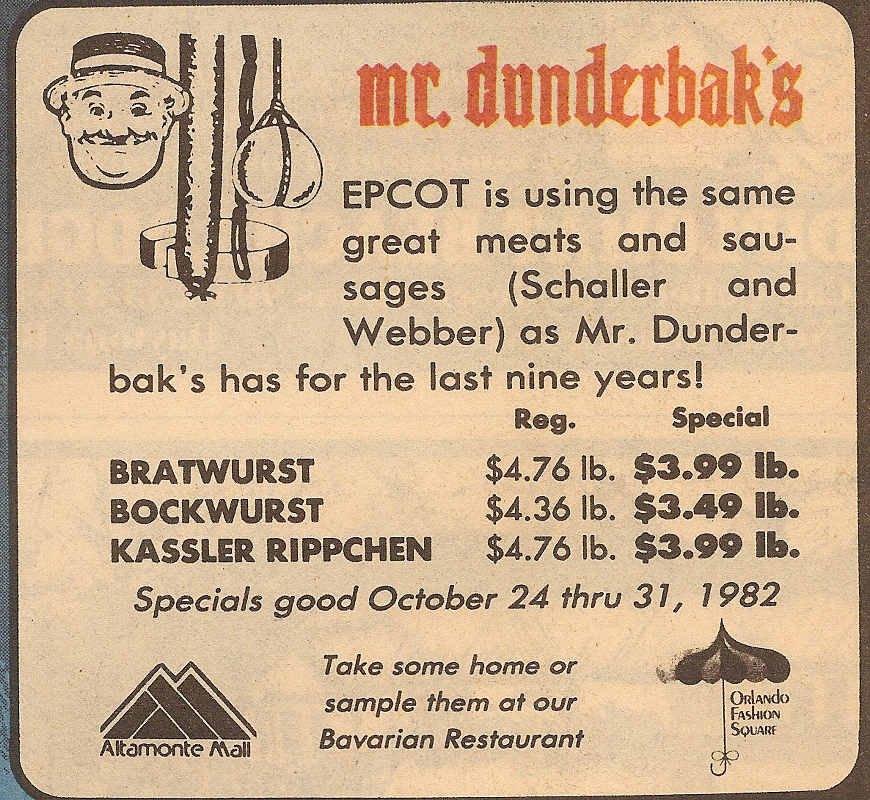
Mr. Dunderbak's was a chain of German Cafes of which a handful still remain dotted through the southeast. The Tampa and Daytona Beach versions still thrive as independent restaurants, and there may still be others in North Carolina and Alabama. The Tampa and Daytona versions are true time warps, and offer great food to boot, so please take any opportunity to support them.


A slightly bizarre pair of ads from Geary Distributing, and the second ad seems to have arrived seven years too early. And just who is Geary Distributing and Scan-Am Import-Export to salute EPCOT on behalf of entire nations, anyway??


Here's a fascinating one.

In 1982, Pepsi-Cola and Coca-Cola equally shared corporate soft drink ownership of Magic Kingdom - Coke sponsored the Tomorrowland Terrace and Pepsi sponsored the Country Bear Jamboree and Mile Long Bar in Frontierland. Most restaurants in Walt Disney World offered both soft drinks at this time.

Coca-Cola agreed to come onboard and sponsor the incredibly expensive American Adventure show with American Express, and as a result were granted sole soft drink dominion over EPCOT Center. Pepsi-Cola pulled out of Magic Kingdom later in the 80s, leaving Country Bear Jamboree sponsorless (the oval woodcut of Zeke, Big Al and Tennessee on the attraction marquee to this day was actually designed to cover up Pepsi-Cola's oval-shaped 80's corporate logo) and Coca-Cola reigning supreme over Walt Disney World, an arrangement which continues to this day.

Also in that issue of the Sentinel, many Orlando-area contractors who helped build EPCOT boasted of their accomplishments:


And finally, most enjoyably for EPCOT Center fans, many of the major corporate sponsors took out large newspaper space to promote their new shows and attractions:


Walt Disney World themselves quietly put out a single ad, much smaller than most of the others:


Disney's first International Fellowship program had not been as large of a success as they had hoped, and Disney had plundered every division hoping to get warm bodies to operate the World Showcase pavilions, whether they be ethnically appropriate, or not.

Ginger H., a longtime Walt Disney World Cast Member whom I spoke to, was pulled from It's A Small World in 1982 to operate El Rio del Tiempo - what she called the Mexico Boat Ride - when it was fast-tracked to be ready for opening day. She hated working the ride, and told me that she was in the habit of going into the Plaza de los Amigos gift shops, borrowing a sombrero and serape, and sitting at the Mexico Boat Ride control panel with her head down, apparently asleep. As each boat would roll past her out into the River of Time, she would unexpectedly raise her head and bark: "Don't drink the water!"

Happily for her, Ginger was transferred back to Magic Kingdom within the year. And Happy 31st Birthday, EPCOT Center.

Fair Warning: Offer Probably Void