Now Available! My newest book!

Monday, July 18, 2011

The Jungle Cruise: The Early Years

(EDIT JULY 2012: New information has been discovered! This article has not been updated in the interest of full disclosure, but links have been added to a  post with the updated information!)

In the world of themed design scholarship, we tend to spend a lot of time fussing over oeneiric, platonic versions of attractions. Especially in Haunted Mansionology, there's a lot of discussion of intention - who did what, why did they do it, and what does it mean - which is usually an attempt to extrapolate out a reading of an unfinished area already in the ride or a new idea being introduced and whether it truly meshes with the creative intent of the original design team. And of course that great castle in the sky of themed design: what would it have been like if it turned out exactly as planned?

In such cases, the idea is often floated that the earliest possible incarnation of the attraction, minus of course any momentary technical imperfections, is supposed to be the "perfect" version, the version against which all others are judged. This happens a lot in film scholarship too, especially with reference to filmmakers who misbehaved or were removed from films. There is an entire restoration of a Welles film, Mr. Arkadin, based on this idea - that the earliest extant cut of any given scene is preferable over others because it's more likely that Welles edited it himself before being locked out of the cutting room. It's just one example, sure, but it's a real life example of the phenomena - the "earliest possible version" theory.

Of course this is absurd because the rides change constantly, from wear and tear or just the environment. Lights burn out and are maybe replaced with lights of not quite the exact same brightness and color. And who says there's anything to whether or not that lamp is supposed to be 60 watt or 75 watt bulb? The original construction crew probably didn't give it much thought either.

Still, I bet most of us would like to know, for example, exactly what Pirates of the Caribbean was like in 1967 when it finally opened. Did those timbers in the burning city sway just the way they do now? Should they? In other words, has the original vision of the designers been diluted over time? That's the point of it all, that the earliest versions - ones most likely to have been tinkered with by the original WED staff - can be a guide to all subsequent alterations to preserve the intended effect. And in case you think that's being extreme about things, you should know that Disney plays this game too - the type, brightness, and color of every light and lamp in every attraction is recorded on opening day and compiled into massive documents. There are binders full of reams and reams of codes explaining exactly how one figure or another was programmed. The original staff of WED was fully prepared for their creations to outlast them, and many of them have.

Perhaps today's post will be of interest, then. It is primarily composed of a set of photographs of the Walt Disney World Jungle Cruise under refurbishment in 1973. Now the Jungle Cruise really has not changed much in the past forty years, and good thing, too. Things have broken, been forgotten, been rediscovered, tinkered with, repainted, second guessed. But the biggest changes have really boiled down to the amount of foliage growth, the guests' attention span and how sarcastic the guides are.

It isn't commented on much, but the Florida Jungle Cruise was designed, from a visual perspective, nearly entirely by Marc Davis and his designs were absolutely slavishly deployed by the WED model shop. Davis had already tinkered with the Disneyland version, but that remained a show designed by committee, a group effort by different teams of designers working in 1955, 59, 62, and so on. The Florida Jungle Cruise was designed by Marc from beginning to end and so faithful to his art were the scenic artists that the attraction is one of the few places in the entire world where one can see Marc Davis rocks and waterfalls. Squint below for a rare peek at his art for Inspiration Falls sitting on the table near its model counterpart.


Or to put it another way, what is good and unique about the Florida Jungle Cruise is good because Marc Davis designed it to be that way. So the Florida jungle is an unannounced treasure - a completely intact Davis design, not substantially altered in realization, still operating after 40 years. This photo set represents some of the earliest and most extensive photo documentation I've ever seen of the ride at a time when it had not been touched basically at all since opening day - a true look at the unadulterated vision of the original design team. It's also a fascinating look "under the water" at the Jungle Cruise, something few people ever get to see.

But first, some preliminaries. Let's begin way back at... the beginning - in fact, even before then.

This piece of concept art can't exactly be said to be "rare"; it's available on a DVD you can buy at the park itself (!), but it may reasonably be said to be "uncirculated" or "under appreciated". This unidentified artist also created beautiful pieces for the Sunshine Pavilion, but unlike many early Magic Kingdom art pieces, this one is perhaps most remarkable for how closely the final product resembles it, strongly suggesting that the Jungle Cruise was amongst the earliest attractions to be designed for the park, perhaps as early as 1969 - it along with the Haunted Mansion were more or less complete very early on. Davis could have moved off Haunted Mansion directly onto the Florida Jungle Cruise in fall 1969.

The building closely resembles the original Disneyland boat house in general shape and more or less always has, but this piece is maybe is best for showing the original arrangement of drumming tikis outside the building in the sunken courtyard. Although later moved to be nearer the Tiki Room at an unknown time in the first few years, these are exactly the same "wooden" tiki figures which today squirt water. Here they are on an early list of speakers and sound effects for the ride:


Now you know: next time you're at Magic Kingdom, you can point at one of those six tikis and shout "TALKING LOGS"! For the record, we have no real proof they ever talked - only drummed.

Keep those tikis in mind; we'll come back to them later.

Another interesting thing about this piece of concept art is that although it's hard to tell, the second floor of the boathouse does seem to be intended to be appropriately sized and detailed to be used for guest queue. I've been trying to confirm for years if this was ever the case. There is this construction photo clearly showing a staircase rising to the second floor near the current loading area for the ride:


That isn't proof it ever held extended queue. It could have been storage or even a lead office. The rails on the second floor of the Jungle boathouse are realized in forced perspective scale making it a somewhat unlikely spot for guest use; it's also a tiny area which is today made even smaller by being mostly occupied by air conditioning vents and machines. But the air conditioning came later, in 1972-1973, and I'm not sure what other purpose this now long removed staircase could serve; if there were photos establishing a second staircase (one going up and another going down), it may be possible to conclusively prove that an upstairs queue was at least an idea at one point.

For what it's worth, Junior Pouchet (the J.P. of J.P. and the Silver Stars) once told me that on October 1 1971, the "Adventureland Steel Drum Band" performed on the second level of the Jungle Cruise before being relocated to the familiar Adventureland Gazebo location on October 2.

(EDIT JULY 2012: The upstairs was never used as queuing space, see new information here.)

Jumping forward a few months it becomes surprisingly easy to find shots of the Jungle Cruise that look like this:


This image was once common on postcards and Pana-Vue slides, and I'm willing to bet that this image and ones like it (showing the Giant Python figure or the Trapped Safari) was amongst the earliest promotional images shot for the park. These were probably even sold at the Preview Center. You can tell because this is a shot which has been cleverly framed to hide the fact that the ride is still under construction. There is extremely sparse vegetation and, most importantly, there's no hint of water. It would be several months before the river was filled, in all likelihood.

Here's another from the same set, showing "Salesman Sam" aka "Chief Namee" aka "Trader Sam".


Another image likely taken standing on a box in the middle of the dry river, this one is even better at showing the pre-opening state of the vegetation. The Jungle Cruise was the very first part of the entire Magic Kingdom to be landscaped so that opening day guests would not see a jungle that looks like this, and the plants on the very right have always looked to me to be either brought in just for the shot or perhaps were sitting in the riverbed awaiting installation.

By point of comparison here's a 1971 shot showing a jungle steamer headed off into the Amazon in a filled and completed river.


I have no idea why that guy is riding the boat out into the ride, by the way. Watch your head!

A few things to point out about this photo. First, it's taken from the southwest corner of the second floor of the boat house, note the little architectural detail evident at the top right. Second, it's a fantastic view, and thus possible evidence that even if it were never used as such it may have been designed with guest perspective in mind; off-stage areas in Disney theme parks are not known for their great views. Third, those familiar queue lanterns looked fantastic when they were new and their brass finish hadn't yet been rusted over. Finally, as any jungle skipper would be able to identify immediately, half of the queue is missing.

I'd like to be super super clear on this point. Below is a overhead view of the queue building as it looks today.


Above, the different phases are highlighted. The blue and yellow areas are the original construction in 1971; the red area is the queue annex built in 1972-1973. Jungle Cruise was one of a number of opening day attractions which regularly had large queues that spilled outside into the heat and sun; convention wisdom has it that WED Enterprises had not taken into account Florida's brutal weather and shade structures had to be devised. 20,000 Leagues Under the Sea and Haunted Mansion received canopies; Jungle Cruise and Hall of Presidents had full annexes built. Mike Lee sent me this photo showing how the Jungle Cruise queue was expanded concurrently with the construction of Caribbean Plaza in 1972-1973:


In fact, from the pedestrian level the queue annex looks to be part of Caribbean Plaza. Obviously the attraction is still operating at the time this photo was taken, but at some point after this tourist snapshot was taken it closed for a full refurbishment.

(EDIT JULY 2012: This photo shows the "mystery staircase" being removed, see new information here. Also, the map above is incorrect, updated version in new post.)

That's where this photo series picks up. These photos are undated but I'll be willing to guess that they're from 1973 during an early refurbishment, probably taken by WED for reference. This is some of the very earliest photo documentation of any Walt Disney World ride I've ever seen in such an extensive way; this is very close to how the ride was intended to look in 1971.

This refurbishment seems to have accomplished several things:
- general refreshment of the show scenes
- completion of the queue annex
- removal of several figures from the Amazon
- site prep for "Year Two" additions

Here's an overhead view of the load area.


This is one of the photos that helps convince me that this was taken in 1973, by the way. In addition to showing a generally similar level of foliage growth compared to that 1971 Pana-Vue slide of the same area (above), this photo is taken from a raised perspective and an angle that would be impossible unless the queue annex were being built; the photographer is standing on it! Sadly there are no photos in this set of the queue itself; the mysteries of the time frame of the removal of those staircases and the "talking logs" continue to haunt us.

(EDIT JULY 2012: Talking Logs removed concurrent with the queue expansion, see new information.)


A great photo showing the original decoration of Marc's fascinating little shed across from the load area; a perfect overture to the mysterious fantasy to follow. This version follows his concept art closely and I find the draped mosquito netting especially to be very pictorially elegant. Later refurbishments covered this classic little house with all manner of vulgarizing props and bric-a-brac and generally did his designs few favors.


A view of one of Walt Disney World's loveliest waterfalls, currently dry for the refurbishment. I'm pretty sure the cinder block is there to anchor the outrigger canoe that usually accompanies the little house, inlet, and waterfall. These four elements comprise one of the Magic Kingdom's most pictorially elegant compositions; it still has the mysterious allure of tropical fantasy today.


The first scene, the Rain Forest, originally featured this beautiful jungle canopy constructed of welded pipes to which various artificial and real plants were attached. This cooled the river and allowed the mysterious fog effect to settle naturally over the water. The rusted superstructure was removed in 2000 and the fog effect has not worked properly since.


Now we're rounding the bend near Inspiration Falls, one of the loveliest kinetic sculptures at Walt Disney World. Hey, what are those guys doing?


This is entirely conjecture but I'm willing to bet that what we are seeing here is the removal of Davis' giant frog figures. There's always been frog sound effects in this part of the jungle but it was not until recently proven that there were once figures to go along with the sounds. The full story is at Widen Your World, but based on the evidence presented there I will say that these WED employees are standing right where a cluster of four frogs was supposed to be located.


The original Pygmy Canoes scene, this original version closely modeling Davis' concept art once again. This scene was originally the visual accent to a traveling sound effect of beating native drums from just out of sight; a scene of mystery with just a little danger. In the early 90s a more textured beach surface was added along with some skulls on spears and a silly little soup pot with a spoon. I don't know about you, but those decorations seem to hem much closer to the stereotypes of "unseen other" cultures in the third world than this original; the in your face joke of the newer version is that cannibals may be lurking nearby instead of a beautiful but eerie tableau of human culture having just fled the scene at the approach of your boat. I'll take Davis' version any day.

On to the ride's second scene, "Gorilla Area".


This distinct little rock formation may still be seen today to the left of the camp overrun with gorillas; more importantly, what can be seen in this photo is the very first of the ride's animation pits. It's still there and it is still unused. What's supposed to be there is a crocodile being pummeled repeatedly by an angry gorilla. No, seriously! The size of the pit and distance of the scene to the boats to me suggests that had the scene been budgeted and approved for Walt Disney World in 1971, that gorilla would have been smashing that crocodile's head into the water in the way depicted in the concept art, with the croc's tail flailing in the air.

A number of early documents list this scene as "In At Year #2", which would have meant that the scene was meant to be installed during the refurbishment which is being photographed here, and the existence of photographs of this pit from WED in 1972/73 does suggest that somebody was looking at this area seriously. It's possible that the rapid construction of Pirates of the Caribbean, Tom Sawyer Island, and numerous shade structures and extended queues around The Magic Kingdom absorbed the Jungle Cruise's "phase two" figure budget. Any current Imagineers looking to enhance but not detract from the Jungle Cruise would do well to look at Marc's art for the attraction as there are a number of unused and forgotten ideas that came very close to realization.

Disneyland and Tokyo Disneyland did get this scene, but the gorilla mereley threatens to bean the crocodile, which is much less funny because that's the whole joke of the scene. In 2005, the crocodile figure was relocated to elsewhere in the ride and the gorilla now reaches for some bananas on a floating box, which is just stupid, if you ask me.


This angle on the Nile River scene approaching the veldt reveals interesting facets of the design of the ride; I especially like the way the giraffe's heads originally appeared to poke up above the rocks on the approach. Those rocks, by the way, are hollow and at some point were meant to feature a family of baboons:


See how the rocks are similarly shaped? These primates did make the cut during the Disneyland Jungle's 1976 refurbishment which added a number of scenes from the new Florida show, as well as at Tokyo Disneyland. Again, why these figures never materialized in Florida is a mystery. They never appeared on any figure diagrams.


This lovely view of the Veldt shows the original horizon-line effect; it is not for nothing that the Jungle Cruise is situated at the lowest elevation of any attraction in the Magic Kingdom. The lower elevation allows the attraction to sit in a sort of cater; the hills around it blocking out unwanted visual intrusions from both inside and outside the park as Magic Kingdom was built without a Disneyland-style "berm". The lowered vantage point of the boats and the raised hill of the veldt allowed a variety of vehicles, including parade floats, to pass behind this scene unobserved.

In 1988 the "back wall" was filled with plants; the construction of the Grand Floridian meant that the outside world was finally visible on the veldt.
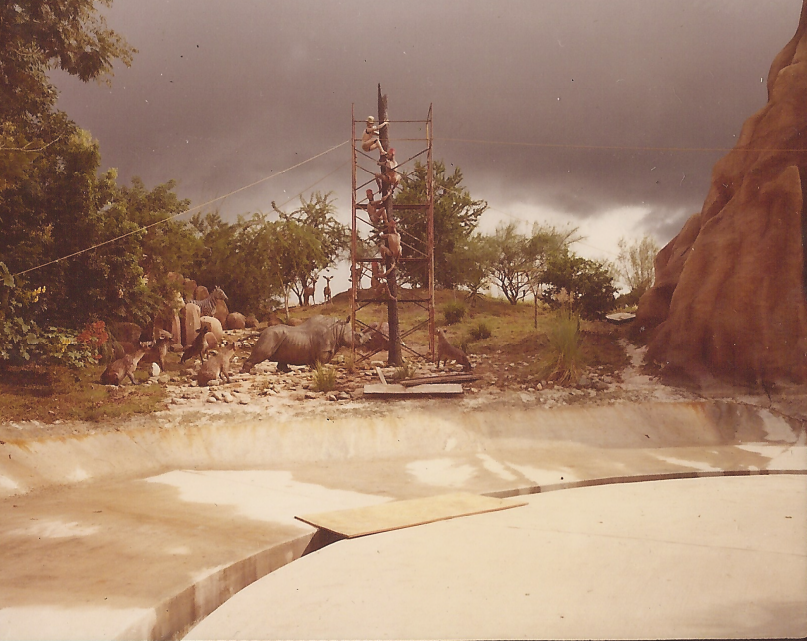

The Trapped Safari, before the entire party got whitewashed and the scene was filled with campground clutter.


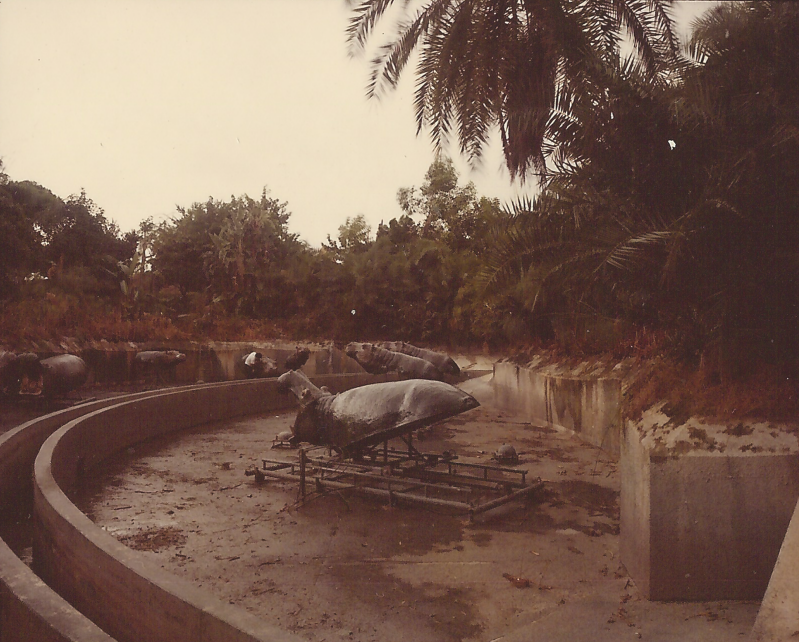
I don't think anybody here will be surprised to learn that the hippos have no bellies. This is the deepest part of the river, by the way.


On to the Native Village. Note the pleasant use of grassy banks here and in the Hippo Pool. Still present but not prominent today are those tikis poking up out of the foliage, but wait - aren't they familiar? Yes, that's right, these are the diminutive counterparts to our "TALKING LOGS", and it seems we've finally come across the native culture that produced those carvings outside the queue!

I've already talked about how Adventureland alternates between structures intended to be understood as "colonial" and those meant to be "native"; we are meant to understand those six totems outside the boathouse as having predated the construction of the outpost itself, a leftover sign of local culture. In this way the contrast between these two items would make the defining dynamic of the Jungle Cruise immediately evident on the approach - European culture's encounter and friction with natives - an encounter the colonists are doomed to lose, by the way, which we know from both history and the ride itself. Gorillas overrun the camp, the colonists are chased up a tree, attacked by villagers, and ultimately there are the Cambodian Ruins, the ultimate reminder of the transience of all conquerors of the jungle. Nature is the only winner; all others fall back.


Davis' original art and some early promotional literature tell us that the Native Village not only originally was supposed to have skulls on sticks, but that they were on fire. Weird.

(EDIT JULY 2012: they were there! See new information.)

Bet you can't guess what we'll find in the "Floating Croc Area".


Of course these figures are just a minor visual accent to one of WED's most gorgeous and haunting tableaus ever: the magnificent crumbling ruin of the Khmer empire. The small dome shaped devices surrounding the crocs create bubbles in the water and are used extensively in the Hippo Pool as well; you're supposed to imagine dozens more crocodiles underwater.


Look at how beautifully painted this is; the WED model shop really was amazing.

Since we're looking at an animation mechanism here it's worth pointing out that the Jungle Cruise figures aren't really "animatronics" so much as what is called "animation". They're run pneumatically and the illusion of life is more or less achieved entirely through actions which translate to a solenoid valve being open or closed. For example, on the veldt the value opens and closes quickly to cause ears and tails to flick. This crocodile is either rising or falling based on whether or not his mechanism is receiving compressed air.


This is the first Squirting Elephant; the caged intake valve next to him draws in water to feed Elephant Falls, Inspiration Falls and the Load Area waterfall.


This is the other elephant, but don't look at him; look past him, to the left. See that raised concrete platform at the water line along the shore? That's the location of the final never-installed scene along the river, and our final puzzle to ponder.

Now this one is even more mysterious. In some ways its' easy to figure out why the Gorilla-Bashes-a-Crocodile or the baboons never showed up: money and time became scarce, projects rolled along and the scenes work fine without them. This scene is something else, though, there's some elusive other reason why it isn't there in the ride today.

This is it. It's a parrot on a stump being leered at by crocodiles.


Again, on most early diagrams this scene is labeled "In At Year #2". It never appeared in Florida, but it did appear in Disneyland in 1976, now significantly revised by Davis. Now the crocodiles poked their heads out of the water, the parrot has become a hornbill, and the stump has become a branch over the water. Here it is along with a Pana-Vue slide of the same scene.


But why did Davis revise the scene at all? His concepts for the Gorilla vs. Croc scene and Baboon Family were faithfully created to match the concept art. It can also be pointed out that he added water buffalo to the Florida Giant python scene when it was exported to Disneyland in 1976:


Of course there's no evidence that buffalo weren't planned for Florida at one point as well; or maybe Davis was simply trying to find a new use for some old animals as water buffalo had appeared alongside the jungle river back in the late 50s. Or maybe it was to mirror his new scene at the start of the ride; in 1976 the Jungle Cruise began with predators surrounding a docile bird on a branch and ended with a predator on a branch surrounded by docile buffalo.

Actually, Davis redesigned the bird-on-a-stump gag because it had already been used. This is where things get really weird: the scene was built, but not at the Jungle Cruise. It was and still is alongside the Walt Disney World Railroad. Here's a picture I found on flickr of that scene from the 70s:


As you can see the setting has been transposed from a jungle to a swamp and been mildly restaged; still, I think this reads faster and is much funnier than the bird-on-branch incarnation from Disneyland. But what's the deal with that creature on the stump? Why, it's a frog. A frog that had recently been removed from the Jungle Cruise. Remember that picture of the WED staff lurking around the site of some former frogs above?

Davis was the show designer for the Florida Rivers of America, too, and while the river was down in 1973 to allow the installation of Tom Sawyer Island, a number of Davis gags and scenes were incorporated there and along the backside of the railroad track. To be clear: this work was happening at the exact same time as the Jungle Cruise refurbishment we've been looking at.

But seriously, why? It seems like a madly strange thing to do. Those crocodiles were made just for the scene and a few eventually made their way into Disneyland's jungle, too. Why relocate it at all and then, once you've done that, why use a figure you've just removed from the ride you relocated it from? Time and money is only the easy answer, there may yet be something else to it. I hope one day to be able to report that I know why.

The Jungle Cruise has always been about mysteries and enchantment, and I believe the Florida version of the show is a genuine classic, the best thing of its' type for emotional flow, for beauty, and artistic excellence. But the jungle does not yield her secrets easily and is all too often overlooked for her more obvious elements: silly jokes and limited believability. We need not have everything be "realistic" for it to be good; Animal Kingdom, the nearest obvious successor of the Jungle Cruise, could learn a thing or two from Davis' beautiful but patently fake primeval wilderness. I feel like I learn more every time I ride it.

And now, two smiling native boys will help you from your boat, and please watch your step.

Saturday, July 09, 2011

Snapshot: Marines Capture Coke Corner

Only a few days late after a nice long rest here at Passport to Dreams World HQ and we've got a story to share with you about the fourth of July! .... About the fireworks, to be precise.

Now, fireworks have always been a part of Disney theme parks, for better or for worse. Of course way back at the beginning they had very little resemblance to the cloying three-hankie schoolroom malarkey that passes for nighttime entertainment today. These displays were about fireworks, not soundtracks, and Disney did them better than anyone else.

In 1975 and 1976, Disney was hitting the "Patriotism" angle especially strongly. It's true that today few things seem as inherently "American" as Walt Disney World but the early 70s featured such promotions as "I Am An American Week" celebrating the birthdays of Washington and Lincoln back before they were complied into a single holiday (don't blame Disney for the ludicrous name; Florida governor Ruben Askew made it an official Florida event in 1973). But 1975 - 1976 were especially star spangled at Walt Disney World; the Bicentennial promotion was underway. The freaky / awesome America on Parade rolled through the park twice daily. You could see the Hall of Presidents for free - a 90 cent value (that's almost four dollars today, by the way)! There was even a special floral display on the Hub.


And yes, in case you've been wondering for your entire life why the Electrical Water Pageant ends with "Grand Old Flag", it's because of the Bicentennial.

So it makes sense that Disney would come up with a heck of the fireworks show for July 4, 1975 and July 4, 1976. The summer 1975 issue of Walt Disney World Vacationland provides details in an article entitled "Red, White and Blue Spectacular":

"In August 1973, the Entertainment Division began preparing for the 1975 season of shows. In keeping with the Bicentennial celebrations which will begin this summer, the fireworks will feature red, white and blue exclusively."

"Realizing that the tremendous demand for red, white and blue fireworks during 1975-76 will far outreach the supply in the United States, Disney experts set out to find other sources from around the world. A partnership of fireworks manufacturers from eight countries was established, under Disney direction, to help meet the coming need. Included are pyrotechnics experts from Japan, Free China, France, Brazil, Great Britain, the United States, Canada and Mainland China."

"In the past, the visual effects of fireworks have generally been a potpurri of color. But as Disney's imaginative teams envisioned the pariotic shows, they had some very specific designs and effects in mind . Armed with artist's rendering which illustrated these various designs, they traveled around the world searching out experts in such countries as Japan and Mainland China. These drawings introduced a new approach to an ancient art and soon became a kind of universal language where no other could be understood."
Or, to put it another way, Disney spared no expense to make these fireworks as elaborate as possible. But that, of course, is the public side of the story, written by Walt Disney World's publicity department. Enter... Spotlight Magazine.

Established in 1975, Spotlight Magazine was the sarcastic equivalent of Eyes and Ears, written by front line cast members instead of the PR department. In a December 1976 blurb in Eyes and Ears, they described themselves as such:

"What are we looking for? Humorous stories, short jokes, cartoons, serious short stories, humorous photographs, quality photographs (black and white only) you wish published, poems, jokes, limericks, jokes, satirical views of company related items, jokes and more jokes! In fact, we can use almost anything you can think up."

Whereas Eyes and Ears is the safe and publicly acceptable version of events, Spotlight Magazine throbs with the wild and bitter imagination that any front line cast member, past or present, will recognize as their own. Several include articles by Randy Bright.

Captioned still from "The Apple Dumpling Gang", Spotlight 1975

But there's something else to it, too. What began life as inside comedy has become, over time, obscure comedy. Spotlight Magazine has become the ultimate inside joke, a blend of comedy and history of the Vacation Kingdom that is something like Disney Nerd Nirvana.

And so, now that the requisite background information is out of the way, I present for your delight, an article from the Winter 1976 issue of Spotlight Magazine written by Rich Whitt.

BIGGEST "SKY SPECTACULAR" EVER PLANNED SOON

Plans were announced last week for the fireworks show on July 4, 1976. Being the Bicentennial birthday, our Entertainment Division promised the biggest and best show ever attempted. Dell Shilling, spokesman for Entertainment Division and part-time choral director, told SPOTLIGHT that... "We are putting together a show right now that is so big, even Howard Cosell's mouth couldn't hold it." In our exclusive interview, we learned the proposed schedule of events:

9:55 pm - Following the conclusion of "America on Parade", hard hats which have already been distributed to guests should be put on and protective eyeglasses and clothing adjusted.

9:59 pm - All employees should be under cover and all air traffic cleared from the area.

10:00 pm - Fireworks begin from four different locations around the Magic Kingdom.

10:02 pm - Overture begins, played by the New York Symphony Orchestra and sung by the Mormon Tabernacle Choir, live from a barge anchored in the Seven Seas Lagoon.

10:05 pm - Fifty hot air balloons representing our fifty states arise from locations around Theme Park and start to twinkle red, white and blue.

10:09 pm - Two giant American flags burst into flame from sites atop the Contemporary Resort and Space Mountain.

10:11 pm - 25,000 singers and dancers parade down Main Street singing "Yankee Doodle Dandy" while the Mormon Choir takes up singing it.

10:12 pm - Grand Finale Begins

10:12.30 pm - On musical cue, the 59th Air Force Squadron will begin aerial bombardment of Sea World.

10:13 pm - Battleship "USS New Jersey" anchored off Treasure Island will open fire on the Chinese Junk and the Ports-O-Call.

10:14 pm - Tribe of authentic Seminole Indians will attack Fort Wilderness and burn Pioneer Hall

10:15 pm - False ending.

10:15.30 pm - As music builds, the following will happen simultaneously:
a. Fireworks sites launch ground-to-air missiles.

b. Torpedoes and launched from Friendship I at "USS New Jersey"
c. Wave machine begins to operate.
d. Battalion of Marines land on Magic Kingdom dock, fight their way up Main Street meeting heavy opposition in Town Square

10:24 pm - On musical cue:
a. Sea World launches counter-attacked aided by forces from the Miami Beach and Daytona resort areas.
b. The 59th Air Force falls in flames.
c. The "USS New Jersey" explodes.
d. Marines capture Coke Corner
e. Wave machine destroys Polynesian Resort
f. First stage of Castle Rocket ignites, putting it in orbit

10:30 pm - All systems shut down, The End.

Happy Fourth of July!!!

Buena Vista Obscura:
Marines Capture Coke Corner
The World Cruise
Captain Cook's Hideaway (plus followup)
The Lake Buena Vista Story: Part One
The Lake Buena Vista Story: Part Two
The Lake Buena Vista Story: Part Three
The Lake Buena Vista Story: Part Four
The Golf Resort

History and Esoterica:
Snapshot: Mysteries of the Second Floor
Snapshot: Olde World Antiques
Snapshot: The Great Southern Craft Company

--

This post is part of the Disney Blog Carnival. Head over there to see more great Disney-related posts and articles.

Special Thanks to Matt Feige for the Spotlight Magazine blurb from Eyes and Ears.

Thursday, April 21, 2011

Fireworks of the Universe

You know, I love vintage Walt Disney World ad publicity. It's nearly always well written, terse, and evocative. The Lake Buena Vista Club isn't just a golf clubhouse, it "features 14-ft. vaulted ceilings with exposed beams, rough-sawn cedar planks, plush carpeting and wide-view windows overlooking the fairway." Really, who wouldn't want to go there after a description like that? And the Polynesian luau isn't just dancing, it features "the delightful Samoan slap-dance, [and the] romantic Hawaiian Wedding Song."

The delightful Samoan slap-dance. Try saying that to somebody out of the blue. Spectacularly strange language.

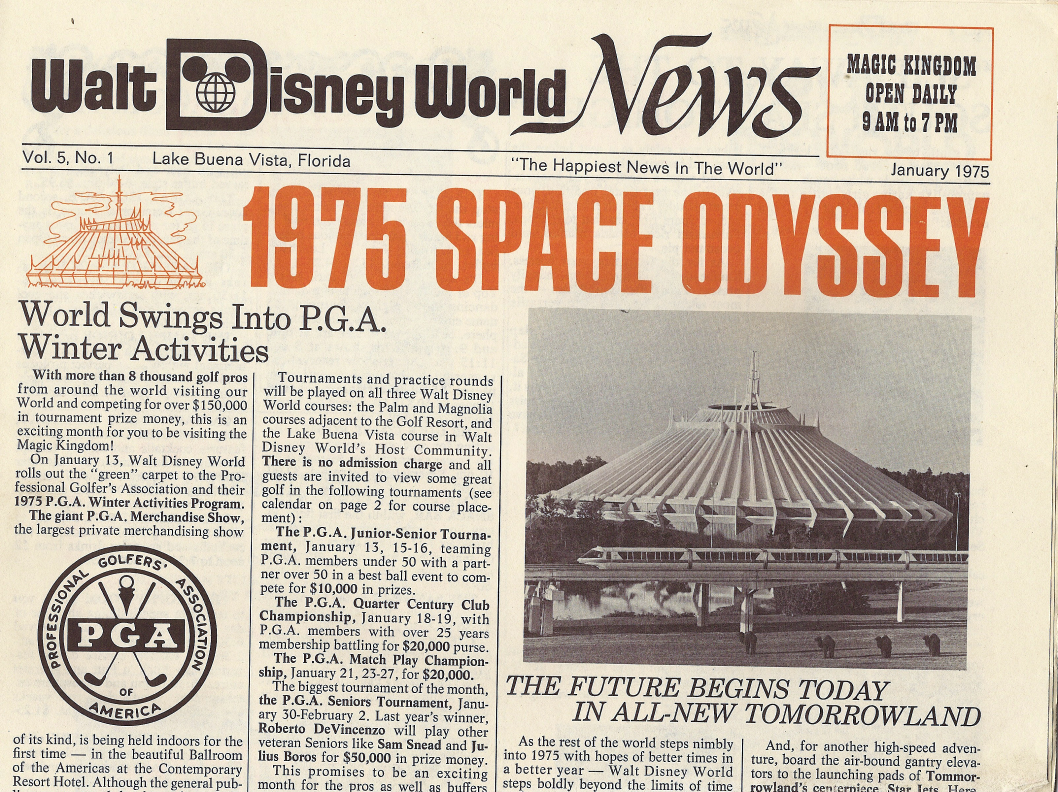
But sometimes they just hit it clear out of the park and into a low-hanging orbit, such as the cover story for this January 1975 edition of Walt Disney World News:

Take that, Arthur C. Clarke! We got there 26 years early!

Amongst a front page featuring such curiosities as "World Swings into P.G.A. Winter Activities" and "Hall of Presidents Adds No. 37" is a pretty picture of Space Mountain (with topiaries!) and the subject of our article today. We all can agree that Space Mountain is a pretty big deal, right? I mean, Magic Kingdom would not be Magic Kingdom without it. It's been rebuilt in every Disney "castle park" around the globe. But you just don't get it, man. Space Mountain isn't just a big deal - it's going to CHANGE THE WORLD. The article is so full of astonishing hyperbole and bizarre turns of phrase that I have no idea what to say about it besides..... it may be the apex of all Walt Disney World promotional material.

"THE FUTURE BEGINS TODAY IN ALL-NEW TOMORROWLAND

As the rest of the world steps nimbly into 1975 with the hopes of better times in a better year - Walt Disney World steps boldly beyond the limits of time and space into the 21st century!

At 2:00 pm, Wednesday, January 15, the Grand Opening Ceremonies of Space Mountain, the monolithic white "mountain" towering over Tomorrowland, will mark the beginning of a new era in space adventure! Visiting dignitaries (including U.S. astronauts), the musical pageantry of over a thousand band members, plus a spectacular display of daytime fireworks will celebrate the end of the "armchair astronaut."

For in Space Mountain, presented by RCA, you, without any previous aeronautical acquaintance, can experience the incredible adventure of outer space!

You'll board the eight passenger space capsule, buckle your seat belt and be whisked away into the most enthralling, free-falling flight through brilliant stars, whirling spheres and unearthly forces ever imagineered!

Disney imagineered, of course (see related story, p. 8).

After a spinning re-entry into earth's atmosphere, you'll disembark and tour the technological wonders of life in the twenty-first century in the RCA "Home of Future Living."

Then, be off to visit the second exciting addition to Tomorrowland - the G. E. Carousel of Progress. A unique unveiling of the American Family's advancement from the wood-burning stove of the 1890's to the micro-wave wonders of the 1970's, each of four eras is portrayed by audio-animatronic actors as the audience rotates around them, carousel-style.

This unique theater is similar to the original "Carousel of Progress" which entertained more than 45 million guests at the 1964-1965 New York World's Fair and later joined Disneyland in 1967.

And, for another high-speed adventure, board the air-bound gantry elevators to the launching pad of Tomorrowland's centerpiece, Star Jets. Here, you'll pilot your own space ship up, down, and around the atmosphere of your very own mother ship.

Adding still another futuristic look to Tomorrowland will be the People-Mover, scheduled for operation later this year. An elevated transportation system, which winds its way around the entire complex, the People-Mover will be comprised of 30 "trains" with five cars each. Operating under a covered guide way 14 feet above the Tomorrowland mall area, the People-Mover will transport over 3,500 guests an hour.

The most highly appreciated aspect of the People-Mover, however, is that it operates via a magnetic field of force without moving parts and, consequently, free of any pollution whatsoever.

Space Mountain, Carousel of Progress, Star-Jets, People-Mover. All part of an all-new Tomorrowland which will allow you, our guests, to touch tomorrow today - at Walt Disney World."

Wow. Where to begin. That's a heck of a way to begin an article, isn't it? All this time you knew that your method of entering the new year was inadequate compared to Walt Disney World's ability to bend time and space. And let's not forget that we take for granted that back in 1975 humankind forever vanquished the age of the "armchair astronaut." Somebody behind the typewriter had a previously unforeseen gift for the Amazing Ongoing Alliteration. And of course it's always amusing to see a description of the plastic red re-entry tunnel as "spinning", which popped up both in Disneyland and Walt Disney World promotional materials and which seems as inappropriate as ever. Really, spinning? Did that red plastic ever spin?

It's amusing and fun to see the term "imagineered" half explained and not capitalized as it would be today. It was not yet a marketing term!

And I personally am very enthusiastic about calling the cavernous Tomorrowland pedestrian space the "Tomorrowland Mall Area." Thank you, anonymous Walt Disney World ad-pub writer of two generations ago!

Let's not overlook the brilliant use of boldface!

The hilarity continues in the article mentioned on page eight, "The Mountain That Imagineering Built", although with less concentrated interest and lunacy. I'll not transcribe it here, but I'll have you know that it features the phrase "Fireworks of the Universe", which is either Byronian opium-induced poetic verse, of just another example of early Walt Disney World's astonishing fever dreams of promotional prose.


I only wish we had nonsense like this today.

Friday, April 15, 2011

Palate Cleanser

My goodness, it's been a long time, hasn't it? It has... in the meantime I've gone to Disneyland and come back with a head full of ideas and not much desire to write them. A lot of stuff has happened to Disney and to the rest of the world too, and not all of it has been great.

What we need is a palate cleanser, hopefully to kick my butt back into gear and to give us all a little relief from drudgery. And since this is Passport to Dreams Old & New, that likely means... seventies stuff. Bright, beautiful, early Walt Disney World goodness to keep us mindful of our priorities.

Shall we?


This early Walt Disney World couple, taken for a 1976 merchandise catalog, may be showing off their spiffy "Collegiate" tees but they're also standing in a spot where taking this photo is today impossible. In the background where the white rail and benches are was the original proposed location for the Tomorrowland Railroad Station; it's also the original exit to the Space Mountain attraction. Today, a massive half round salmon colored arcade blocks this fantastic view.


Wow, look at the line for the Peoplemover!! All those people are going to be happy to have spent their E ticket (yes, it was an E ticket in 1975) on what is arguably still one of the greatest experiences at Walt Disney World. Who remembers the little dioramas in the tiny hexagonal boxes on your way up and down the speedramps (visible in the background here)? Tomorrowland was so awesome.


Look how clean the track is. Tomorrowland hasn't looked this good in years.

Hopping across the Seven Seas Lagoon, we come across this group, also modeling Walt Disney World "Ready To Wear" tees at the Polynesian Village:


Besides Bob-A-Round boats and the Asian Resort expansion pad, let's take time to apprechiate the rich wood grained sides of the Polynesian longhouses long before they were painted cartoonish yellow and the lovely effect of the decorative wood tucked into the peak of that roof before it was alternating shades of yellow, orange and white. The roofs of each longhouse were intentionally rusted to an orange patina instead of being painted that way.


Here's a Rarity I've been looking for for some time: this is the sign for the short lived Lake Buena Vista Shopping Village tobacconist, which as you can see did not lack for seventies "groove". All of the original Shopping Village signs were brilliantly executed craftwork pieces; the sign for "Von Otto's Antiques" was emblazoned on an antique coffee grinder and anybody who stared in fascination at the sign for "Lite Bite" will likely never forget it. This one can't quite compare but it lasted less than two years, so what it lacks in interest it makes up in obscurity!

The following pictures were taken to celebrate the second anniversary of the Lake Buena Vista Shopping Village in Eyes and Ears of Walt Disney World, and although they focus on goofy-looking Cast Members, the photos, like most, reveal interesting details at the margins that the photographer did not intend.


It's fun to see the proper scale of this sign which featured an actual spout! It's also fun to see the rather uninspired costumes worn by cast outside of the "Vacation Kingdom"... that blazer with the Lake Buena Vista emblem looks pretty dorky today. The caption for this one is too cheerfully lame not to reprint:
"Modern as well as 'vintage' spirits are the specialty of the Vintage Cellar. Jo Tisdale and Jerry Robinson compare their job with the Haunted Mansion... both deal with the spirit world!"
Well... not everyone got to wear the Mansion green and white, so we'll go easy on them.

This rather assertive mugshot is chiefly interesting for capturing, even if in passing, the interior of Shoe Time. The ladies pictured therein are Jeannie Clarke and Kaye Frampton.


...and we'll go out with this page from the merchandise catalog we've been skirting this whole time. I don' know if these kids are actually in a room at the Contemporary or on a set somewhere, but I suspect that this will bring a smile to even the most hardened heart:

Saturday, March 05, 2011

Rubber Spider Revue

You know it wasn't all that long ago that you could walk into the Haunted Mansion, hop in a doombuggy, ride up through the library and past the self-playing piano and see this:

Boo.

HBG2 at the excellent Long-Forgotten blog has recently written on the Haunted Mansion's debt to popular culture Halloween traditions, or the lack thereof, and locates these spiders in a tradition of iconic Halloween images - like sheet ghosts, orange and black treat bags, etc.

I'm not exaggerating when I say that, at the time when the Haunted Mansion fangroup was still being organized on the internet, a time I was absolutely a part of, everybody hated this scene. It was dark, spare, unimaginative, and cheap, and - worse of all - put square into the middle of a ride known for lavish sets and effects. I took that picture in 2002 and it was for my old GrimGhosts.Com Haunted Mansion website, by the way, so I speak from experience here!

Well... I'm not so sure about all that. I've posited in the past that the Grand Staircase scene was a bold if failed attempt to create something basically impossible to represent, that it was Claude Coats at his most representative and basic, that the concept was interesting if the execution was not, etc. By and large these opinions have not infiltrated the fan community to any extent and most people will agree that the endless staircase / spooky eyes scene that exists in that spot in the Haunted Mansion now is a far better use of that space than what was basically a flat black wall, some string and a few rubber spiders on wires.

Or, to put put it simple: rubber spiders, nobody loved you.

But here's the thing, those guys may have just been stupid rubber spiders painted day-glo colors and jerked around in webs, but those rubber spiders deserve your respect, darn it. And I'm going to prove it. You may not agree with me in the end, but at least you'll be fully equipped to understand where that scene came from and make up your own mind about something that was, after all, despite its obvious faults, part of our Magic Kingdom heritage.

Now, I've searched high and low to find the origins of those rubber spiders. Ken Sundberg offers in his super comprehensive look at Snow White's Scary Adventures that the 1955 version of that attraction may have included one or more rubber arachnids in the original Ken Andersen dungeon sequence, but photographic evidence is not forthcoming and I have a better idea anyway. Although Mansionologists like myself tend to associate these rubber spiders with Claude Coats and his ideas about negative space in themed design, Marc Davis is actually the one to blame.

This is a segment from a beautiful Davis piece from 1963, drawn for his top-to-bottom re-imagining of the Jungle Cruise's "sunken city":


And the actual scene from a mid-60s Pana-Vue Slide:


You'll notice that although Davis' concept features Ganesha, the Hindu Remover of Obstacles, the final scene actually depicts Hanuman, the ape-headed disciple of Rama. Ganesha got moved to appear just before Davis' new Indian Elephant Bathing Pool scene and the alligators which previously appeared where those elephants now play were moved to this new scene. This whole little stretch of the river has been subject to dozens of iterations which may be tracked on Daveland's Jungle Cruise page more or less chronologically, but the point is that once Hanuman shows up in his rebuilt shrine, the giant spider makes his debut in Disney history. Marc Davis spearheaded all these changes.

Let's take a close look at that Jungle Cruise spider because it's the best look you'll ever get at her.


I say that this spider must date from 1963 for a variety of reasons. The first is that it's a custom mold and an excellent one at that; we're used to seeing the default "orange spider" around these days but painted differently it can look like a pretty creepy beastie. Even had there been rubber spiders in the 1955 Snow White ride, they likely would have been off the shelf spiders. By the mid 60s WED had a very robust model shop and had the time and money to make a serious and unique rubber spider, which is what they did. It's impossible to prove but to my eye it looks like the work of Adolfo Procopio, who was WED's resident wildlife expert for almost 40 years.


Now HBG2, resident Mansionologist at Long-Forgotten Haunted Mansion, tells me that this spider and its twin which lurked in the loading area of the Disneyland Haunted Mansion for almost 35 years, were basically props, ie, not animated in any way. But from the Disneyland Haunted Mansion to the Magic Kingdom Haunted Mansion it's only a leap of about two years, so follow me now and together we'll go on a...


THE HAUNTED MANSION!

We'll begin our Safari at the point we began this article, in the Haunted Mansion. It's fairly common knowledge these days that the Florida Haunted Mansion expanded on the Disneyland load area concept to make the "Grand Staircase" it's own scene (or maybe not: as we used to joke, the "Grand Staircase" was neither grand nor the staircase [it is and has always been a ramp]). For a few weeks in the test and adjust phase, the scene consisted of three webs: two with the familiar rubber spiders, and one with a skeleton caught in it. The skeleton was shortly removed but the vacant web stayed for almost 35 years.

Both of these spiders got upgraded to what Disney calls "animated figures" for the 1971 show, via a wire attached to a solenoid valve which would click open and closed, causing the spider to wiggle slightly. The resulting clicking sound was familiar enough to anybody ever got stuck in this part of the ride.

Here's the spiders. This first image I stole from Imagineering Disney because it's a different angle than the first and shows the spider clearly. The second I got off Disney Fans and was taken by Al Huffman in the mid 90's, showing the second of the two spiders and webs.


(I feel like I'm making a GrimGhosts.Com page again...)

Two things about these spiders. First, they looked okay under black-light, but their webs were pretty terrible. Just look at that first spider, whose web was very impressively sized, but just filled with broken strings, spit, and debris. Goodness knows how old that iteration of his web was - twenty years? Thirty years? Scroll up and look at that 60s Pana-Vue slide and you can't tell me that these webs weren't in awful shape. I think this accounts for the poor reputation of the scene: it just looked cheap.

The second issue is that the webs weren't painted so much as sprayed with the Mansion webbing effect, giving the scene a dusty, ethereal quality. Because the web was right near a wall and very large, it was lit up a bit too much, casting light on the wall and ruining the "boundless void" effect. Had the scene been suitably black, had the webs been well maintained and commonly replaced, and painted properly, this particular part of the Haunted Mansion may have needed nothing more than some new set dressing to update it.

Well. Okay, maybe not.

THE JUNGLE CRUISE!

Let's hop across the park and visit an attraction Marc Davis was heavily involved in c. 1969-1970: the expanded Walt Disney World Jungle Cruise. For this incarnation, Davis took his 1963 "sunken city" concept to new heights with an entire indoor sunken temple. The pivot point of the scene is a shrine to Hanuman, covered with gems and treasure and guarded by swaying cobras. This is pure gold Marc Davis intrigue, but he repeated the spiders too, to the left and right of the scene:


Also noteworthy: unlike the Disneyland original, these spiders also moved, in the same manner as the Haunted Mansion arachnids discussed above.

Both of these spiders actually look fantastic under show lighting conditions, with careful painting, properly built webs, and excellent staging. That first spider, which is to the right of the shrine, is rarely seen due to appearing extra-dim on daytime cruises but if you ride the Jungle Cruise at night and the skipper turns off all the lights on her boat as you head through the temple, you'll see and appreciate the proper appearance of this simple gag.

I've never much liked the second spider because she looks a little too flopsy and rubbery, but expand the image and you'll be able to clearly see the wire tied 'round her midsection leading behind the pillar to the solenoid that makes her wiggle. Classic Imagineering, people!

I think it's important to note that Davis still felt this simple tableau - I mean, is there anything simplier than sticking a rubber spider in a fake web? - merited inclusion in a ride which dramatically and sometimes totally reworked the basic stuff of the Disneyland original, and despite his gag having been already recycled twice in other attractions.

Twice? Actually... make that three times.

SNOW WHITE'S ADVENTURES!

Moving further eastward, we come across the 1971 Snow White's Adventures, probably the nearest WED ever got to designing a true, traditional spookhouse dark ride. A variety of people worked on these rides, including the "1955" crew for Fantasyland, amongst them Ken Andersen and Claude Coats, plus some later-generation Imagineers who had a hand in refurbishing the 1955 originals in the 1960s: Yale Gracey and Rolly Crump.

Hey, Yale, what'cha doing there?


See? The Rubber Spider conspiracy grows by the moment.

I'll stop here and quote Ken Sundberg's Snow White Adventures page now. He's talking about the 1955 original version of the attraction at Disneyland, referencing scene where the shadow of the Witch crosses your path through an arch. In that arch was a spider web, and a picture of the scene may be found in issue #13 of The E Ticket.

"Following immediately after the Dungeons scene, the vehicle faced a huge spider web in a dark archway. The silhouetted Shadow of the Wicked Witch emerged behind the web and moved across the wall. [...] In the late 1970's the foreground of the Shadow of the Wicked Witch scene was changed glowing in fire-orange, with a spider possibly flicking across the web as the vehicle passed the archway. The movement of the Witch's shadow was also changed; it didn't move across the wall anymore, but rocked up and down to the right, as if the Witch was dipping the apple in a cauldron."

Whoever it was who decided to add this little vingette to the Walt Disney World version of the ride, however, was undoubtedly doing so in the spirit of both the original and the generally increased interest in rubber spiders at WED in the late 60s:


Mike Lee took this picture of part of the original dungeon scene in the early 90s, shortly before the ride was removed. The skeleton would flap its jaw at you and warn you to "Go Back!" You'll notice that this spider's web is painted right on the wall behind it... because this spider was the only one to actually move. That's right, it would slowly lower towards the skeleton on a track. I remembered this vividly from my early visits to Walt Disney World and after the removal of this scene - this corner is where the witch can now be seen poisoning the apple - I couldn't remember which ride it was from and swore that the Haunted Mansion spiders used to move towards you on a track.

We lost this spider, probably the most impressive of them all, in 1994.

In 2007, both of the Haunted Mansion's spiders went away, leaving the two in the Jungle Cruise the only spiders left holding down the fort. The Magic Kingdom's 1971 rubber spider population has been decimated by 60%.

Over at Disneyland, the spider in their Haunted Mansion load area bowed out in 2003 and has not been seen since. In 2005, as part of a larger refurbishment effort, the 60s WED spider was removed from the Jungle Cruise. Some new spiders, in more realistic but less fun webs, appeared deeper in the Sunken City sequence. But these spiders look off-the-shelf and don't match the subject of our article here, the 60s version.

Overseas, Tokyo Disneyland's Haunted Mansion carries on the tradition of the giant rubber spiders, and I'm sure their spiders and webs looks very good, not just because they're Tokyo Disneyland but because they each have to be removed and replaced once a year for their Haunted Mansion Holiday Nightmare overlay. And in an ironic twist of fate, the same year that the original WED spider was removed from the Disneyland Jungle Cruise, in Hong Kong Disneyland the "Jungle River Cruise" ride opened, the saddest and most anemic of all the Jungle Cruises. But it features an astonishing number of these fake spiders... I counted at least six in one ride video and there's probably more. So overseas at least, rubber spiders continue to haunt the darkest corners of Disney rides.

It's sort of hard to feel bad for the fate of these singularly unconvincing rubber arachnids. I've made the best possible case for them here but let's not forget: It's a rubber spider. In a fake web. Some of you have probably made more impressive rubber spider displays in your Halloween decorations than all of WED could muster in the early 70s.

But the real fascination isn't what it is, it's how easy it was to find it. All of Imagineering and WED-era design especially has maddening consistencies, consistences which made the experience of going to The Magic Kingdom or Disneyland truly singular. Beyond the obvious scope and scale of the ambition, it had to do with the excellence of the staging, the care of the painting and sculpting, and yes, sometimes, the constant recycling of materials. Submarine Voyage's tropical fish obtained a new coat of paint and became salmon jumping in and out of the water on the Mine Train Trough Nature's Wonderland. The "Old Man in the Bayou" scene of Disneyland's Pirates of the Caribbean begets The Magic Kingdom's Beacon Joe, who makes return appearances at Tokyo and Disneyland Paris. Beacon Joe's face is a Blaine Gibson sculpture who appears elsewhere in Pirates of the Caribbean, along with several appearances in the Haunted Mansion and so on.. and on and on. These are the sort of fun games the true hardcore students of WED design can play.

So now I've clued you into a secret. Have fun playing the game and remember: it all started with a rubber spider.