Now Available! My newest book!
Showing posts sorted by date for query "The Haunting". Sort by relevance Show all posts

Friday, April 12, 2019

Five Batshit Crazy Rides

Okay everybody, put on your silly hats, because today we're all about really weird rides.

As a Disney World-obsessed child growing up on the other side of the country, although Disney was a major influence on my interests, the fact is that it was not an everyday, every week, or even every-year thing. Just as big of an influence on me, in those multi-year stretches between the family vacations, were less-ambitious examples of theming: malls, miniature golf courses, oddball restaurants, and regional amusement parks. So while the obsession really took hold between the ages of eight and ten or so, the fact is that I have more, and stronger childhood memories of something like Lake Compounce or Riverside Park or Lake George than I do Walt Disney World.

On this blog, we spend a lot of time talking about the prime cuts: the Disneys and Universals of the world, which offer beautifully, fully realized environments. But just as compelling to me are the lesser steaks, the parks that operate on smaller budgets and milder ambitions, that make do with less. They may not be as rich and juicy, but there's a lot of flavor to chew on in places like Knobels, or The Enchanted Forest, or Silver Dollar City.

Which is maybe a longwinded way of saying: I love Pirates of the Caribbean, but I love the weird shit too, and there is simply not enough of it on this blog. And while these five examples may not per se be on the same level as a handmade mini golf course in Michigan, they aren't exactly on the Disney or Universal or Efteling level either. What they are is truly, truly bizarre, sometimes ambitious, fascinating, and, yes... batshit crazy.

Mammut Tree, Conny Land, Switzerland

We'll start with something fairly mild. As the park says, "to conquer this tree, you need nerves of steel"!

A landmark in Conny Land, the Mammut Tree looks like a gigantic redwood with its top blown off. On the ground level, pedestrians can walk around and through the root system of the tree. In the air, a cable car takes riders through a hole in its top. Looks harmless, right?

Except! when the car passes through the terrifying Mammut Tree, doors close around the car and it's trapped and, then... well maybe you should just watch the video, but there's wind, sparks, fireballs, and... yodeling.


Conny Land has other oddities, like a shuttle coaster that stops you upside down and a Universe of Energy-inflected dinosaur dark ride, but it's the weird, inexplicable "mammoth tree" that captures my heart. It's like a non-sequitir given physical form.

Gremlins Invasion, Warner Brothers Movie World, Germany

When I was about ten years old, Gremlins was one of my favorite things in the world. It's the perfect "starter" scary movie - crazy, a little gory if you're ten, suspenseful, and sweet. It's gone on to be recognized as something of a classic in years since, but in the depths of the 90s with the world having moved on all I could do is rent the thing and keep spreading the word and wondering if I was the only one who loved this movie as much as I did.

Suffice to say, had I had access to this attraction as a ten year old, Gremlins Invasion / The Great Gremlins Adventure would maybe be my favorite ride ever.

The premise begins with absolute lunacy and only gets weirder from there. Passing through a receptionist office and into a screening room at "Warner Brothers Studio", visitors are treated to a collection of bloopers from films past and present hosted by... Sandra Bullock? Okay...

After several minutes of this, we suddenly cut to the set of ALF, where ALF is chasing the household cat under a sink. He's then attacked by the Gremlins, who electrocute the cameraman shooting the television program. As ALF encourages viewers to flee, the projector breaks and the famous "film break" segment of Gremlins 2 plays. An employee rushes into the theater to hurry the audience to a load area where the ride operator has been killed by the Gremlins, but no worry - ALF and Gizmo are at the ride controls!

Some context here. There were two versions of this attraction, one in Australia and one in Germany. The Australia version featured Beetlejuice, which I suppose makes some sense as that character was then at the height of his popularity and was also a fourth-wall breaking, horror comedy kind of character. If you squint a little, you can see why somebody would make the connection.

Meanwhile, over in Germany, ALF had been something of a cultural phenomenon, and he took a much larger role in the German edition of the attraction, piloting the vehicles through the Warner Brothers Film Archive and appearing in the pre show. While touring a film archive under attack by Gremlins while Beetlejuice appears and cracks wise is plenty bizarre in itself, the inclusion of ALF as a major character elevates the simply weird into the truly sublime.


You wanna know what? This ride is pretty good. It uses entirely dimensional sets, it has decent gags, and it's perfect for the Gremlins - attacking a movie studio and re-enacting scenes from Singing in the Rain and The Adventures of Robin Hood. There's a decent Pepper's Ghost gag where ALF and Gizmo electrocute a number of Gremlins, and another moment where the ride vehicles pass each other and trailing behind the second vehicle is a ride car filled with Gremlins. The finale where ALF arrives in a fire truck has never made much sense, but if you've gotten this far into the ride, what do you honestly expect? The Gremlins pack themselves into boxes, the film archive burns, and the perfect late 80s pop culture dream state ends.

In the past ten years, Gremlins Invasion has graduated from obscurity to minor infamy due to the ever-vigilant novelty consuming nature of social media, but right there at the intersection of crazy and possibly good sits a ride starring Sandra Bullock and ALF that was torn down for a Van Helsing coaster. It is, in its' own small way, perfect.

Donkey's Sherry, Shima Spain Village, Japan

This one only exists thanks to the diligence of park designer Dave Cobb, who knew weird when he saw it back in the 90s. Donkey's Sherry is vastly bizarre and makes one wonder what other strange rides once existed across the globe that were never documented and since have been lost.

A fever dream starring anthropomorphic donkeys, rather than the cute Disney-style characters you may expect, this is entirely "musician of Bremen" style donkeys, upright animals wearing clothes. As the ride begins, the donkeys are manufacturing the sherry, crushing grapes in huge wooden vats, drinking the sherry, dancing in the town square, getting drunk.... and then things get weird.


The absolute masterstroke of Donkey's Sherry, if it can be said to have one, is after all of the escalating insanity with executioners, conquistadors, and a burning city, is the puzzling final scene, where we are left to wonder if the whole thing was the drunken hallucination of an animal. Honestly, we're left to wonder if it wasn't a drunken hallucination of *ourselves*, but no matter. there may be plenty of questionable in Donkey's Sherry, but find me another ride that wordlessly suggests a twist ending with nary a bit of narration.

Looney Tunes Adventure, Warner Brothers Movie World, Germany

Here I go picking on poor Movie World Germany again. For what it's worth, this park has a really interesting history which predates its Warner Brothers branding in the 90s, and Warner did a lot of interesting things with it when they bought it. It was the only place in the world with a rapids ride themed after The Never-ending Story, a stunt show based on Police Academy, and a Batman Returns motion simulator. It was.... very odd.

Much like Gremlins Invasion, Looney Tunes Adventure was a copy of a similar ride originally built at Movie World Gold Coast in Australia. In both attractions, we enter the Looney Tunes Studio where a pre-show room has an actor interacting with animated figures of the Looney Tunes characters. It seems we're just in time to participate in the filming of their newest picture, to be set in, depending on one's location, either the outback or the Black Forest of Bavaria. So off we go into the ride and board a boat...


Where even to begin? The animatronics were designed by Sally Corporation, and honestly with the exception of Bugs, who's very difficult to translate into three dimensions, I think they're pretty good. But mein gott, this ride is just strange. The juxtaposition of the Looney Tunes, faithfully realized in three dimensions, with realistically created trees, rocks, and Bavarian architecture is just strange. But what pushes the whole thing from peculiar to haunting is the fact that there is absolutely no musical soundtrack during the ride! The Looney Tunes act out their comedy at the sluggish pace provided by mid-range animatronics circa 1996, viewed from a slow moving boat, and scored to a backdrop of birdsong and croaking frogs. The result is queerly suspenseful, but strangely compelling, in a mirror-world kind of way.

Oh, and another thing. I gave a simplified version of the actual story in the description above, because it was already confusing enough that their was a somewhat similar but also very different Looney Tunes Adventure in Australia. In the pre-show, you see, we're welcomed to "Hollywood" (the sign is on the mural in the background) and told that Bugs Bunny has gone to Germany to scout new film locations! In order to make the film, we must, and I kid you not, dig a hole through the earth to Germany. Speedy Gonzales asks if he can get good tacos in Germany, and no, I didn't just make that up. So we're led to the set of an old Science Fiction film, where Marvin the Martian is at the controls, and we ride his gigantic drill, Flight to the Moon style with televisions and a shaking floor, to the Black Forest. This is why Bugs says "Welcome to Germany!" when we see him in the first scene.

So at the Looney Tunes Adventure at Movie World Germany, we're transported to Hollywood for a pre-show, then through back immediately to Germany in the most bizarre way possible. Here's a video with both of the pre-show rooms, and a better view of the baby dragon encountered at the finale:


What can I say? It's strange, very strange, and I wish like hell I could have seen it. I'm sure the same kid who would ride El Rio del Tiempo six times and who grew up to write this blog would have loved every strange moment of it.

(Thanks very much to this blog post and this wiki article for helping make sense of blurry videos in other languages!)

Hollywood Tour, Phantasialand, Germany

I don't know what it is about Germany that just breeds crazy rides, but I'm well aware that 4 of the 5 on this list are located in Germany or Switzerland - and I didn't even get into Europa Park! This is also the only true knockoff on this list, but boy howdy, it's a dilly.

Phantasialand is honestly a very well realized park, with compelling rides and far, far above average textures and theming. One simply has to look at the facade and queue of their enclosed drop tower, Mystery Castle, to see that they're working at a much higher level than their competitors. Their version of Main Street is a lushly realized vision of Berlin at the height of its pre-WWI spendor. They have a very interesting Chinese variation of the Haunted Mansion, one of the most inspired such "reinterpretations" in the world. Oh, and there's Hollywood Tour, which is honestly insane.

To get on this ride you climb up! up! up! many staircases until you reach a barely decorated loading room where an animatronic of a director holding a martini - who may or may not be Alfred Hitchcock - addresses you. Then you board a boat, drop into a cavern, and...


The type of internet commentator who likes to shriek that any less than perfectly realistic animatronic is "creepy" will have a field day here, but really, those are the cheap shots. This ride is almost perversely strange, and the low budget figures are just part of it. It's the whole thing, the strange music, the slow pace of the boats, the reckless and entirely bizarre idea to replicate a mashup of the Great Movie Ride and the Universal Studios Tram Tour as an animatronic boat ride...

I love, for instance, that it recreates the Jaws scene at the Tram Tour in bizarrely specific detail - including the now-removed fishing guy in a boat who's pulled underwater. The entrance from The Great Movie Ride is there, as is Wizard of Oz, but in other cases they're riffing and coming up with their own weird versions of iconic scenes, like Frankenstein or an unspecified giant spider movie. The whole thing builds up to an experience that's appropriately named... it's oneiric, half remembered, hallucinated.

It's a mutt, but I love mutt rides - after all, the Disney and Universal park franchises now have options all over the world, but there's only one Hollywood Dream.

What's your favorite batshit crazy ride from outside the world of the billion-dollar attractions? Leave the details in the comments, and if you enjoy reading about Theme Park design, check out our archives here. Thanks for reading!

Friday, October 27, 2017

A Social History of Background Music

"Muzak and mood music [...] emit music the way the twentieth century is equipped to receive it. They have so successfully blended genres and redefined music appreciation that they have become the music world's Esperanto." - Joseph Lanza
Some time ago I was at a thrift store, hovering over an especially unpromising stack of vintage records, when I had an uncomfortable realization.

Over the years, first from working at Disney, then writing this blog and researching historical music loops, has warped my musical taste. I'm much more likely to spin a piece of background music to relax - Epcot's Innoventions music loop, for instance, or perhaps George Bruns' Moonlight Time in Old Hawaii. After a tough day at work, I want to settle into a groove with a drink and some mellow music.

As I stood there contemplating one of these dog eared LPs, I had one of those horrible moments of lucidity that makes one doubt her sanity: I was shopping for easy listening music. I was excited to find elevator music. I went home and began to cue up video after video on YouTube of the most treacly, canned music possible - and I loved it. Theme parks had made me love Muzak.

Gradually I began to wonder if that was such a bad thing after all. Background music cassettes from K-Mart went viral just a few years ago; a cursory search online reveals a raft of websites dedicated to preserving the background music of the past. And yet, theme parks are one of the few places left where you can experience true background music; walk into an average Starbucks or Waffle House and they're playing a sleeker, streamlined kind of BGM that's entirely popular recordings. It's sort of startling to realize that humans as recently as 80 years ago lived in a world where music wasn't constantly blaring out of every ceiling; what's so bad about a preference for music that's atmospheric and relaxing instead of popular hits of the past 20 years?

So I thought I'd take a quick look through the history of moodsong in the 20th century. At first blush this seems to be a tangent for this blog, but the links between postwar elevator music, social engineering, and Walt Disney run deeper than you think - once you go about digging them up, of course. It's a story that stretches over the better part of a century, world wars, and wrenching social changes, all events that can be bridged by strings echoing out of a tinny speaker in the ceiling.


Music To Read By

It was the early 1920s, and George O. Squier had an idea. George had spent a lifetime as an inventor and tinkerer for the US Army - he had invented the method for carrying multiple conversations over a single wire, allowing for the rise of a functional national telephone system, and had flown in one of the Wright Brothers' earliest aircrafts. Now, he wanted to apply his way with wires to send music to homes, offices, factories, and ballrooms across the country. George took the final two letters from "Kodak" and applied it to "music" to end up with "Muzak".

Squier was competing for an increasingly congested marketplace. The original American - which is to say, industrialized and populist - source of background music was almost certainly the radio. A boom market in the 1920s, by the 30s the radio was ubiqutious in American homes - it's been said that if you walked down the street on a hot summer evening during the broadcast of Amos 'n Andy or The Fibber McGee and Molly Show, you could hear the entire program from the open windows without missing a word. In the places where average Americans congregated - cafes, diners, and soda fountains, the radio rapidly gave life a distinct rhythm. And while today we think immediately of the radio stars of old, the fact is that the popular evening radio programs were but a tiny slice of an 18 hour broadcast day - a broadcast day made up of lots and lots of music.

Experiments in the teens and twenties discovered that those early crystal radio sets were best at transmitting a very narrow range of sound. The subtle buzz and hum of early radio transmissions could be counteracted by stringed instruments - especially those played overlapping, in a high frequency range. While George Squire was asking apartment owners to pay several dollars a month for subscription to his wired music services, a crystal radio set could play nearly nonstop all morning and night after the purchase of just one attractive unit that complemented the washing machine and icebox.

Unauthorized use of commercial 78 records, or electronic bootlegs of the same, were so rampant amongst small, rural radio stations that record companies began to stamp "Not For Broadcast" on their record labels. But even the mainstream radio stations of the 20s and 30s had off hours to fill with content, and in-house orchestras were kept gently sawing away between 11 pm and 1 am in stations like Chicago and New York in programs called Music To Read By, Time For Dreams, or Nightcap. The sounds of soft classical music became the defining sound of progress and modernity for a generation.

These early crystal radios were AM only; the superior FM format lumbered along inauspiciously, copying the content of the AM stations until World War II, when political pressure from radio manufacturers and increasing demand for television airwaves caused the US Government to move all of the FM stations further up the dial. This rendered obsolete in a stroke nearly every FM radio in the country. FM stations already just about on the rocks needed to adapt quickly or fold; they began offering their services to two symbols of modernity in urban America: the department store and the self-service grocer. Merchants found that the music helped move product and added and aura of prestige. In later years this format would come to be known as BM Music.

BM - Beautiful Music - stuck around for an astonishingly long time and has never really gone away - do a quick search and you'll find a small station probably not far from you who still broadcasts it. BM stations often ended up as a smaller operation inside of a larger radio studio, handled by less experienced operators. Free of commercials or announcements, BM stations churned away silently in the backdrop of modern life in major cities around the country. All across the country, businesses sprouted up like mushrooms with names like The Storecast Corporation of America, Store Radio, and Point-O-Salecast. Muzak's first major success came in arranging, recording, and selling music to BM stations who were becoming an increasingly legitimate and organized business.


Social Engineered Sound Scapes

George O Squier had died in 1934, a decade before Muzak's full ascendancy. In comparison to the wireless music provided by BM stations, all through the 40s Muzak had differentiated themselves by only offering wired music - the fidelity and reliability being said to be much better. Muzak also refused to be content with playing bootlegged light classical music - they recorded their own versions in house, carefully arranged to be as pleasant and unobtrusive as possible.

As early as 1935, Muzak was using red, vinyl discs running at 33 1/3 RPM, making them more or less the inventors of the LP. They also began to target their music to specific periods of the day - marches for breakfast, tangoes at lunch, light jazz at cocktail hour, then classics at dinner and dancing  till midnight. Through the 30s, Muzak had been bolstered by a raft of social studies published by such outlets as the Stevens Institute of Technology who found that "pleasant, functional music" improved worker productivity and happiness. The constant hum of nonintrusive music had become a welcome addition to a world plagued by depressions and worldwide wars.


(Yellow, Green, Red and Blue were Muzak's four programs - Red was intended for small restaurants, Blue and Yellow serviced retail, and Green for home use.)

By the end of World War II, Muzak Corporation had hit upon the concept of "Stimulus Progression". As American culture converged towards an illusion of stability in the late 40s and early 50s, Muzak claimed that workers were happier and more efficient while background music was playing, and that said music was more effective when played in 15 minute chunks, then silenced for another 15.

Muzak installations that offered the Stimulus Progression package came in two varieties: music for factories and music for offices. A 400 hZ signal broadcast over the wires separating the 4 fifteen-minute chunks would tell the office Muzak installations to remain muted during the more upbeat factory installations, or vice-versa. But a company doesn't go from a name brand to a description on novelty alone; you can't go from Xerox to 'xerox' by accident. With Stimulus Progression. Muzak hit exactly the tenor of their time.


By the 50s, except for that annoying Rock and Roll, American taste was flattening out. The generation that had fought a great depression and two World Wars wanted things to be simple, to be pleasant for once, and a growing peacetime economy and a technology boom promised a happy, prosperous America from sea to shining sea. What could be more pleasant, more productive, more futuristic and modern than pleasing, scientifically selected mood music?

What got forgotten in the Baby Boom generation's rush to tear down all of their parent's idols is that many people genuinely liked the sound of this stuff. The seeds planted back in the 1930s with the radio constantly cranking out it light classical tunes eventually flowered in the 50s into an entire genre: Easy Listening. Go to any old record store and there they will be: hundreds upon hundreds of easy listening records, bought back in the 50s and 60s by Mom and Pop while junior held his nose. Muzak went mainstream, and emerged on the other side as muzak - and ended up on the home stereo.

Indeed, a key part of an hostesses' job was selecting exactly the correct record to play on the newly behemoth home record player consoles, which could play five or six LPs stacked up in order - a full evening's worth of mood music. In the era where the home cocktail party or backyard luau was the social glue that held together a generation, the tasteful background of cocktail tunes was an essential skill.
"The musically aware hostess no longer allows the butler, or her husband, to sling records on to the turntable in a haphazard way... she now supplies a ready made background of elegant and suitable music to smooth the evening into one long feast of pleasure and unshattered nerves." - Liner Notes, Velvet by the Frank Chaksfield Orchestra
The boom economy begat imitators. Seeburg, who started off manufacturing orchestrions, had moved into jukeboxes by the 50s and eventually released the Seeburg 1000 BMS1, the Cadillac of background music equipment. It was sized and styled to replace the old crystal radio haunting shelves in diners across the country.

Each Seeburg 1000 played specially-sized records at 16 1/2 RPM; the device would play the underside of a record, drop it down, then play the top. The device would hold over 25 records, each holding 40 minutes of music, for about 16 hours total, and could automatically repeat the process. Every four months, a new shipment of five records would arrive, and five records would have to be removed and sent back to Seeburg for destruction. Like Muzak, Seeburg offered a number of subscription "plans" intended for various settings, which they called Basic, Mood, and Instrumental. The strictly enforced obsolescence of the music discs and the styling of the unit itself makes the Seeburg 1000 highly collectible today, thankfully, interested parties can stream the music online for free at Seeburg1000.com.

By the same time, radio stations had moved away from records and towards the new endlessly repeating, automatically cueing Fidelipac cassette tapes, a kind of precursor to the 8-track. Fidelipac tapes were a single length of magnetic tape which spooled around inside its caddy endlessly; while best for voice announcements, it could also be played slowly enough and theoretically made large enough to allow for background music application.

The most impressive of these tape systems was the Cantata 700, manufactured by 3M of Scotch Tape fame. Consisting or two giant tape reels spinning around in a massive walnut box, 3M sold the device and tape outright to businesses instead of offering the subscription plan that BM Stations, Muzak, and Seeburg relied on and saw the device fail as a result.

That was in 1965, where the market was already overstuffed enough to see new options floundering. But cultural changes were underway - rock and roll came back, and now it was politically charged and experimental. The lightly relaxing music which once connnoted sophistication and modernity was the squarest of the square; just about the most damning thing you can say about any piece of music, then or now, is to called it elevator music - to call it Muzak.


The Decline of Background Music

Muzak and Seeburg continued trudging along, offering their subscription plans through the 70s and 80s while the various tape machines began to degrade, fall apart, and eventually be replaced by... the radio. Popular radio stations fled the AM band, crowding out BM stations. Grocery and department stores, accustomed to their FM receivers, kept playing the new FM program of popular hits. A few BM stations moved back to the AM band, but most just closed. After 8-track, after compact cassette, it was no longer classy or special to walk into a store and hear music playing - it was just something that happened everywhere.

In 1968, a company called Yesco began offering what they called "foreground music" - popular music of the day, intended to appeal to young Boomers. By the 80s, the writing was on the wall, and Muzak struck a deal with Yesco and began distributing their music programs through the existing Muzak channels. A few years later, both companies were purchased and merged. Yesco's corporate officers and headquarters ate up Muzak, which continued to do business only as a name - their entire strategy was oriented around Yesco's "foreground music".

In the 70s, Brian Eno sat in an airport for a few hours waiting for a flight and was annoyed by the canned background music. In 1978 he produced Ambient 1: Music For Airports, a mellow, experimental soundscape intended to relax listeners. Rolling Stone missed the point entirely, squawking that you could only appreciate the music by listening to it. In 1986, during the Muzak-Yesco merger, Ted Nugent, back then most associated with arena rock, made a public stunt of offering to buy Muzak for $10 million in order to destroy it. In the minds of many, Muzak, which effectively no longer existed, was still associated with inane social programming.

And yet, throughout all of this, wasn't there something unacknowledged just below the surface? In the 50s easy listening boom, records by Jackie Gleason, Henry Mancini, Les Baxter and Martin Denny pictured rigorously sexualized, perfectly up-do'd women staring temptingly out from the record sleeves. Compare this to the cover of any Mantovani album and perhaps we begin to wonder if the marketing of the Les Baxters of the world were perhaps overcompensating for something. Since the 50s, those who rail and rally against the constant musical backdrop of mood song have danced around what would otherwise seem to be their core complaint. Don't their protestations ultimately come down to the music being a little wimpy, a little emotional, a little... feminine?

Women were the ones who heard, supported, listened to, curated, purchased and played the genre we now know as easy listening. It was women who were home all through the 30s to get the taste for the light classical constantly blaring out from the crystal set. Women supported and enjoyed the addition of background music to take the drudgery out of factory jobs as they flooded the workforce during the war effort. And the modern cocktail hostess, armed with a fleet of up to date wonder devices like the washing machine and self-cleaning oven, provided the social lubricant of the 50s and 60s with her easy h'orderves and jello molds made with convenient, shelf-stable products. Mantovani, Liberace, Frank Chaksfield, Ray Conniff and Lawrence Welk played music that appealed to women, and there may still be a sublimated hint of sexism in today's detestation of the genre.

Today, aural relaxation techniques include everything from nature sounds to ambient music. Pop hits, perhaps from several decades ago, are more likely to be heard at workplaces than peppy little marches. The few businesses that do play light classical or jazz music do so in a deliberate attempt to differentiate themselves. While in the American lexicon "muzak" is today synonymous with any sort of canned music, you'll have to look pretty hard to find any genuine examples.

That is, except at Disneyland. Just as it won't take much online searching to bring up people who insist that background music contains "subliminal messages", Disneyland has always reflected the surface optimism and social engineering of the 1950s that some have always found so sinister. In 1957, Muzak was even purchased outright by Jack Wrather, television mogul and owner of the Disneyland Hotel. It's probably a safe bet that Disneyland used Muzak's "aural wallpaper" in several areas around the park in the early days.

Walt Disney was one of those twentieth century conservatives who supported large scale effort to improve the lives of the middle class. Born of blue collar cities at the turn of the 20th century, the product of the hangover from 19th century utopian fiction and the fallout of the great depression, Walt believed in massive public and private efforts like the building of the Eisenhower interstate system. I'm sure his EPCOT City would have played wall-to-wall Muzak inside its covered downtown, apartment complexes, monorails, and Peoplemovers.

It seems that, at least inside Disney, the association between a continuously flowing musical accompaniment and an automated, futuristic world never quite went away - EPCOT Center opened in 1982 with an entire, carefully orchestrated and custom recorded aural soundscape intended to set to mood. The styles ranged from bombastic at the entrance to ambient outside Journey into Imagination to unambiguously Easy Listening in World Showcase.

In the late 60s, Disney hired ex-radio DJ Jack Wagner to act as their permanent in house background music specialist. Jack's job was to clear the rights to and compile music into pleasing musical programs to play in the park - essentially, nothing but Disney's version of the "Stimulus Progression" concept. Prior to his assignment, Jack always maintained that "you'd go down Main Street and they'd be playing '60s musical hits like 'Mrs. Robinson'", which sure sounds an awful lot like something Muzak would have provided. But the story of Jack Wagner and his contributions to theme park background music are a story for another article.

While malls, grocery stores, department stores, and workplaces were switching over to the invasive hum of the radio, Disney held true to their convictions and background music eventually became an accepted facet of theme parks. In the 90s, Universal Studios Florida played pop hits from popular movies - none of that lame easy listening stuff! But their second theme park, the beautiful Islands of Adventure, had a much more traditional theme park musical background, setting the stage for their attempt to out-Disney Disney. The Port of Entry BGM remains one of the finest ever created.

Background Music and Moodsong in Context

Today, we are all music curators. The iPod taught everyone how tough it is to create the perfect playlist, and the disastrous effect following up Duke Ellington with Radiohead can have. What's more, theme parks are one of the only places left where you can watch background music still working. You can watch people pick up the pace in tune to the music on Main Street, or take on solemn, attentive postures inside the Hall of Presidents. It may be subliminal messaging or social programming, but it also works and makes people happy, which is what these places are all about.

There's never going to be consensus about background music, because there are as many people as there are options. But, you know, Muzak, or specifically Yesco - now called Mood Media - are still around, and they still sell sounds and even smells to retail chains. The "Muzak Principle" is still a sound one - consider how the teenagers who frequent, say, Abercrombie & Fitch would feel about those clothes if Garth Brooks were playing in the stores. Or how the patrons of Bass Pro Shops would feel if Run-DMC were playing at the entrance.

Meanwhile, certain sectors of the 50s and 60s Easy Listening genre have managed to shed their toxic reputation and bounce back to respectability. Thanks to his hipster image, Frank Sinatra has never really stopped being cool, but it's easier to find people enthusiastic about Dean Martin, Bing Crosby, or Nat King Cole than it was even twenty years ago. The re-emergence of cocktail culture in the United States has lifted a great number of moodsong purveyors of the 40s and 50s, and the subsequent re-emergence of Tiki as a popular drinking subculture means that exotica music is back in a big way. If you enjoy Percy Faith when he's orchestrating faux-Oriental nonsense under the auspices of a midcentury idol, you'll probably enjoy him in other contexts, too.

Ironically, the concept of background music may be making a resurgence. For many, just getting through a week is getting tougher and tougher, and any kind of stress-free outlet is appreciated. Next time you've had a hard day at work, try playing some Henry Mancini or Mantovani when you get home. It may not be chic, but it still works if you let it.

In 2015, Downtown Disney in Florida became Disney Springs, and the radio-style pop music which once haunted the streets of Downtown Disney was replaced with a mellow, nearly ambient selections of light jazz tracks. The new custom loop for the Marketplace is an hour and a half of unbroken ambient riffing which occasionally breaks into recognizable Disney tunes. It's as if the long arm of Stimulus Progression is reaching through time to gently guide us along, after all.

Sources
Elevator Music by Joseph Lanza, St Martin's Press, 1994
The Soundtrack of Your Life by David Owen, New Yorker Magazine, April 2006
A Brief History of Beautiful Music Radio by Richard O Connor, Percy Faith Pages, 2009
History of Muzak, Inc - Funding Universe
Seeburg 1000 BMS1 Background Music System - Techmoan
3M Cantata 700 - Techmoan

--

Do you enjoy long, carefully researched essays on the ideas and history behind theme parks, like this one? Hop on over to the Passport to Dreams Theme Park Theory Hub Page for even more!

Saturday, May 31, 2014

The Age of Not Believing: Week Two

"The Age of Not Believing" is a movie review series tracing the history of Disney in the years following the death of Walt Disney. It covers three films a week in an effort to see all theatrical Disney films released between January 1967 and December 1973. The entire series can be found here.

October 16, 1967 - The Jungle Book

Have you ever seen Richard Williams' The Thief and the Cobbler? And by that I mean the fuller, unexpurgated versions floating around online, not the dreadful dub n' hack version released by Disney.

It's a fascinating film, not least of which because Williams refused to storyboard the film. As a result, each shot in a sequence is as long as its' animator wished it to be. As a result, each shot has internal rhythms but the larger sequences do not, dictated as they are by such factors as speed, fatigue, and interest. It's an animator's dream but an editor's nightmare.

I think Thief and the Cobbler helps illustrate why the 60s and 70s Disney animated features are so pokily paced. Through the 50s, Walt and others insisted on keeping the pace up and the narrative tight, but as animators like Ollie Johnston and Ken Anderson were given more latitude to craft sequences, the whole pace of the enterprise slows down to a casual wobble. It's the pace of animation allowed to exist for its own sake.

The Jungle Book is the ultimate Disney clip show movie. It's the first Disney film I'd be comfortable calling a road movie - while an argument can be mounted for Pinocchio, it's Jungle Book that sticks pretty closely to the road movie formula. The frame story is a linear movement from point A to point B, and each "stop" along the way is a self-contained episode that can be split off from the other episodes with little lost. Within those episodes, the animation is astonishing, and with the slacker pace and structure in place it's the animated performances that totally drive the film. That's a good thing, because the road movie formula thrives on vivid characters and incidents, allowing us to project ourselves into these situations through central characters on a journey who are no more than ciphers.

a pivotal scene.
Honestly, if there's a problem with Jungle Book, it's Mowgli the man-cub. While he's cute enough, Mowgli is a big donut-hole in a film filled with remarkable personalities. He's voiced by director Reitherman's son Bruce, who does a serviceable job and provides some live-action reference that will be animated and recycled as Christopher Robin in The Many Adventures of Winnie-the-Pooh. Disney's Mowgli is a far cry from the fierce and wise survivor of Ripling's book or the 1942 film. When he's about to be mauled by Shere Khan we express only minor alarm. When he's about to be devoured by Kaa we register amusement. This makes the Jungle Book a weirdly passive experience: even Baloo steals all of the big emotional moments. In the final reel, as Mowgli vanishes into the human village, we shrug in amusement the same way Bagheera does and the film returns, much more deservedly, to Baloo and Bagheera as they saunter off into the sunset.

What separates Jungle Book from atmospheric but dramatically inert rambles like Sword in the Stone or Robin Hood is probably what Walt brought, which is a fastidious attention to structure and rhythm. Each sequence has a big bit of slapstick action or a clever song or, often enough, both. There are two sets of two characters, with Mowgli standing between each: Bagheera and Baloo complement Kaa and Shere Khan. Each of these four characters have two big scenes, one in each half of the movie. The entire film is bisected by King Louie, who can only appear once for danger of stealing the whole show. Louie himself is a comic figure who becomes increasingly sinister as his sequence unfolds, paving the way for the sinister Shere Khan who is lightened by touches of comedy.

This is a really nicely set up film which requires the animators knock down the sequences, neatly and cleanly; in other words Walt constructed the only film which truly plays to the strengths of the animation unit in the Reitherman era.


The film slacks in the last few reels where it really should be getting tighter; the Beatle-vultures who sing "That's What Friends Are For" are funny enough but the scene wouldn't be harmed by removing them and proceeding directly to the confrontation with Khan. It's a shame that John, George, Paul and Ringo turned these roles down, for no other reason than it'd perk up a scene in need of perking. On the other hand, the roles seem to reflect the public image of the Beatles as ludicrous mop-topped good natured slackers, an image the Beatles themselves had been working to escape for the better part of two years at the time of Jungle Book's release. The disconnect between the sophistication of the actual Beatles act, which in October 1967 was between Srgt. Pepper and the "White Album", and this fun-house reflection by Disney, the squarest of the square studios, is deliciously inappropriate. Or is the casting of the bandleaders of the psychedelic movement as scavenging birds a subtle slam?

Watching Jungle Book I was reminded of a piquant passage in Walter Kerr's The Silent Clowns where Kerr describes the poetic effect of the best silent performances. Silent films were shot in cameras cranked by hand and projected back at a pace rate somewhere around 20 fps, you see, and since the human hand is not a motor there is naturally a subtle, almost organic fluctuation in the rate at which the image is exposed. When you project this back at the right speed the result is a slight increase in the movement of the human onscreen. Turns become balletic, falls become spectacular, and the very best of the silent stars - Lon Chaney, Mary Pickford, Douglas Fairbanks, Harold Lloyd, Charlie Chaplin - could modulate their movements onscreen to look remarkably graceful on playback. It's not the way people move - it's better.

Great animation is a lot like that. These animals are more human than people can be. They move, think, react better, faster, funnier than people do. That's why when we see sped-up human actors bouncing around in, say, the Gnome-Mobile the effect is the opposite of what's intended... ghoulish and artificial, the opposite of being magical and effortless. It's just people moving twice as fast, not twice as well. You have to go to the Disney animated films to get the real deal.


Still, from the gorgeously painted backdrops to George Bruns' haunting score, I prefer Jungle Book to the roughly similar Lion King.  Walt's road movie may not express the full breadth of his brilliance, but it shows America's last great showman as the last great coordinator of the craft he helped create.

October 16, 1967 - Charlie, the Lonesome Cougar

Okay, who here has heard of Lev Kuleshov? If you have, then you know where this is going.

Kuleshov was an early film experimenter who devised a simple series of shots which wrote his name in history. The shots were images of a bowl of soup, a little girl in a coffin, and the woman reclining on a couch. Each shot was edited together with a repeated shot of an actor staring impassively into the camera. When this actor's blank face was contextualized by the soup, the dead girl, etc, audiences experienced through the actor the idea of hunger, grief, or love.

Kuleshov was not the first person to figure this out. In Hollywood, filmmakers had been experimenting for years with editing - in the service of storytelling. American directors found that they could cut together two strips of film to give the illusion of continuous action - a pioneer family trapped by Indians as the Calvary rides to their rescue, for example - to create dramatic effects. Editing could also be used for purely spatial effects - Charlie Chaplin walks off frame right and enters frame left in the next shot and we know he is in the next room over. As basic as all this is, there was a time when these were radical ideas.

The "Kuleshov Effect" is basically the big thing Charlie has going for it. As entertainment it's modest - unless you are a filmmaker or editor, in which case it becomes fairly interesting. Trained cougars flounce around nondescript shacks or cross logs and the magic of editing makes them into an endearing character: Good-Time Charlie, the cougar kitten of the pacific northwest.

"I'm acting!"
This film has a disarming gravitas because it appears to be what it manifestly is not: a documentary. Shot in grainy 16mm on what appears to be a wing and a prayer, Charlie inter cuts trained cougars, actors, non-actors, and documentary material into a surprising whole. Were the result a bit more demanding on the audience, it could qualify as avant-garde. As it is the film has the squirmy, uncomfortable sense of is-it-real-or-not captured in films like The Blair Witch Project or Boggy Creek II.

Casually narrated by Rex Allen, and with a uniquely terrible theme song, Charlie is a B movie release all the way, but it's not all that bad. Demanding only about an hour of your life, even the poky pace and mediocre actors give a sense of weight to the basic illusion of the film. Looking back at it from 2014, it's remarkable that this film even qualified for a theatrical release by a major studio - a lot of what can be found on YouTube looks more professional.

The film appears to have been shot mostly or entirely silent on location; actors are looped shouting dialogue while onscreen in Washington are seen gesturing wildly. Close ups and dialogue points that move the story forward were shot back in Burbank on the optical stage; these shots stand out because the actors are sharp and synchronized while the background is soft and grainy. One shot of actor Ron Brown did not have the background optically inserted so he momentarily appears to stand in a black void; this was left in the movie! One wonders if the whole thing was just made up as they went along. It's more of a fascinating byproduct of an unusual creative process than it is an honestly good movie.

Still, it's cute enough. I wonder if the kids ran around the theater the whole time Roger Ebert saw it.

November 30, 1967 - The Happiest Millionaire

 "I understand Mr. Biddle is going off to war."

"I'm glad to hear it. Maybe we'll finally have some peace around here."


Well, here it is, and at least it's out of the way early - the longest official Disney movie.

If we're talking about Disney movies as things Walt Disney personally oversaw, Happiest Millionaire is pretty much the end of the line. For Disney people, it's an item of particular fascination, because of what it is and also what it isn't. Walt's hand is felt very strongly in this one, but so is his absence.

What we really need to begin with here is addressing why this is a Disney movie at all. One of the most consistent claims for the true top tier classics is that Disney films are timeless - and whether that's true or not, what a "Disney Movie" is is a distinct enough sub genre that those films which fit pretty well into it and remain in the consciousness tend to keep getting watched. Despite being as of it's era (ie 1938) as something like Mr. Moto's Gamble, Snow White and the Seven Dwarfs also works well enough as a "Disney movie" that people are still watching it, 80 years later.

Happiest Millionaire isn't one of those. There's no fairy tale element, no magic, no scary villain. There isn't really even a neat moral like "love conquers all" or "families are magical" or whatever it is that Mary Poppins is about. In fact, looking back from today it may not even be obvious why Disney made it at all. Outside of the context of 1964, it's hard to see Mary Poppins as part of a string of high-budget color musicals which began officially with Gigi in 1958. Poppins itself was up against My Fair Lady for best picture of 1964, and the prestige musical cycle continued into the 1970s. In 1968, the year that the landmark 2001 was in theaters, the best picture winner was... Oliver. A fine film, sure, but best picture?

There was money and prestige to be had in this sort of thing, however, and so Happiest Millionaire went from a minor stage comedy to an expensive musical. Walt spared no expense: a talented cast, hugely elaborate sets furnished with real antiques, and a full overture, intermission, and exit music - Millionaire was an A-picture effort. Fans of 1960s musicals are more likely to get something out of it than other viewers.


It's doubly unfortunate, then, that Walt died shortly after the first cut (ie, a rough assembly) was made. In its full form, Millionaire is an absurdly, butt-numbingly long movie. The Shermans here contribute three great songs and a bunch of just okay ones, and their music all but vanishes from a long stretch of the second half.

Millionaire is a film that defines the concept of "bloated". An introductory number - which fades up out of a painting, the exact same gag used to start Bullwhip Griffin - is lots of fun but takes forever to get actor Tommy Steele to the actual mansion where the film will take place. There's at least five gags along the way that stop the momentum and once he gets there he dances up and down the front steps to sing his final refrain. This would be fine by itself but the entire film has this same everything-but-the-kitchen-sink mentality. Once Steele gets into the mansion, two brothers who never re-appear sing a song to demonstrate the family affinity for boxing and knock out their sister's suitor, who also never re-appears. Later, sister Cordelia has her roommate teach her how to dance in the current fashionable way in a tedious musical sequence. When Cordelia gets to the dance she hardly even uses her new moves and is swept off her feet in yet another song about dancing.

Tommy Steele, as butler John Lawless, sings and grins up a storm and steals the show, although to be fair he doesn't have too much competition. Fred MacMurray is surprisingly good here, and demonstrates a nice singing voice from time to time. Greer Garson as his wife is mostly on view to stand around and scold him; their most effective scene comes at the very end of the film and was cut from all theatrical prints. Gladys Cooper is the only real competition for Steele; her dressing down of Geraldine Paige is the highlight of the second half. MacMurray keeps alligators in his conservatory because... well, that doesn't really go anywhere either, except to provide a slapstick sequence at the 90 minute mark which, typically, goes on about ten minutes too long. Near the end there's another slapstick sequence in a bar with a terrific Shermans song, Let's Have A Drink On It, that would play better if we hadn't been beaten down to the point of apathy by two and a half hours of go-nowhere material preceding it.

The real problem is that Millionaire has no real sense of how to condense all of this into something better than its constituent parts. Details aren't just redundant, they're absurdly redundant. Even the best musical numbers are too long. Characters drift in and out randomly without any reason to be there. Each plot point is treated with about the same dramatic emphasis as everything else, as if Cordelia going off to boarding school requires the same dramatic weight as her deciding to get married.


This is a shame because what works in the movie is really good. Even MacMurray, who comes off somewhat dry in other similar roles for Disney, is unexpectedly moving when he's finally faced with an empty nest. Then, of course, he ends up going off to World War I.

Oh yes, I haven't even mentioned that the film is set between 1914 and 1917. The period atmosphere is nicely handled, with a pleasing emphasis on vintage publications like the New York Times, Saturday Evening Post, Town and Country and Harper's Bazaar. MacMuray as Biddle has extended dealings with the Marines after being kicked out of every office in Washington. He knocks out their best boxer and so the corp tolerates his efforts to teach them "self defense".


These are more scenes that do very little to advance the plot, and sadly that's about where the period detail ends. Either director Norman Tokar or cinematographer Edward Colman decided to shoot everything bright, wide, and flat, like a TV movie. It looks like every set was lit exactly once and the power switch was thrown at the start of shooting each day with no extra emphasis. It's almost impossible to tell day scenes from night scenes. Outside of a few matte paintings, there's no sense of the Biddle house as a real place. MacMurray is supposed to have a converted garage out back that he
teaches his bible/boxing classes in, but you have to watch the film a few times to understand how this connects to and relates to the house; it's just another set. When you consider the atmosphere a director like Robert Stevenson brought to even the weakest Disney movies he was handed, this is another huge demerit to this film.

Then there's the central romance between Cordelia Biddle and Angier Duke. Probably the only onscreen romance between a boxing tomboy and a jiu jitsu-tossing car enthusiast (this plot point is exceptionally weird), actors Lesie Ann Warren and John Davidson do a perfectly straightforward good job. Davidson's big ballad about Detroit, where he longs to move and become an automobile magnate, isn't very good but Davidson sells his dream well. Weirdly, the actual sequence of Davidson singing his love song to Detroit is the only one staged in the countryside - the natural trees and open sky contrasted directly with his lyrics about "a land where golden chariots are molded out of dreams". When Cordelia agrees to move with him to Detroit, the heavens open up into a menacing rainstorm. The shot proceeding it is eerily like the roadside confession in Vertigo. Is this a premonition?

The last shot of the film is an unexpected downer - Cordelia and Angie's car rolling towards a hell scape city skyline belching smoke. It's like something out of a horror movie and ends the film on an uncomfortable note - are we supposed to find this as appalling as it looks? If so, then how are we supposed to feel about this romance?


I'm sounding really down on this movie, and I shouldn't, because despite all of its problems I do like it. But it's very much a film that appears as if it could have cohered into a minor classic had there been a mediating influence like Walt Disney to iron out the problems and insist on keeping the pace up. This is almost a film that demands its own fan edit, like others have done with Star Wars.

In many ways this film seems to have been orphaned by Disney.  The DVD release, in non-anamorphic widescreen, is bleary and pixellated. There are no extras to provide much needed background and context. In this form, even the visual and textual pleasure of the film are too blurred to really enjoy. As unlikely as it may be, this film would really benefit from a HD upgrade.

I didn't really expect to watch Millionaire all the way through again for this review, having seen it several times before, but once the film started unrolling I found myself watching it and enjoying it and it mostly held my attention, so despite the hundreds of words of misgivings I've typed up above, there is something to it that I find worthwhile. This one is recommended to interested parties who know what they're getting into. Ordinarily I'd say a product like this is a ruin of a great film, but that assumes that the film was ever built to completion to begin with, which it wasn't. The Happiest Millionaire is more like a pallet of lumber that's supposed to be a house. You supply the nails.

The final shot - weirdly, a mirror of the opening shot of The Magnificent Ambersons

For next week: Blackbeard's Ghost, The One and Only Genuine Original Family Band, and Never A Dull Moment

Monday, March 03, 2014

Chasing Captain Cook

Captain Cook's Hideaway, I thought I was done with you.

Back in June 2010, I wrote - and ammended - a series of articles about Captain Cook's Hideaway, the earliest place for Cast Members to drink in the first ten years of Walt Disney World. Captain Cook's and especially their in-house band, rock-folkies The Salt Water Express, have since risen to something of a place of prominence in Disney circles, thanks to their goofy look and elusive hit single from 1972, "Can You Arrive Alive on 535?"


Footage (and music!) of them even cropped up at the 2011 Destination D event sponsored by D23, where Robert Christopher and Gary Stratton appeared in a mildly traumatic promotional short as pied pipers, leading a group of teenagers on a Magical Mystery Tour to Grad Nite 1975.


I thought I had covered Captain Cook's Hideaway sufficiently. Despite some initial confusion, I even identified where I thought it was located. The lounge is described as follows in a 1973 Vacationland:

"For guests desirous for a dark rendezvous and the strains of a haunting guitar, Captain Cooks Hideaway provides both, as well as an outside patio romantically bathed in soft candlelight."

In many late 70s' souvenir books the following photo appeared, depicting what appeared to be this outside patio:


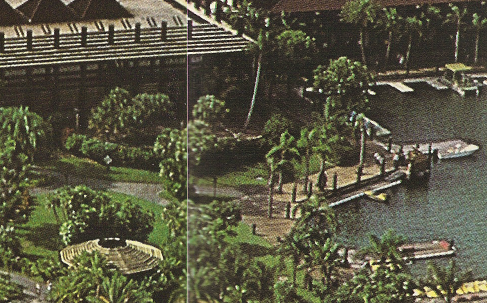
And working backwards from this photo, I identified an aerial view of the Polynesian Village showing where the patio and thus where Captain Cook's was probably located.


Which, to me, seems to be pretty solid evidence. Well, in the past few weeks I managed to turn up some interesting primary documents from the Polynesian, one of which was a cast member orientation guide from way back in 1971 - far enough back that it was simply called the "POLYNESIAN HOTEL". But the real discovery here was two pages showing exactly where everything was in the Great Ceremonial House and Outrigger Assembly House in 1971.


And - surprise - Captain Cook's Hideaway is in the "wrong" place!


The spot I had previously ascribed to Captain Cook's appears to be filled by the "Mickey Mouse Clubhouse", a child care facility. What's most shocking about this is this space still more or less exists - as the seating area to the Polynesian's cafeteria, still called Captain Cook's. Although the original space appears to have been slightly larger to accomodate a bar, it always has been and continues to be a spot with just a handful of tables weirdly crammed inside it.


Although I'm delighted to learn that this particular space at the Polynesian seems to have always been a tiny room with tables, I was simply agast that this spot in particular was Captain Cook's. This was the hopping Cast Member after-work hangout where Salt Water Express sang about State Road 535? You could hardly fit three more tables in here.


A October 1971 Walt Disney World News also mentions the outdoor patio so there must have been a "spill-over" outdoor section very much like the one that still exists today, only servicing those with alcohol instead of Dole Whips.

I went digging back through my files and found that mentions of the "Mickey Mouse Clubhouse" at the Polynesian persist on and off until the mid-70s, when it seems to migrate to the Contemporary Resort Hotel, possibly opening up its original space to an expanded Captain Cook's.

So if Captain Cook's expanded into the old Clubhouse space, then it makes sense that Barefoot Snack Bar would take over the old Captain Cook's space, which is the original arrangement which most of us remember from the late 80s and early 90s. That arrangement still exists today, although the seating area has now taken over the original menswear shop.

I was also able to find a clipping at the Orlando Public Library which mentions Captain Cook's:


53 seats seems like too many for that original 1971 corner location even if they were also counting the patio. Since the article also mentions the Tangaroa Terrace, the family restaurant built in a custom structure outside the Great Ceremonial House in 1974, 53 seats (about fourteen-seventeen tables) may describe the lounge's second location in the former Clubhouse space.

As for Salt Water Express, their story is an interesting one. In March 1975, the Vacation Kingdom's most popular duo moved to the Lake Buena Vista Shopping Village to open the lounge attached to the Village Restaurant, hilariously named "THE CHUMMERY":

WHY WOULD YOU NAME SOMETHING THIS
It was such a short lived stint that they may have never played there at all. Disney was advertising their return to the Polynesian Village within a few weeks.

Bob Christopher and Gary Stratton's contract was renegotiated in 1976, at which point they began appearing under the new name "Stratton & Christopher". In-house references to the group (and their popularity) begin to decline from that point onward, and by the late 1970s seem to vanish altogether. In the early 80s they seem to have moved to a well-reviewed restaurant called Limey Jim's at the US-192 Hilton Resort.

They pop up again in California in 1986, filing a trademark on their name and logo which may be viewed here. I haven't been able to find much past that. Besides the few pictures gathered here, no recordings of either Salt Water Express or Stratton & Christopher seem to survive. Which is a real shame - I know I'd love to hear "Can You Arrive Alive on 535?" at least once in my life.

The Polynesian Resort is now in the process of being dramatically altered - a new wing is going up in what was once open lagoon space, the name is reverting to the Polynesian Village, and sections of the hotel are closing one by one for remodeling. Renewal is a constant cycle of life at the Disney hotels, although none feel as sacred or personal to me as the Polynesian. Since the Tambu Lounge was relocated out to the lobby during the refurbishment which changed the original Papeete Bay Veranda into 'Ohana, maybe this newest refurbishment can bring back more vintage Disney names than just the one for the whole hotel.

Too long relegated to an eatery in its former location selling burgers, it may be time to reclaim the name of Captain Cook and attach it to a new Captain Cook's Hideaway, selling stronger stuff than Dole Whips. It would be a nice nod to the past in the one Disney hotel which seems most thoroughly drenched in it.


Saturday, December 21, 2013

The Branch Beyond the Window and Other Details

The experience of a theme park is pretty similar to that of a well-made film, isn't it?

Well, yes it is. But even if we move beyond the convenient fact that this idea is the main crux of most of my writing, it's an comparison worth making because most of the people who created the Disneyland classics were film people. Marvin Davis, Dorthea Redmond, and Harper Goff were brought in from film design to work on Magic Kingdom and Disneyland. And those who came from the Disney Studio's animation department were already working for an organization revered as the most perfectionist and artistically significant of Hollywood's golden age. Film language is coded deep into the DNA of good themed design.

It may be interesting, then, to get outside Disney and think about the subject from the perspectives of filmmakers not imbued with the Disney culture. In this spirit, allow me to introduce Carl Theodore Dreyer.

Now, for those who aren't cinema buffs, it's worth noting that Dreyer is amongst the very few thoroughly, universally canonized film directors; his name is uttered in the same breath as names like Bresson, Ozu, Renoir, and Eisenstein. Practically every film he made from 1928 to 1962 is considered a top-tier masterpiece (even if there were only five!). But the Dreyer whom supplies our upcoming quote is not the grand old man of cinema; these are the words of an up-and-coming director, making an atmospheric drama in Germany in 1924 called Michael.

Michael is fairly obscure, although its status has grown in recent years due to prominent home video releases. Still, of all the great things Dreyer has said about film making over the years, one little comment has kept rolling around in my head for nearly a decade. This is Dreyer speaking to a Journalist about Michael in 1924:
"Isn't it particularly difficult to make a film where atmosphere is decisive while the narrative takes second place?"

"Yes it is. The pictures must be arranged according to the rules of art. It is necessary that the director have a sense of the pictorial. Things must fit together. Every picture must be a true picture; a unity. But, in addition to that, each individual object found in, for instance, a drawing room, must be genuine. And even objects that are not seen, but only sensed, have to be there when they even to just some extent contribute to giving the room character." [Emphasis mine]
Now, when I first heard this, the idea struck me as absurd. After all, cinema artists from Méliès on have understood the power of cinema's limited frame; it implies an endless space and continuous action much like reality but can significantly exclude anything undesirable. This is why we can still make films set in vintage periods like the Gay Nineties or old west: if you don't point your motion picture camera at those telephone lines off to screen left, then they don't exist. The motion picture frame includes by exclusion. Similarly, anything off-frame that's "seen but only sensed" doesn't exist.

Méliès' set for A Trip to the Moon, 1902
But in another sense, the more I thought about this quote the more sense it made. After all, we all know what it's like to see actors laboring for reality inside a bad or unconvincing set, and so in many ways the cinema set is as much to set the proper atmosphere for creativity as it is to capture on celluloid the apparent image of an imaginary space. In the 1910's, D. W. Griffith broke precedents by insisting on placing real glass panes inside the windows of his sets; they had previously been empty. Why include something the camera or audience won't see?

Yes, the camera won't know that the glass is real, Griffith reasoned, but the actors will, and will adjust their performances accordingly. In 1922's Foolish Wives, Griffith admirer Erich von Stroheim used real glass in windows, real bullets in guns, real water in lakes, and most famously real champagne and caviar in dining scenes - as much as he wanted, for as many takes as it took. Decried by Universal as another frivolous expenditure, we can see here Stroheim leveraging the difference between things seen and things sensed.


But this train of reasoning really began to come together for me last year in the Disneyland Haunted Mansion. The ride was stopped and we were all gathered in the portrait corridor waiting for operation to resume. As you probably know, in this scene there are four windows on your left. The first two have the famous "rainy night" effect diorama outside them, but the last two windows have their exterior shutters closed. Lightning still flashes through these, but there's no cool effects to see outside them.

But, but.... if you crouch down next to the second to last window and wait for a lightning flash, you can, in fact, for that split second, see some branches outside the window.... just as you would expect. Why bother with these at all? Hardly any guests would ever notice them, and I bet you'd never bother to look for them if I hadn't just bothered to point them out to you. to the right you can see my most successful attempt to photograph them, and even then they're kinda tough to make out.

I think the main reason those branches are there isn't because they're an "Easter Egg" or some kind a testament to Disney's "attention to detail". I think they're there because they're needed. The first two windows set an expectation for a pattern: trees outside the windows, some spooky fog, lightning. And although the human eye may not be wired to decode on sight what fake lightning flashing outside a fake window may look like, we do know what light passing through branches looks like, and the first two windows set us up to expect some branches outside that window. In other words, almost nobody will see it because it's there, but everybody would sense it if it wasn't. The branches are insurance against a break in the illusion (by the way, yes there are not branches outside the fourth window, but nobody looks at it anyway because the line turns right and there's the busts there to distract you).

User "dland_lover" on MiceChat
The more I thought of it, the more the "branch outside the window factor" seemed to speak less to every-detail perfectionism or foolish consistency as it did to Dreyer's insistence that things "not seen, but only sensed, have to be there when they even to just some extent contribute to giving the room character." After all, there are few cinematic "magic spaces" where atmosphere is more decisive than in the stylized film world of a theme park.

Take the example of Big Thunder Mountain: the rocks are fake, but the attraction is littered with authentic antique mining equipment. The equipment isn't just about being authentic, however, and it isn't just about it being difficult to successfully build fake mining equipment. The equipment not only validates the stuff that WED did build for the ride - just a bit salted through makes everything look more real - but it validates the mining operation as a real thing, and because the mine is real, the mountain becomes real. If you think you're too clever to be mentally tricked by this, just consider that Big Thunder Mountain is, in fact, almost totally hollow. It's hard to visualize that, isn't it? that's what the value of things sensed rather than seen can add.

For whatever reason, Claude Coats was amazing at knowing exactly how much of the illusory world is needed to carry the illusion and where a few corners can be cut. More than Haunted Mansion, consider his terrific Caribbean seaport in Pirates of the Caribbean, which unlike Mansion's collection of flats and walls really is mostly there. The success of this ride is largely due to Coats' atmospheric direction in both the cavern and town sections.


But have you ever noticed how fully integrated Coats' town is with the action of the pillage narrative? His staging solutions are so simple that it takes a moment to stop and realize that somebody had to sit down and figure out how the whole thing should hang together. His sea-port is designed but it feels organic. Take note of how the location of each action is mirrored by the content of the scene. For example, the town's mayors and magistrates have been rounded up to be interrogated at the town well. The well is in an impressive public space with a central gathering point. This spectacle of indecency to public officials is being performed in the most public area seen in the attraction's fictional town, immediately implying that the Pirates represent not just a physical but an ideological threat. They are upending social structures.

Consider how easy it would've been to change this idea a little bit and lessen the impact. There's no reason why the well has to be in front of Carlos' house; it could've been a bit off to the left and his wife could've popped out of a window to the right. But it wouldn't be as funny or memorable. Would you have made this same exactly right decision if you were forced to design Pirates of the Caribbean from scratch?

Which brings us to my favorite instance of Coats' staging in the ride. Following his dictate of design following narrative, we move to the public market where the village maidens are being auctioned. This is happening directly in front of a huge building labeled "MERCADO". That's probably obvious, you've no doubt noticed it before. But have you ever noticed that you can actually see inside the market?

Yes, we can write this off as just more detail, but why is the detail there? Well, it's because this allows Coats to visually juxtapose the chain of brides with the market of produce behind them: these women are being treated like wares to be quickly consumed by the highest bidder.


But more than that this detail is the sort of thing that make Pirates of the Caribbean a true picture; in Dreyer's words, a unity. It's easy to throw a lot of detail into theme parks and end up with overkill because what's more important than having details is meaningful details. Everything we expect must be present, but nothing we don't expect or don't need to see is needed.

This, I feel, is what contributes to the sense of peace and relaxation experienced at Disneyland, Magic Kingdom, EPCOT Center and Tokyo Disneyland, while parks of more recent vintage can feel cluttered, chaotic and unpleasant. There's just enough detail to allow us to suspend our disbelief, but not so much that the parks lose their sense of pastoral simplicity and beauty. Everything looks carefully vetted, designed, and built, compared to the visual chaos of a typical urban "strip".

We associate careful detail with the classic WED period of 1964-1984, but it's been there since the start. How many of you, for however long you've been going to Disneyland, have ever noticed that Sleeping Beauty Castle thoughtfully includes a chapel?

 (detail enlargement of a 1957 photo posted at Gorillas Don't Blog)

You may have noticed this before; it's one the right side facing Main Street. This is a common enough feature of genuine historical castles to not be noteworthy in and of itself, but due to its placement on the east side of the castle, which is an uncommonly photographed angle, and a half-century of tree growth on the Tomorrowland side, it can be downright tricky to spot it.

But once you do spot it, the real trick is to come back and see the chapel at night. All of the windows on the castle are lit up bright, welcoming yellow... except the chapel, which is lit internally by candlelight.

That's a detail which, to me, moves beyond the traditional "wide, medium, and close shot" methods used by Imagineers, which more lay out guidelines for consistency. To me, the marketplace behind the Auction, the tree branch outside the window, and the candles in the chapel are some kind of as-of-yet unnamed kind of themed design detail, which is the detail inside the detail, the sort of thing that you half don't expect to see but you go looking for anyway and there it is, waiting for you. It creates a satisfaction that goes beyond the normal level of detail presented by, say, a themed door knob. It's the discovery inside the discovery and it makes the false theme park world seem real, and lived in.

It's always been an ongoing project to make theme parks seem more convincingly realistic, especially in the hollow areas of themed facades which all too easily can appear to be the hollow or functional spaces they are. The tradition goes back to the start: this July 18, 1955 photograph from Daveland shows what the earliest WED designers probably thought of as "set dressing":


The "stuff-on-balconies" school reached its apotheosis in New Orleans Square in 1967, of course, but the Magic Kingdom in 1971 included balconies in as many niches as possible, sometimes to great effect. The simple balcony above Aloha Isle in Adventureland, stuffed with wicker chairs and faux foliage, has been firing the imaginations of observers for decades.


Stuff-on-balconies can only go so far, however, and Disneyland's other main method of creating imagined extended space is the "light in the attic" method: lamps in upper windows. There are fewer examples of this in Disneyland than expected, and most of them look pretty much like this:

(excerpt of a larger photo by rocket9 on flickr)

In 1971, the expanded scale of Magic Kingdom allowed Disneyland's designers to experiment with some of these techniques in a larger scale, and the result is very interesting. Instead of simply placing lanterns behind lace curtains. Magic Kingdom's Main Street has actual rooms in the upper level of its facades.


The rooms, of course, are nothing more than a few feet deep. It's actually a wall which encloses the upper level of the Magic Kingdom's office areas, but some well chosen wallpaper and props and the effect is very beguiling. It's also nearly impossible to photograph; the human eye can very easily distinguish between the various surfaces involved in the depth illusion - a richly patterned wallpaper viewed through an elaborate lace curtain - in ways that the camera eye cannot, but I tried very hard:


In person, this effect is nearly subliminal. I've only noticed it in the last few years, but the illusion that there really are Victorian parlors and drawing-rooms behind those windows is remarkably convincing and only fails from certain angles, which is certainly more than should be expected from details within details within details.

To avoid foolish consistency, however, some of the windows do use the simple Disneyland-style lamp, curtain and cloth, as in this handsome tribute window for Yale Gracey:


Or the beautiful dim pink light overlooking Town Square:


This one doesn't have any light inside it but it does have a full-sized chair and table and very intricate "back wall", which can only be seen by those looking very closely during the day:


The curtains hanging in the windows act as diffusion screens to make the textured rear walls - really only a few feet away from the windows - appear more distant than they are, and the illusion holds so long as the floor and ceiling remain hidden and the wallpaper chosen has small, intricate patterns. It's one of the most successful forced perspective illusions in the park. Elsewhere, in Liberty Square, the space above Liberty Tree Tavern is enlivened very simply but effectively in a window only visible from the courtyard behind the Christmas shop:


A chandelier is hung inside an unfinished attic. From the perspective of the street, the unfinished interior visually translates as the rough beams we expect inside of a colonial tavern, and a whole interior is implied for those who bother to find it:


There are other, less specular uses of lights and props throughout Magic Kingdom, although most do manifest in the traditional "light in the attic" rather than 'implied interior" seen above. However, in 1982 in World Showcase, WED Enterprises took another stab at the illusion and ended up with some interesting effects.

The "lighted windows" are applied with less regularity than throughout Magic Kingdom. Magic Kingdom is about nostalgia and exploration and so a warm feeling is created through elaborate displays of lights (except in the "dangerous" area of Adventureland). World Showcase is more about culture and its treatment of lighted second floor windows varies more widely: while Germany wants to create a feeling of warmth and gemütlichkeit and so uses many lit windows, the small British village of the United Kingdom pavilion feels almost sleepy at night due to its mostly darkened interiors. Until you get around the back towards the London flats, there's just a lonely lantern burning in one darkened upper window, one of EPCOT Center's most haunting details:


Contrast the United Kingdom with France, represented by Paris. EPCOT's facsimile doesn't just evoke the city of light through use of a boldly lit fountain; the France pavilion works overtime to imply a busting cultural metropolis just behind and beyond those windows and doors. Elaborate, half-glimpsed lights hang in the windows above the entrance to the Impressions de France attraction:


Diffusing curtains make these very hard to make out, but this fictional "upstairs" space is validated by the nearby second floor restaurant facing the water and, facing the United Kingdom pavilion, the upstairs art gallery, sadly long since closed.


 But the best touch, for me, is around the corner down the "provincial" side street. Many of you, no doubt, have noticed the glass-enclosed artist's loft in this area...

photo by Al Huffman
...but how many of you have seen the artist who lives there? If you return at night you can see him painting:


Yes, it's just a little cutout, but to me this is the ultimate example of the "Branch Outside the Window" effect. If you just so happened to see this one detail early in the day, wondered if it was supposed to be an artist loft, then just happened to walk back that way later and had your suspicions confirmed? How many have done that? A few dozen a year?

To me, this is what makes the difference between the sort of detail we've been discussing today and the run of the mill sort of detail which Imagineering can now do with their eyes closed. Very few may notice these sorts of things, but the cumulative effect cannot be undervalued: the impression of an organic world where there is none.

To me this sense of inevitability of these sorts of details is the mark of a great, assured artistic creation. To paraphrase Dreyer, the theme park designer must have a sense of the pictorial. Things must fit together. Every picture must be a true picture; a unity. But, in addition to that, each individual object found in, a theme park, must seem genuine. And even objects that may not be seen, but only sensed, have to be there when they even to just some extent contribute to giving the park character.

That's the difference that a great designer makes. The branch behind the window, rarely seen, but always sensed.